
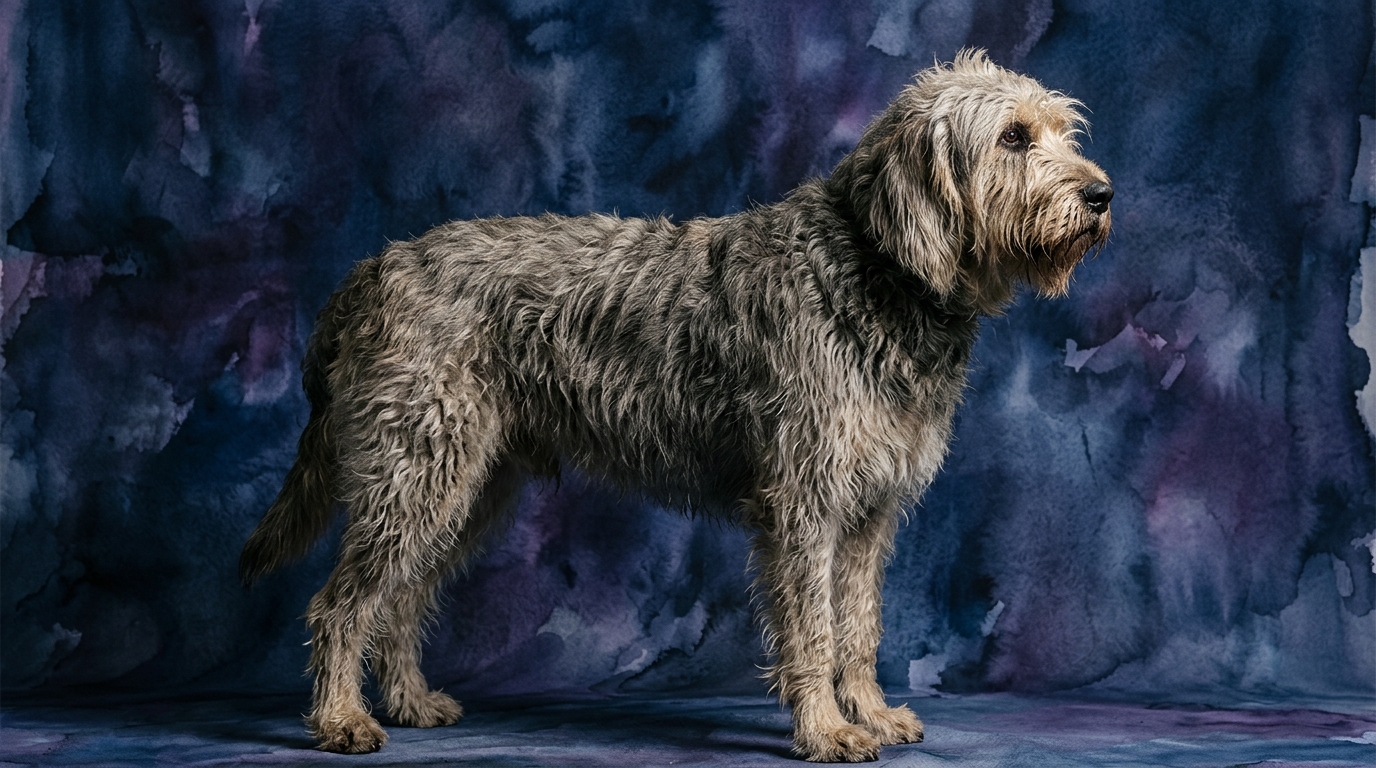
Side-by-Side Cognitive Profiles: Briard vs. Otterhound
The Briard, a robust herding dog, registers a Coren rank of #30, indicating a capacity for understanding new commands with fewer repetitions and a higher rate of obedience. Our Pet IQ Lab assessment scores the Briard with a 4/5 in Problem Solving, reflecting their aptitude for navigating complex situations and adapting strategies. Their Training Speed also stands at a strong 4/5, suggesting a readiness to absorb and execute commands efficiently. Social Intelligence is rated 3/5, indicating a balanced ability to interpret human cues and interact appropriately, while their Instinctive Drive, at 3/5, speaks to a purposeful, yet controllable, inherent motivation tied to their herding lineage. Finally, the Briard's Memory scores 4/5, enabling them to retain learned behaviors and routines over extended periods.
In contrast, the Otterhound, a hearty scent hound, is not assigned a Coren rank, a common occurrence for breeds whose primary working intelligence lies outside traditional obedience. Their Pet IQ Lab scores present a different cognitive emphasis: Problem Solving is rated 3/5, reflecting a more specialized approach to challenges, often centered around scent work. Training Speed also comes in at 3/5, implying a steady, but perhaps less rapid, uptake of new instructions compared to the Briard. Social Intelligence mirrors the Briard at 3/5, suggesting a comparable capacity for interspecies communication and group dynamics, particularly within a pack setting. Their Instinctive Drive is also 3/5, but this drive is profoundly channeled into olfactory pursuits. The Otterhound's Memory is rated 3/5, sufficient for retaining critical information for their tracking tasks, though perhaps less focused on varied command sequences.
Where the Briard Cognitively Excels
The Briard's cognitive strengths are rooted in their heritage as a multi-faceted herding and guarding dog, demanding a blend of independent thought and handler cooperation. Their superior Problem Solving score of 4/5 means they are not just capable of following commands, but can also interpret situations and make decisions. For example, a Briard might proactively re-route a straying sheep without direct instruction, demonstrating an adaptive intelligence beyond rote learning. This capacity extends to novel situations, allowing them to figure out how to open a gate or retrieve a toy from an awkward spot with relative ease.
Furthermore, the Briard's 4/5 Training Speed and 4/5 Memory create a powerful synergy for learning. They can grasp complex sequences of commands quickly and retain them over time, making them adept at advanced obedience, agility, or even service work. This allows for a richer, more nuanced communication between handler and dog, as the Briard remembers past lessons and applies them to new contexts. Their cognitive architecture is built for continuous learning and responsive partnership, thriving on mental engagement that challenges their capacity for logical progression and recall.
Where the Otterhound's Unique Cognition Shines
While the Otterhound's numerical scores might appear modest next to the Briard's, their cognitive profile is exquisitely tuned for a highly specialized purpose: scent tracking. Their 3/5 in Problem Solving, while lower, reflects a deep and tenacious approach to olfactory puzzles. An Otterhound's problem-solving isn't about herding strategy; it's about meticulously dissecting a scent trail, differentiating between faint and strong odors, and navigating varied terrain purely by nose. This requires an incredible focus and persistence that, while perhaps not scoring high on a generalist problem-solving test, is a profound cognitive strength in its own right.
The Otterhound's 3/5 Instinctive Drive is paramount here. It's a relentless, almost meditative pursuit of scent that overrides many other stimuli. This isn't just a physical drive; it's a cognitive commitment to a single sensory input, demanding sustained attention and memory for scent patterns. Their 3/5 Social Intelligence, while equal to the Briard's, is often expressed through pack dynamics, where cooperation in a hunting scenario requires specific communication and awareness of fellow hounds. Their memory, also 3/5, is particularly adept at recalling the nuances of specific scents and the routes they've followed, crucial for their work.
Ease of Training: Behavioral Differences
When considering ease of training, the Briard generally presents a more straightforward path for the average owner due to their higher Training Speed (4/5) and Problem Solving (4/5). Briards typically possess a strong desire to please their handler and a natural inclination to work collaboratively, making them receptive to command-based learning. Their ability to quickly associate actions with rewards and remember these associations means they can progress through training levels efficiently, often enjoying the mental challenge. Behavioral differences include their tendency to look to their owner for direction and their capacity for self-correction once a concept is understood.
The Otterhound, with a Training Speed of 3/5, requires a different approach. Their powerful Instinctive Drive (3/5) towards scent often means that their nose takes precedence over human commands. Training an Otterhound demands immense patience, consistency, and creative methods to engage their specialized intelligence. Owners must learn to work with, rather than against, their hound's primary motivation. For example, using scent games as rewards or incorporating tracking into training sessions can be far more effective than traditional drill-based obedience. Behavioral differences include their independent nature when on a scent, and a potential "selective hearing" when a compelling odor is present, demanding more effort to maintain their focus on the handler.
Matching Breeds to Lifestyles: Active vs. Relaxed Owners
For active owners seeking a dynamic, engaged partner in various activities, the Briard is often a more suitable choice. Their cognitive profile, with its emphasis on problem-solving, training speed, and memory, makes them excel in dog sports like agility, obedience, and even protection work. They thrive on mental stimulation and consistent interaction, requiring owners who are prepared to dedicate time to training, exercise, and intellectual challenges. Owners who enjoy hiking, long walks, or structured training sessions will find the Briard a willing and capable companion, eager to participate and learn alongside them. Their need for a 'job' means they are happiest when their mental and physical energies are regularly channeled.
Relaxed owners, or those seeking a companion whose activity is more self-directed and less dependent on constant human guidance, might find the Otterhound a better fit, provided they can accommodate specific needs. While not a couch potato, the Otterhound's activity often revolves around following scents at a steady pace, rather than intense bursts of speed or intricate maneuvers. Owners who appreciate long, meandering walks where the dog can explore with its nose, or those interested in casual scent work, will find the Otterhound's natural inclinations fulfilling. They require a secure, fenced yard to prevent them from following a compelling scent trail, and a patient owner who understands their independent, sometimes boisterous, nature. Their relaxation often comes after a satisfying session of nose work, rather than high-intensity physical exertion.
The Verdict
Choose the Briard if you desire a highly trainable, versatile companion eager to engage in complex tasks and structured activities, thriving on a close working partnership.
Opt for the Otterhound if you value a tenacious, independent scent hound, appreciate their unique olfactory talents, and are prepared for a dog whose primary motivation is the world of smells.
🧠 Find Your Pet's IQ Score
Our Pet IQ Lab assessment covers 25+ tests across 5 cognitive dimensions — personalized to your breed.
Take the Full IQ Test →Frequently Asked Questions
Is the Otterhound truly difficult to train?
The Otterhound isn't 'difficult' in the sense of lacking capacity, but their training requires patience and understanding of their profound scent drive. They learn at a steady pace, but their focus can be easily diverted by interesting odors, demanding creative, consistent, and reward-based methods.
Do Briards need a lot of mental stimulation?
Yes, Briards definitely benefit from significant mental stimulation. Their high problem-solving ability and memory mean they thrive on learning new commands, engaging in puzzle toys, and participating in dog sports or other 'jobs' to keep their minds active and prevent boredom.
Which breed is better for a family with other pets?
Both breeds can integrate well, but the Briard's stronger social intelligence and desire to please often make introductions smoother, especially with smaller pets they might perceive as part of their 'flock.' The Otterhound's strong prey drive for small, furry creatures, stemming from their hunting heritage, means careful supervision and early socialization are critical if other small pets are present.