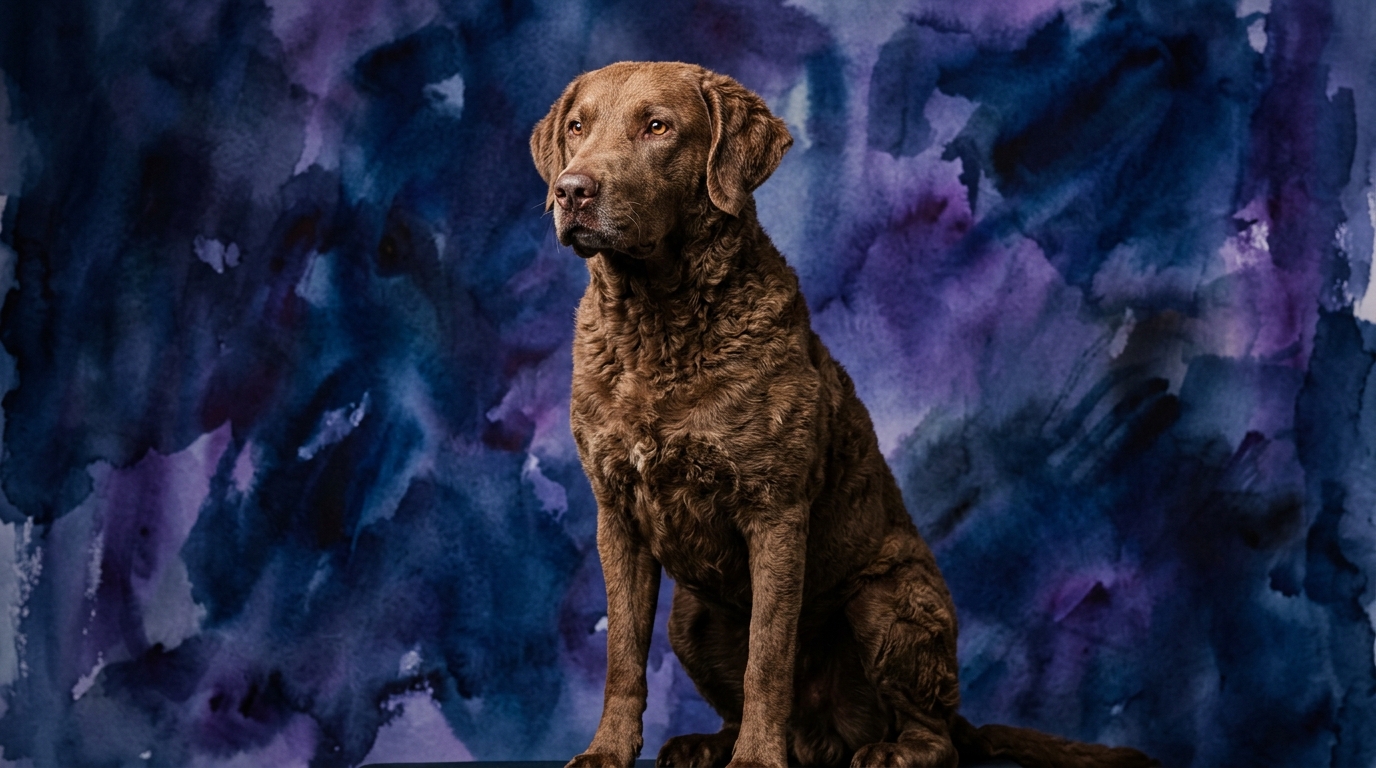
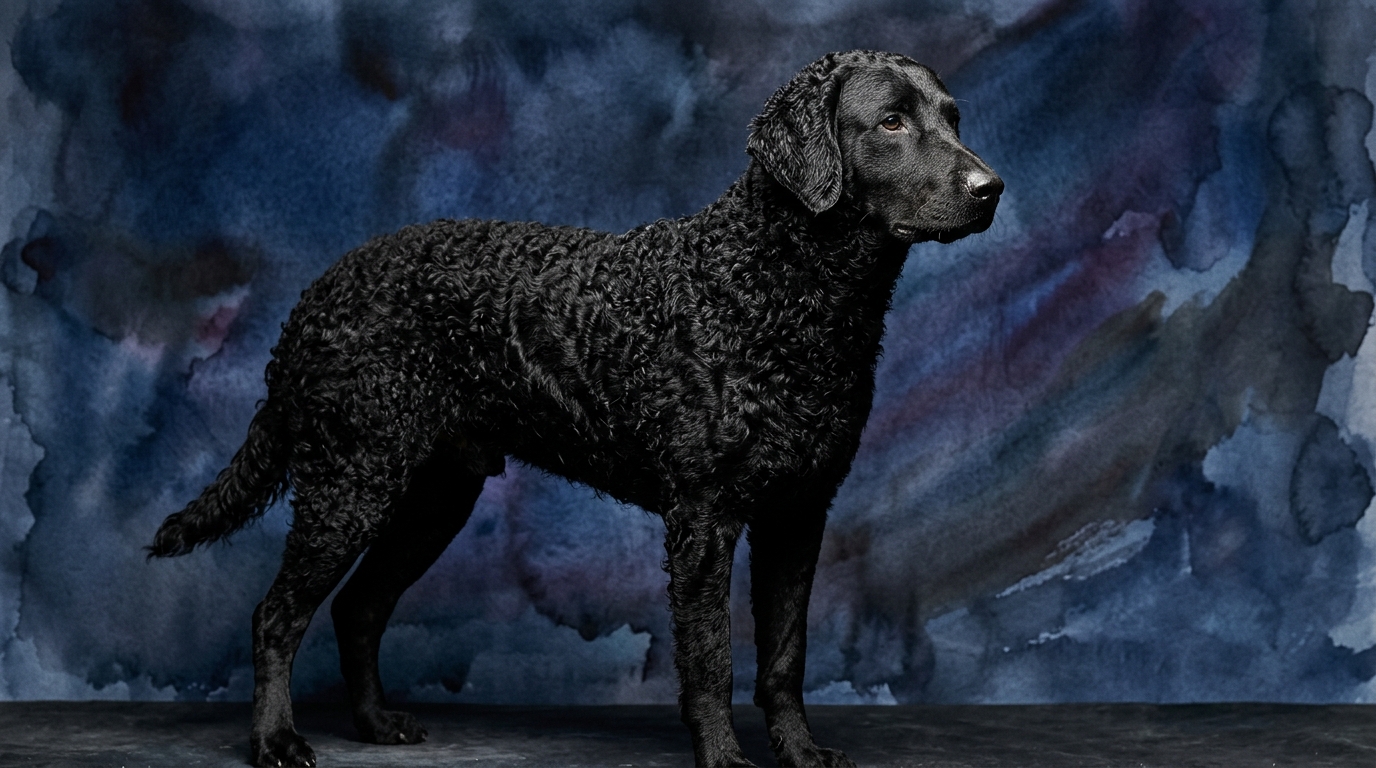
Side-by-Side Cognitive Profile
To understand the nuanced mental landscape of these two retriever breeds, The Cosmic Pet Pet IQ Lab employs a five-dimensional framework, providing a granular view of their cognitive strengths.
Problem Solving: The Chesapeake Bay Retriever scores an impressive 4/5 in problem-solving, demonstrating strong independent thought. They often devise solutions to complex tasks or environmental challenges without direct human guidance, figuring things out with a notable ingenuity. In contrast, the Curly-Coated Retriever earns a solid 3/5 in problem-solving. They possess a robust capacity for learning and applying established strategies effectively, diligently executing known solutions even if less prone to inventing new ones.
Training Speed: The Chessie's 4/5 in training speed indicates a rapid grasp of new commands and concepts, typically requiring fewer repetitions for proficiency. Their focused attention and intrinsic desire to work facilitate a quick learning curve in structured training. The Curly-Coated Retriever, with a 3/5 training speed, learns at a steady, reliable pace. They absorb new information well with consistent, positive reinforcement, building a deep understanding over time and valuing clear instruction and patience.
Social Intelligence: Both breeds register a 3/5 in social intelligence. The Chesapeake Bay Retriever exhibits moderate social adaptability, forming strong family bonds but often appearing reserved or discerning with strangers. They observe social cues well within their established pack. Similarly, the Curly-Coated Retriever shares this social profile, devoted to their inner circle while maintaining a dignified distance from unfamiliar individuals. They are attuned to family moods but generally prefer familiar social environments.
Instinctive Drive: Both the Chessie and the Curly score a 3/5 for instinctive drive. The Chesapeake Bay Retriever displays a strong, focused natural drive for retrieving and working, well-honed for their purpose. They show determined persistence when engaged in tasks involving scent or retrieval. The Curly-Coated Retriever possesses an equally strong, purposeful instinctive drive, particularly for their retrieving heritage. They are motivated by the inherent satisfaction of their work, showing enthusiasm in activities tapping these natural urges.
Memory: In the realm of memory, both breeds excel with a 4/5 rating. The Chesapeake Bay Retriever retains commands, routines, and past experiences with impressive recall. This robust memory contributes significantly to their reliability in complex tasks and their ability to follow intricate sequences. The Curly-Coated Retriever also demonstrates excellent memory, effectively storing and recalling learned behaviors and environmental information. This enduring cognitive trait makes them dependable in maintaining trained skills and remembering past interactions.
Where the Chesapeake Bay Retriever Wins Cognitively
The Chesapeake Bay Retriever's cognitive edge primarily shines through their superior problem-solving acumen and faster training speed. Their 4/5 rating in problem-solving means a Chessie is more likely to independently strategize its way through a new obstacle, whether it's navigating a complex retrieve or figuring out how to access a desired toy. This aptitude for self-directed thought makes them particularly adept at advanced obedience, field trials, or even intricate scent work where novel challenges are frequent. Furthermore, their 4/5 training speed indicates a quicker uptake of new commands and concepts. Owners often find Chessies require fewer repetitions to solidify a behavior, allowing for a more rapid progression through training levels and the introduction of more sophisticated tasks earlier in their development. This efficiency in learning means a Chessie can master a broader repertoire of skills and respond with precision to nuanced cues, making them a formidable partner for demanding activities that require both mental agility and swift comprehension.
Where the Curly-Coated Retriever Wins Cognitively
While the Curly-Coated Retriever's scores might appear slightly lower in some areas, their cognitive profile presents unique advantages, particularly in consistency and a pragmatic approach. Their 3/5 in problem-solving and training speed, combined with a 4/5 in memory, suggests a dog that excels at mastering routines and applying learned solutions reliably. Instead of constantly seeking novel approaches, a Curly is exceptionally good at internalizing the *correct* method and executing it faithfully. This can be a significant 'win' for owners who value predictability and a steady, unwavering performance once a task is learned. Furthermore, a Curly’s cognitive style might mean they are less prone to 'overthinking' or devising mischievous schemes born from intense boredom, making them potentially more straightforward to manage in a home environment once their physical and mental needs are met. Their excellent memory ensures that once a behavior is learned, it is deeply ingrained, making for a highly dependable companion.
Which is Easier to Train and Why
Based on their respective cognitive profiles, the Chesapeake Bay Retriever is generally considered easier to train due to its higher training speed score of 4/5 compared to the Curly-Coated Retriever's 3/5. A Chessie typically absorbs new commands and concepts with remarkable quickness, often requiring fewer repetitions and a shorter duration to achieve proficiency. Their inherent drive to understand and execute tasks effectively makes them highly responsive to clear instruction and positive reinforcement. In contrast, while the Curly-Coated Retriever is certainly trainable and willing to learn, their 3/5 training speed indicates a need for more consistent repetition and patience. Curlys thrive on a structured and predictable training regimen, where commands are reinforced regularly and success is built upon a solid foundation. They may take a bit longer to generalize a learned behavior, but once a concept clicks, their excellent memory ensures it sticks. Therefore, owners looking for swift efficiency might find the Chessie's cognitive makeup more aligned with their training goals.
Which Suits Active Owners vs. Relaxed Owners
Both the Chesapeake Bay Retriever and the Curly-Coated Retriever are Sporting Group members, meaning they require significant physical activity and are not suited for truly sedentary lifestyles. However, their cognitive differences subtly influence the *type* of activity and engagement they thrive on. The Chesapeake Bay Retriever, with its 4/5 problem-solving and training speed, is a better match for highly active owners who enjoy engaging their dog in complex mental and physical challenges. These dogs flourish with regular participation in demanding activities such as advanced obedience, agility, or extensive field work that requires strategic thinking and rapid learning. Owners who can dedicate time to intricate training sessions and provide varied mental stimulation will find a Chessie to be an exceptionally engaged partner. The Curly-Coated Retriever, while still requiring substantial exercise, might be a better fit for active owners who appreciate a dog that is perhaps a touch more independent and less insistent on constant, novel mental puzzles. Their 3/5 scores in problem-solving and training speed suggest they are content with mastering routines and performing learned tasks reliably, rather than constantly seeking new intellectual frontiers. They still need vigorous daily exercise – long walks, runs, or retrieving sessions – and can be excellent companions for hiking, swimming, and consistent retrieving games, appealing to owners who enjoy active outdoor pursuits but without the intensity of competitive dog sports requiring constant new learning. Neither breed is ideal for a truly relaxed owner, as both possess strong working drives that need an outlet.
The Verdict
Choose the Chesapeake Bay Retriever if you seek a partner eager to master complex tasks quickly and thrive on constant mental challenges in competitive dog sports or demanding field work.
Opt for the Curly-Coated Retriever if you appreciate a steady, dependable companion who excels at consistent routines and reliable performance, offering a strong bond with a touch of independent spirit.
🧠 Find Your Pet's IQ Score
Our Pet IQ Lab assessment covers 25+ tests across 5 cognitive dimensions — personalized to your breed.
Take the Full IQ Test →Frequently Asked Questions
Do Chesapeake Bay Retrievers get bored easily if not mentally stimulated?
Yes, with their 4/5 problem-solving ability, Chesapeake Bay Retrievers require consistent mental engagement. Without sufficient challenges, they are prone to finding their own "problems" to solve, which can lead to destructive behaviors or mischief. Regular training, puzzle toys, and varied activities are essential for their well-being.
Is a Curly-Coated Retriever less independent than a Chesapeake Bay Retriever?
Both breeds display a degree of independence, scoring 3/5 in social intelligence and instinctive drive. However, a Curly's slightly lower problem-solving score might translate to less cunning independence, meaning they are less likely to devise intricate plans or constantly test boundaries compared to a Chessie. They are devoted but not overly clingy.
Can a Curly-Coated Retriever excel in dog sports despite its 3/5 training speed?
Absolutely. While a Curly may take a bit more time to grasp new concepts than a Chessie, their excellent memory (4/5) ensures that once learned, skills are deeply ingrained. With patient and consistent training, Curly-Coated Retrievers can achieve high levels of success in various dog sports, showcasing their dedication and reliability.