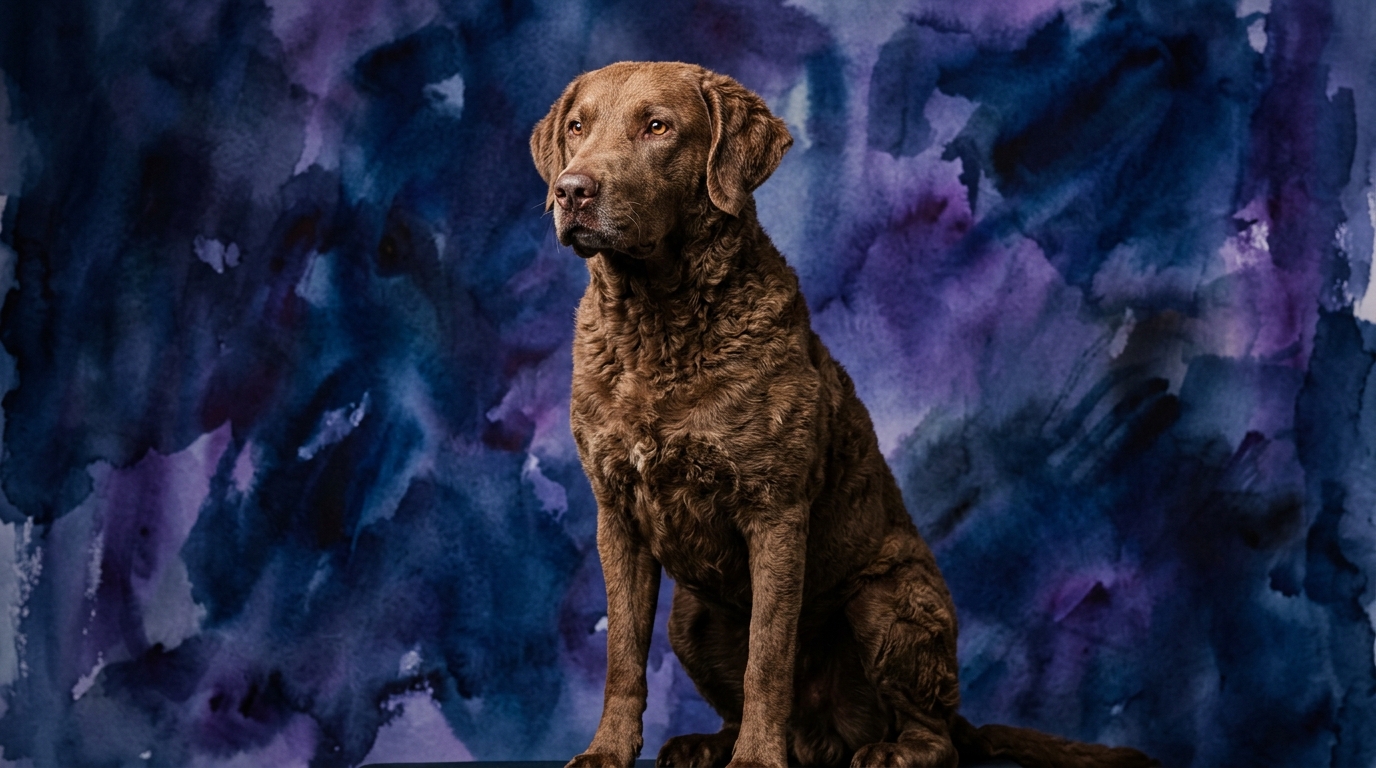
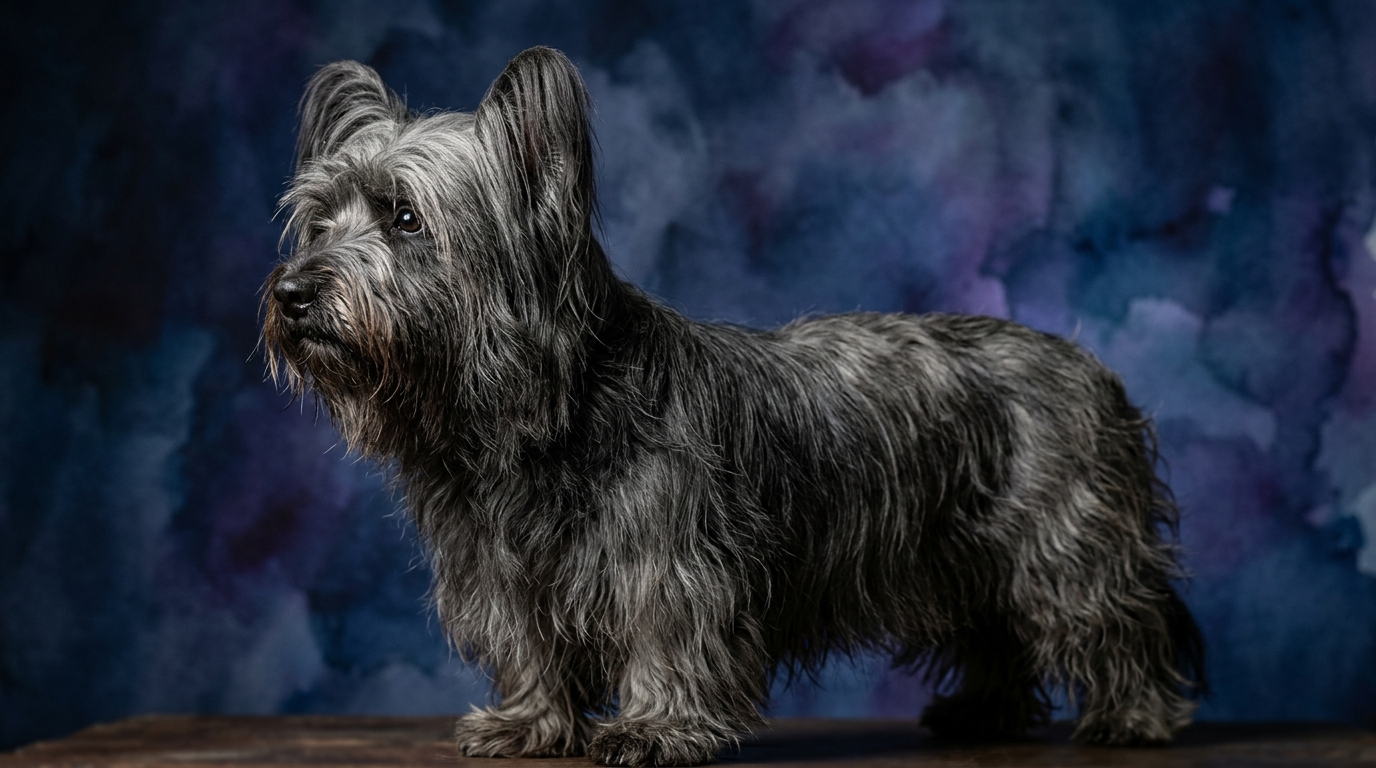
Side-by-Side Cognitive Profiles: Chessie vs. Skye
In The Cosmic Pet Pet IQ Lab, we assess canine intelligence across five critical dimensions to understand the unique cognitive landscape of each breed. For the Chesapeake Bay Retriever, a breed steeped in demanding waterfowl retrieval, its scores reflect a sharp, cooperative mind: Problem Solving 4/5, Training Speed 4/5, Social Intelligence 3/5, Instinctive Drive 3/5, and Memory 4/5.
The Skye Terrier, a breed developed for independent vermin hunting in rugged terrain, presents a profile emphasizing tenacity and self-reliance: Problem Solving 3/5, Training Speed 3/5, Social Intelligence 3/5, Instinctive Drive 3/5, and Memory 3/5. While the numerical scores might appear modest for the Skye, they tell a story of a discerning and persistent mind, tailored for specific tasks and social interactions.
Problem Solving evaluates a dog's ability to navigate new challenges and figure out solutions. The Chesapeake's 4/5 indicates a rapid capacity for strategic thought, such as mapping out complex retrieve routes or quickly learning how to manipulate puzzle toys. The Skye's 3/5 in this dimension suggests it approaches problems with determination, often relying on persistence and an independent thought process, which might take more time but ultimately leads to a solution tailored to its own methods.
Training Speed measures how quickly a dog grasps new commands and routines. A 4/5 for the Chesapeake means it absorbs new information with notable alacrity, often requiring fewer repetitions due to its eagerness to collaborate. The Skye's 3/5 indicates a steady learning pace, but its inherent terrier independence means training often demands more consistent patience and creative motivation to integrate new behaviors.
Social Intelligence reflects a dog's understanding of social cues and its interaction with others. Both breeds score 3/5, yet their expressions differ. The Chesapeake forms strong bonds with its primary family, displaying loyalty and an understanding of pack dynamics within its trusted circle, though it can be reserved with strangers. The Skye also exhibits deep devotion to its core family, often forming an intense, singular bond with one person, while maintaining a dignified and often wary distance from outsiders, reading social cues selectively.
Instinctive Drive relates to a dog's innate behavioral predispositions. Both breeds score 3/5 here. The Chesapeake possesses a strong natural inclination for retrieving, swimming, and working alongside humans, driven by its heritage as a waterfowl dog, often seeking to fulfill this drive collaboratively. The Skye retains a formidable prey drive, characteristic of its vermin-hunting ancestors, displaying tenacity and focus when tracking or engaging with smaller stimuli, often operating with a powerful sense of purpose that is more self-directed.
Memory assesses a dog's ability to recall learned information and past experiences. The Chesapeake's 4/5 signifies a robust memory for commands, learned routines, locations of objects, and past experiences, significantly aiding its training and ability to perform complex tasks. The Skye's 3/5 indicates a reliable memory for its environment and established routines, remembering people and places, though perhaps not with the same intricate detail or rapid recall for complex sequences as the Chesapeake.
Where the Chesapeake Bay Retriever Excels Cognitively
The Chesapeake Bay Retriever's cognitive strengths are deeply rooted in its heritage as a working retriever, demanding acute focus and rapid processing. Its 4/5 scores in Problem Solving, Training Speed, and Memory converge to create a highly efficient and adaptable learner. Chessies excel at tasks requiring multi-step command sequences, such as retrieving multiple birds from different locations, demonstrating not just physical prowess but also sophisticated spatial memory and strategic planning.
Their ability to quickly map out the most efficient route to a fall, even in challenging terrain or water, showcases their superior problem-solving in real-time scenarios. This breed's remarkable training speed means it absorbs complex hand signals and verbal cues with minimal repetition, making it an ideal candidate for advanced obedience, dock diving, or competitive field trials. The Chesapeake's strong memory ensures that once a lesson is learned, it is retained with impressive fidelity, allowing for consistent performance over time and across varied environments. This cognitive profile makes them exceptionally responsive partners in structured activities where precise execution and quick thinking are paramount.
Where the Skye Terrier Demonstrates Unique Cognitive Strengths
While the Skye Terrier’s numerical scores are consistently 3/5, its cognitive profile reveals unique strengths that are distinct from the Chessie’s. The Skye's instinctive drive, while numerically equivalent, manifests as tenacious, self-directed persistence. This is a cognitive win in situations requiring unwavering focus on a single objective, such as tracking a scent or pursuing a burrowing animal, where external direction is less critical than internal resolve.
The Skye's social intelligence, also 3/5, is characterized by a discerning nature. Their selective bonding means they form exceptionally deep, almost intuitive connections with their chosen family members, demonstrating a profound understanding of their inner circle. This discernment can be seen as a cognitive advantage in evaluating social situations, preferring quality over quantity in interactions. Furthermore, their problem-solving, though rated 3/5, is often fueled by this profound persistence. They may take longer to arrive at a solution, but their independent thought process and sheer determination mean they rarely give up, often finding creative, self-reliant ways to overcome obstacles, especially those related to their prey drive or territorial instincts. This steadfastness, rather than rapid acquisition, ensures long-term reliability in learned behaviors once they are fully committed.
Trainability: A Tale of Two Temperaments
When considering ease of training, the Chesapeake Bay Retriever distinctly holds an advantage, primarily due to its 4/5 Training Speed and cooperative nature. Chessies possess an innate desire to work alongside their handlers, a trait honed over generations of retrieving. They grasp new commands, complex sequences, and behavioral expectations with impressive speed, often eager to please and highly motivated by positive reinforcement and the opportunity to engage in a task. Their strong memory further cements learned behaviors, making them highly reliable once a command is mastered. This collaborative spirit means they generally respond well to consistent, fair training methods and thrive on having a 'job' to do.
The Skye Terrier, with its 3/5 Training Speed, presents a different training dynamic. Their terrier heritage imbues them with a strong sense of independence and self-determination, which can sometimes be perceived as stubbornness. Training a Skye requires immense patience, consistency, and a profound understanding of their unique personality. They are less inclined to blindly follow commands and require trainers to make learning intrinsically rewarding or to creatively convince them that a desired action is their own idea. While they are capable of learning a wide range of commands, the process typically takes more repetitions and a more nuanced approach, often involving shorter, engaging sessions that prevent boredom and capitalize on their tenacious spirit rather than trying to overpower it. Once a Skye commits to a behavior, however, their memory ensures it is deeply ingrained, but getting to that commitment point demands dedication.
Matching Canine Cognition to Owner Lifestyles
The cognitive profiles of the Chesapeake Bay Retriever and the Skye Terrier dictate vastly different needs for owner lifestyles. The Chesapeake, with its high scores in problem-solving, training speed, and memory, coupled with a strong instinctive drive, demands an active and engaged owner. This breed thrives when given ample opportunities for physical exercise and, crucially, consistent mental stimulation. Owners who enjoy outdoor activities like hiking, swimming, hunting, or participating in dog sports such as agility, obedience, or dock diving will find a Chessie to be an unparalleled partner. A relaxed owner who cannot commit to structured training or daily mental challenges will likely find their Chesapeake becomes bored and potentially destructive, as its sharp mind and body seek their own outlets.
Conversely, the Skye Terrier, while not necessarily a couch potato, can adapt to a more relaxed indoor lifestyle, provided its specific cognitive and physical needs are met. Its tenacious instinctive drive and independent problem-solving mean it requires consistent, stimulating walks and opportunities for scent work or puzzle toys to engage its mind. Owners who appreciate a dog with a strong, discerning personality, who enjoy consistent but perhaps less intensive daily activity, and who understand the need for mental engagement tailored to an independent thinker will find a Skye to be a devoted companion. They are not suited for owners seeking a broadly obedient, always-eager-to-please companion; rather, they thrive with individuals who value a dog's individual spirit and discerning companionship, and are prepared for the patience required to train a terrier.
The Verdict
Choose the Chesapeake Bay Retriever if you are a dedicated working dog enthusiast, seeking a highly trainable, versatile companion for demanding outdoor activities and structured learning environments.
Opt for the Skye Terrier if you value a loyal, discerning companion with a strong individual character, and are prepared for consistent, patient training tailored to an independent, tenacious spirit.
🧠 Find Your Pet's IQ Score
Our Pet IQ Lab assessment covers 25+ tests across 5 cognitive dimensions — personalized to your breed.
Take the Full IQ Test →Frequently Asked Questions
Are Chesapeake Bay Retrievers good family dogs?
Yes, Chesapeake Bay Retrievers form deep bonds with their immediate family, showing loyalty and protective instincts towards their human pack. However, their substantial physical and mental exercise needs require an active household that can integrate them into daily routines and provide structured engagement to prevent boredom.
What kind of mental exercise does a Skye Terrier need?
Skye Terriers benefit from activities that engage their problem-solving and instinctive drive, such as scent work, puzzle toys, and consistent, varied training sessions. These activities channel their tenacity and independent thought, preventing boredom and providing an outlet for their inherent drive to investigate and pursue.
How do their instinctive drives differ in everyday life?
The Chesapeake's instinctive drive often manifests as a desire to retrieve, swim, and work collaboratively, seeking handler input for tasks. The Skye's drive is more self-directed, focused on independent exploration, digging, or tracking small animals, requiring secure environments and redirection for unwanted behaviors to ensure safety and harmony.