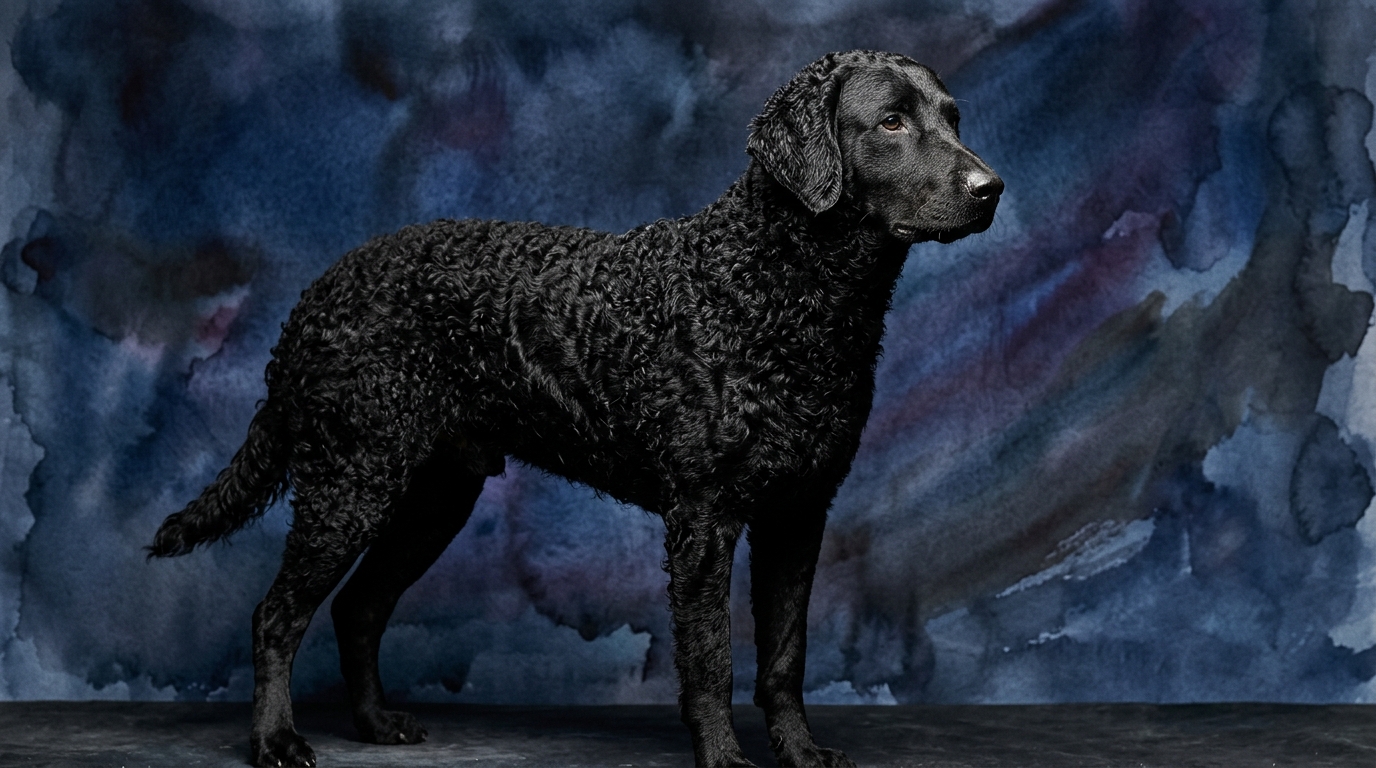
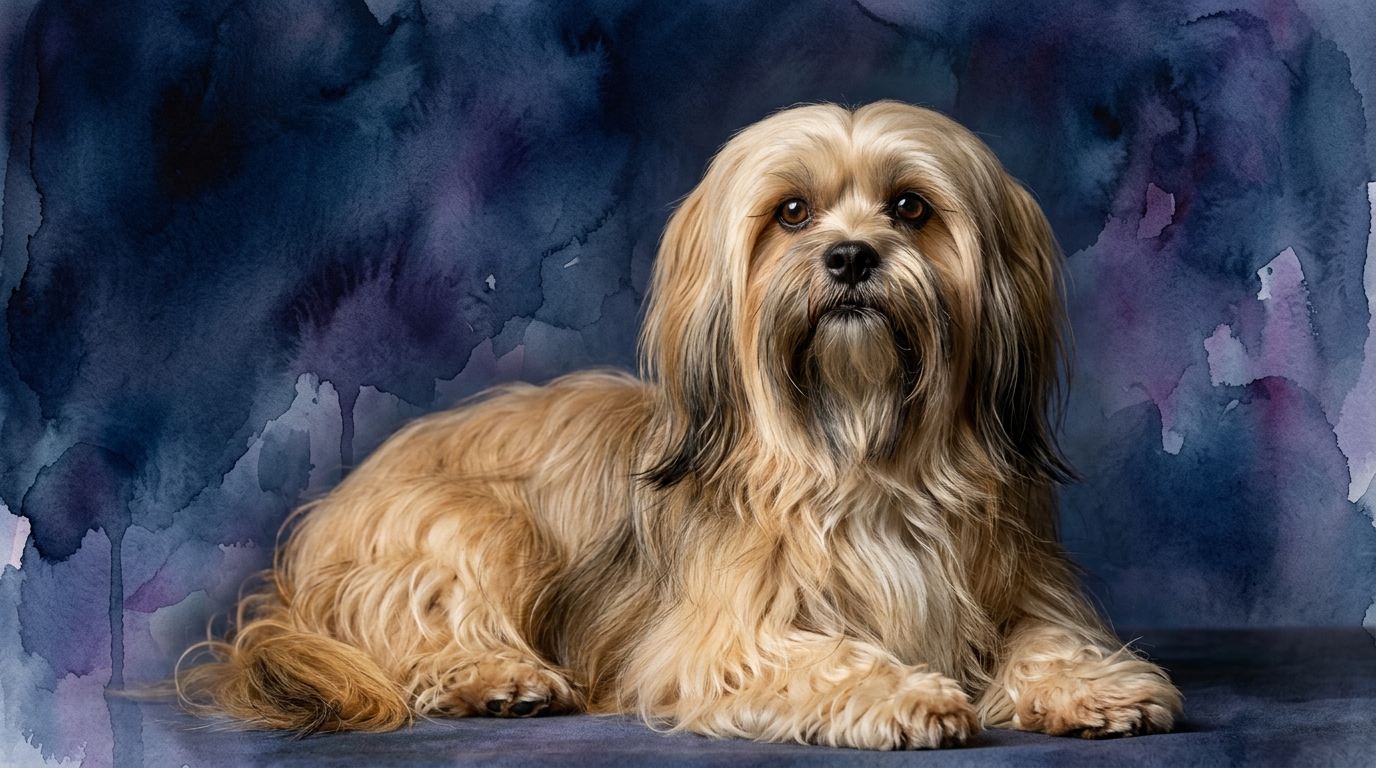
Side-by-side IQ Profile
The Cosmic Pet Pet IQ Lab employs five dimensions to delineate canine intelligence, offering a nuanced perspective beyond simple obedience. For the Curly-Coated Retriever, a member of the Sporting group, its Coren rank of #41 places it firmly in the above-average working intelligence category. Its individual cognitive scores reflect this functional design: Problem Solving at 3/5 indicates a solid capacity to navigate novel situations. Training Speed, also at 3/5, suggests a reasonable pace for learning new commands. Social Intelligence, at 3/5, implies a moderate ability to understand human cues, fitting for a dog that works closely with a handler. Its Instinctive Drive, rated 3/5, speaks to its inherent motivation for tasks related to its breed group. The standout score for the Curly-Coated Retriever is its Memory, at 4/5, indicating an excellent ability to retain learned information and recall past experiences.
In contrast, the Lhasa Apso, from the Non-Sporting group, holds a Coren rank of #68, placing it in the fair working intelligence category. This breed exhibits a remarkably consistent cognitive profile across all five dimensions. Its Problem Solving is rated 3/5, suggesting it possesses a capable ability to figure things out within its environment. Training Speed is 3/5, indicating it can learn, but may require more repetition. Social Intelligence also stands at 3/5, implying an adequate capacity to interact with its human family and discern social cues, though perhaps with characteristic independence. Its Instinctive Drive, 3/5, would lean towards its ancestral role of alerting and guarding. Lastly, its Memory is 3/5, a competent score, but not as exceptional as its retriever counterpart. These consistent scores paint a picture of a well-rounded, self-sufficient intellect, tailored to its historical role as a vigilant companion.
Where Curly-Coated Retriever Wins Cognitively
The Curly-Coated Retriever’s distinct cognitive advantage lies squarely in its superior Memory, rated 4/5 compared to the Lhasa Apso’s 3/5. This enhanced capacity for recall is foundational to its effectiveness as a sporting dog. A retriever with a strong memory can effortlessly remember the precise location of multiple fallen objects, navigate complex terrain for retrieval, and recall specific commands or sequences of tasks even after significant time has passed. This superior memory allows for more sophisticated training, where multi-step commands or intricate routines can be mastered and retained with greater ease and reliability. For an owner engaged in dog sports, advanced obedience, or field work, the Curly’s exceptional memory means less re-teaching and more consistent performance, making it a highly efficient and dependable working partner. It can quickly learn and internalize patterns, routes, and handler expectations, contributing significantly to its overall trainability and adaptability in varied environments.
Where Lhasa Apso Wins Cognitively
While the Lhasa Apso doesn't boast higher individual scores than the Curly-Coated Retriever in any single cognitive dimension, its unique combination of consistent 3/5 ratings across Problem Solving, Social Intelligence, and Instinctive Drive, alongside its historical role, highlights where its particular cognitive profile excels. The Lhasa Apso's "win" isn't in raw processing power but in the application of its intelligence for its specific purpose: that of a keen, discerning sentinel. Its Problem Solving (3/5) is often directed towards assessing environmental changes or potential threats, rather than retrieving objects. This manifests as a sharp awareness of its surroundings and an ability to make independent judgments about who or what belongs. Similarly, its Social Intelligence (3/5) allows it to bond deeply with its family but can also fuel a cautious, observant nature towards strangers, making it an effective alarm system. Its Instinctive Drive (3/5) is powerfully channeled into vigilance and alert barking, a crucial cognitive function for a small dog tasked with guarding. This breed's intelligence shines in its self-reliance, perceptive observation, and unwavering dedication to its perceived duty, requiring less direct human guidance for its primary function than a collaborative working dog.
Which Is Easier to Train and Why
When considering ease of training for general obedience, the Curly-Coated Retriever holds a notable advantage over the Lhasa Apso, a difference clearly reflected in their respective Coren ranks. The Curly-Coated Retriever, ranked #41, is categorized as having above-average working intelligence, meaning it typically understands new commands in 15-25 repetitions and obeys known commands 85% or more of the time. In contrast, the Lhasa Apso, with a Coren rank of #68, falls into the fair working intelligence category, often requiring 40-80 repetitions to learn new commands and obeying known commands 30% of the time or better.
While both breeds share a 3/5 rating for Training Speed, the Coren rank provides a broader context for their overall trainability in a structured obedience setting. The Curly's superior Memory (4/5) further aids its training, allowing it to retain commands and complex sequences more readily and for longer periods. Its Sporting group heritage means it is often eager to work collaboratively with a handler, driven by its instinctive desire to perform tasks. The Lhasa Apso's independence, a desirable trait for its sentinel role, can sometimes translate into a more stubborn or selective approach to obedience training. They are capable of learning, as their 3/5 Training Speed indicates, but their inherent self-sufficiency and discerning nature mean that motivation and consistent, patient reinforcement are paramount to achieving reliable responses. Owners of Lhasa Apsos often find that while their dogs are clever, they require a more thoughtful and persistent approach to training, where the dog perceives a clear benefit or logic in complying.
Which Suits Active Owners vs. Relaxed Owners
The choice between a Curly-Coated Retriever and a Lhasa Apso largely depends on an owner's lifestyle and their capacity to meet a dog's specific physical and mental engagement needs. The Curly-Coated Retriever, a product of the Sporting group with an Instinctive Drive of 3/5 and Problem Solving at 3/5, thrives with active owners who can provide consistent physical exercise and mental stimulation. Its intelligence is geared towards purposeful activity; it benefits immensely from activities like retrieving games, long hikes, swimming, or participation in dog sports such as agility or obedience. An owner who enjoys outdoor adventures and is willing to engage their dog in regular, structured work will find the Curly to be a highly rewarding and cooperative companion. Without adequate outlets for its energy and cognitive abilities, a Curly-Coated Retriever might become bored or destructive, redirecting its problem-solving skills in less desirable ways.
Conversely, the Lhasa Apso, while not a couch potato, generally suits more relaxed owners, or those who prefer intellectual engagement over strenuous physical demands. Its Instinctive Drive (3/5) is channeled into vigilance and observation, making it content with moderate daily walks and regular playtime. While it still requires mental stimulation to prevent boredom, this often comes in the form of puzzle toys, consistent training refreshers, or simply being an engaged participant in the household's routines. Its Problem Solving (3/5) and Social Intelligence (3/5) make it an alert and discerning companion, perfectly happy to supervise household activities from a comfortable perch. Owners who appreciate a dog with an independent streak, a keen sense of observation, and a loyal, albeit sometimes aloof, companionship will find the Lhasa Apso to be an ideal fit, provided they are prepared for its unique training approach.
The Verdict
Choose the Curly-Coated Retriever if you are an active owner seeking a highly trainable, intelligent partner for outdoor activities, dog sports, or a working role, valuing its superior memory and eager-to-please nature.
Opt for the Lhasa Apso if you prefer a self-sufficient, observant companion suited for a more relaxed lifestyle, appreciating its discerning intelligence and loyal, independent spirit, and are prepared for a patient, consistent training approach.
🧠 Find Your Pet's IQ Score
Our Pet IQ Lab assessment covers 25+ tests across 5 cognitive dimensions — personalized to your breed.
Take the Full IQ Test →Frequently Asked Questions
Is the Curly-Coated Retriever truly smarter than the Lhasa Apso based on IQ scores?
The Curly-Coated Retriever shows a cognitive edge in Memory (4/5 vs 3/5) and a higher Coren rank (#41 vs #68), indicating greater overall trainability for obedience, but both breeds possess competent intelligence suited to their historical roles.
Does a Lhasa Apso's "fair working intelligence" mean it cannot be trained?
Not at all; fair working intelligence means they require more repetitions and patience during training, but they are certainly trainable. Their independence means motivation and consistency are key to success.
How does a Curly-Coated Retriever's superior memory benefit a typical pet owner?
For a pet owner, a Curly-Coated Retriever's 4/5 memory means it will remember house rules, learned commands, and routines more quickly and reliably over time, making day-to-day living and ongoing training more streamlined.