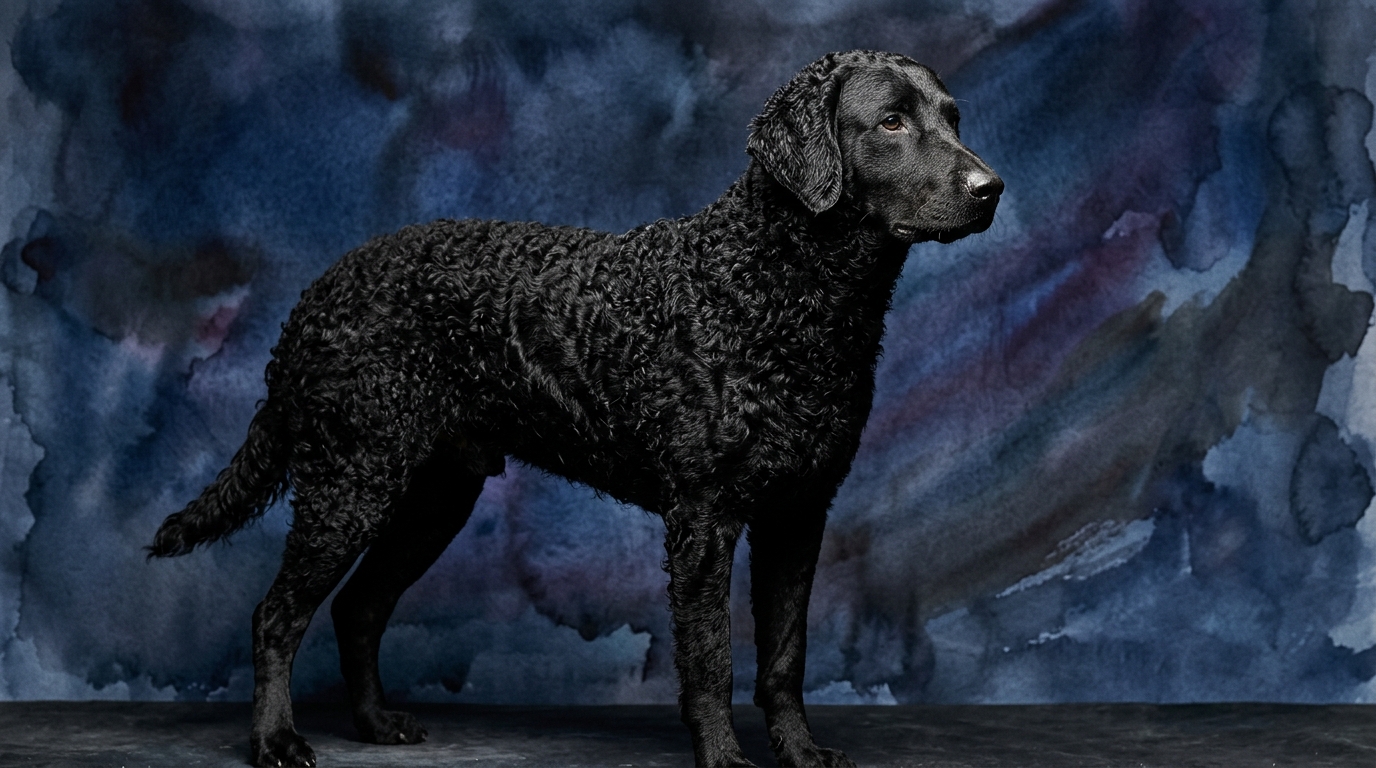
Side-by-Side Cognitive Profile: Curly-Coated Retriever
The Curly-Coated Retriever, holding a respectable Coren rank of #41, presents a balanced and capable cognitive profile. Their Problem Solving score of 3/5 indicates a practical intelligence, adept at navigating real-world scenarios, particularly those involving retrieving tasks or understanding spatial arrangements to reach a desired object. This isn't about abstract puzzle-solving, but rather an efficient, goal-oriented approach to immediate challenges. Their Training Speed, also rated 3/5, suggests they are receptive learners who can grasp new commands and routines with consistent, positive reinforcement, though they may not be the quickest to generalize concepts without repetition. Social Intelligence, at 3/5, points to a breed that is generally attuned to human emotions and intentions, capable of forming strong bonds and understanding social cues within their established family unit, though they might exhibit a reserved demeanor with strangers. An Instinctive Drive of 3/5 highlights their inherent desire to retrieve, swim, and work alongside humans, making them eager participants in activities that tap into these natural inclinations. Finally, their Memory, scoring an impressive 4/5, is a standout trait, allowing them to recall complex sequences of commands, the location of hidden objects, and past experiences with remarkable accuracy, which is invaluable for a working retriever.
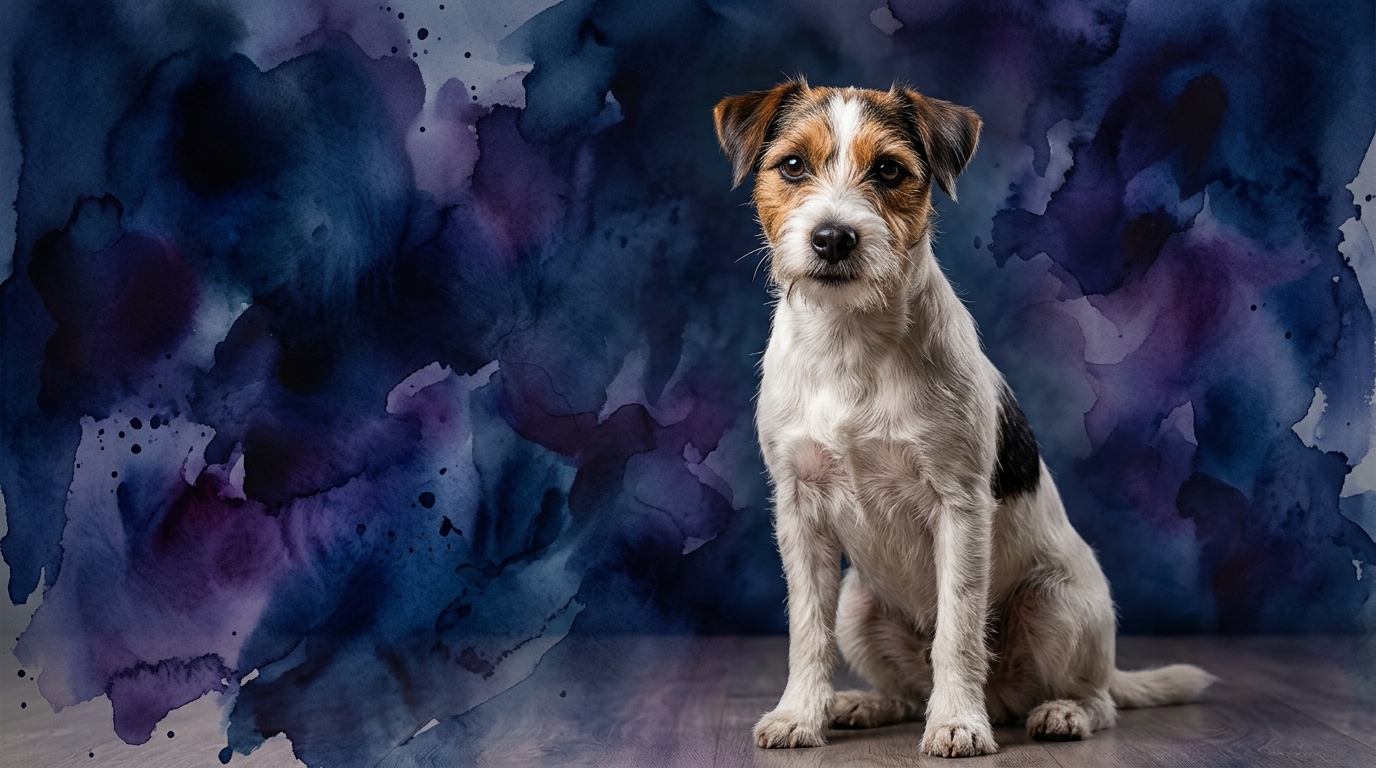
Side-by-Side Cognitive Profile: Parson Russell Terrier
The Parson Russell Terrier, while not included in Coren's traditional ranking, possesses a distinct and equally compelling cognitive makeup, finely tuned for its historical role. With a Problem Solving score of 3/5, these terriers exhibit a tenacious and resourceful intellect, excelling at figuring out how to overcome obstacles or navigate tight spaces to pursue a goal, often driven by an unyielding prey instinct rather than deliberate contemplation. Their Training Speed, also 3/5, signifies a quick wit and ability to learn new cues rapidly, but this is often coupled with an independent streak that demands engaging, varied training methods to maintain focus and enthusiasm. Social Intelligence, rated 3/5, describes a dog that is highly engaged with its primary human companions, often displaying a bold and assertive confidence, but one that can also be opinionated with other dogs or unfamiliar people. The Parson Russell's Instinctive Drive, also 3/5, is profoundly rooted in its terrier heritage, manifesting as an intense, persistent drive to hunt, dig, and explore, making them tireless in their pursuit of perceived 'quarry.' Their Memory, scoring 3/5, is functional and efficient, allowing them to recall learned behaviors and follow scent trails effectively, though perhaps not with the same breadth or depth for complex, multi-stage tasks as some other breeds.
Where the Curly-Coated Retriever Excels Cognitively
The Curly-Coated Retriever truly distinguishes itself in the realm of memory and its application to structured tasks. With a Memory score of 4/5, significantly higher than the Parson Russell Terrier's 3/5, the Curly excels at retaining intricate command sequences, remembering specific locations where items were dropped, or recalling the precise steps of a multi-stage retrieving exercise. This superior memory translates into a dog that is remarkably consistent in its performance once a task is learned, making them highly dependable in activities requiring precision and recall over time. For instance, a Curly is more likely to remember a complex agility course layout after a few repetitions or consistently execute a series of hand signals in a field trial, demonstrating a sustained cognitive blueprint. Their capacity for long-term retention also means that once training is established, it tends to stick, requiring less frequent refreshers compared to a breed with a shorter or less detailed memory. This cognitive advantage makes them particularly suited for roles where reliability and accurate recall are paramount, such as advanced obedience, competitive retrieving, or even assistance work where remembering specific item locations is crucial.
Where the Parson Russell Terrier Excels Cognitively
While their raw scores might seem similar in some areas, the Parson Russell Terrier's cognitive strengths lie in their unique application of problem-solving and instinctive drive within their 'terrier' context. Their Problem Solving at 3/5 is not about deliberate, step-by-step logic, but a quick, tenacious resourcefulness. They excel at figuring out immediate, practical solutions to obstacles, particularly when driven by their powerful instincts. This might manifest as finding the weak spot in a fence, devising a method to reach a hidden toy, or persistently digging to get to an intriguing scent. Their Instinctive Drive, also 3/5, is a relentless engine for these problem-solving endeavors. It’s a focused, unyielding persistence that allows them to remain engaged with a task, whether it's tracking a scent or attempting to 'conquer' a puzzle toy, far longer than many other breeds. This isn't merely about physical energy; it's a cognitive tenacity that fuels their ability to overcome challenges through sheer will and repeated effort. They are masters of the 'try, try again' approach, often finding success through sheer determination where other breeds might give up. This makes them particularly adept at activities requiring sustained focus on a specific, often instinct-driven goal, showcasing a different, yet equally impressive, form of canine intellect.
Training Dynamics: Which is Easier and Why
Determining which breed is 'easier' to train is nuanced, as both the Curly-Coated Retriever and the Parson Russell Terrier share a 3/5 rating for Training Speed, indicating they both possess the capacity to learn readily. However, their underlying behavioral differences significantly impact the training experience. The Curly-Coated Retriever, with its superior Memory (4/5) and sporting dog heritage, tends to be more biddable and eager to please, often demonstrating a cooperative spirit in training sessions. Once a command is learned, their strong memory ensures better retention, meaning less reteaching is required over time. They respond well to positive reinforcement and consistent methods, thriving on structure and routine. In contrast, the Parson Russell Terrier, despite its quick learning ability (Training Speed 3/5), often presents a greater challenge due to its independent nature and intense instinctive drives. Their high prey drive and natural curiosity mean they can be easily distracted by environmental stimuli, requiring a trainer to be exceptionally engaging and creative to hold their attention. While they pick up commands quickly, their strong will means they might choose to 'ignore' a command if something more interesting presents itself. Training a Parson Russell requires a firm but fair hand, a sense of humor, and a deep understanding of terrier psychology to channel their boundless energy and intelligence effectively, making the Curly-Coated Retriever generally more straightforward for the average owner to train consistently.
Matching Breeds to Owner Lifestyles
When considering lifestyle compatibility, both breeds lean towards active owners, but with distinct nuances in their activity requirements. The Curly-Coated Retriever, as a sporting dog, thrives with consistent physical exercise and mental engagement. They are excellent companions for hiking, swimming, retrieving games, and participating in dog sports like agility or obedience. An active owner who enjoys outdoor pursuits and can provide daily opportunities for structured play and mental challenges will find a Curly to be a delightful and enthusiastic partner. While they appreciate downtime with their family, they are not content to be couch potatoes and require a minimum of an hour of vigorous activity daily to prevent boredom and potential destructive behaviors. In contrast, the Parson Russell Terrier demands an even higher, more intense level of activity, making them suitable only for truly dedicated, highly active owners. Their relentless instinctive drive and boundless energy mean they need constant mental and physical stimulation, often requiring more than just a walk around the block. They excel in activities like earthdog trials, agility, flyball, or long, vigorous off-leash runs that allow them to utilize their prey drive and problem-solving skills. A relaxed owner who cannot commit to significant daily engagement will quickly find a Parson Russell Terrier to be a handful, potentially leading to anxiety, excessive barking, or destructive digging. Therefore, while both require activity, the Curly-Coated Retriever is better suited for an active owner seeking a versatile companion, whereas the Parson Russell Terrier is ideal for a highly energetic, experienced owner who embraces a dynamic, often challenging, canine partnership.
The Verdict
Choose the Curly-Coated Retriever if you seek a biddable, reliable companion with exceptional memory for training, eager to participate in consistent, varied activities and family life.
Opt for the Parson Russell Terrier if you are a highly active, experienced owner prepared for a tenacious, independent partner whose problem-solving and drive demand intense, engaging daily challenges and structured outlets.
🧠 Find Your Pet's IQ Score
Our Pet IQ Lab assessment covers 25+ tests across 5 cognitive dimensions — personalized to your breed.
Take the Full IQ Test →Frequently Asked Questions
Are Curly-Coated Retrievers good family dogs given their social intelligence score?
With a Social Intelligence score of 3/5, Curly-Coated Retrievers are generally good family dogs, forming deep bonds with their immediate family and showing loyalty. They can be reserved with strangers, which means early socialization is important to ensure they are comfortable and well-adjusted in various social settings.
What kind of mental stimulation do Parson Russell Terriers need to satisfy their instinctive drive and problem-solving?
Parson Russell Terriers require significant mental stimulation that taps into their problem-solving and instinctive drive, rated 3/5 for both. This includes puzzle toys, scent work, earthdog trials, agility, and consistent, engaging training sessions that challenge their quick wit and tenacious spirit, preventing boredom and channeling their energy positively.
How do the memory differences between these breeds impact daily life and training?
The Curly-Coated Retriever's 4/5 memory score means they retain commands and routines exceptionally well, making training more efficient and requiring fewer refreshers over time. The Parson Russell Terrier's 3/5 memory is functional, but their independent nature often means they might 'forget' a command if a more stimulating distraction arises, requiring consistent, engaging reinforcement in daily life.