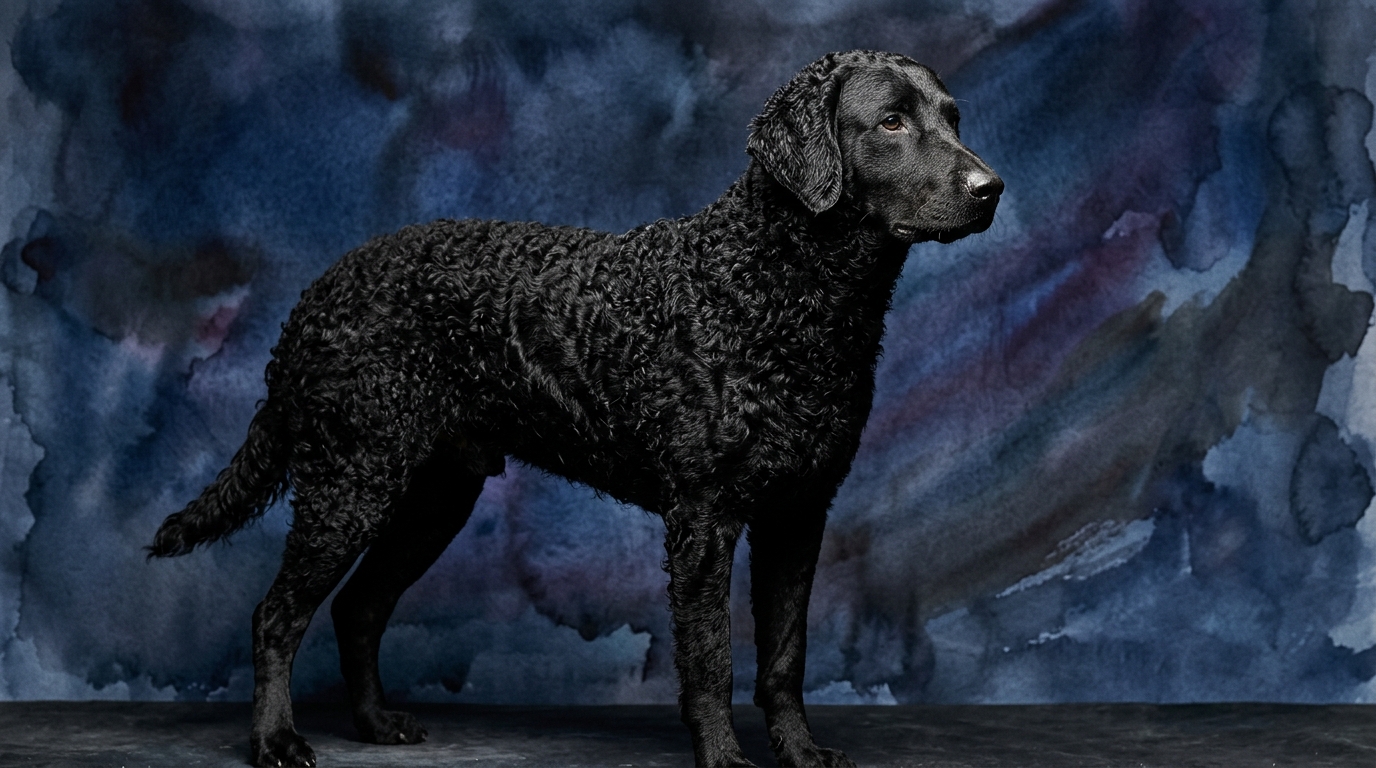

Side-by-Side IQ Profile: Diving Into Cognitive Dimensions
At The Cosmic Pet Pet IQ Lab, we evaluate canine intelligence across five key dimensions to provide a nuanced understanding of each breed's cognitive strengths. Here's how the Curly-Coated Retriever and Rat Terrier compare:
**Curly-Coated Retriever:**
**Problem Solving (3/5):** This breed demonstrates a capable ability to analyze and navigate moderately complex environmental challenges, particularly those involving retrieving objects or following scent trails. They can adapt their approach when faced with a minor obstacle, such as finding a way around a bush to reach a thrown dummy, showing practical application of their cognitive skills rather than purely instinctive reactions.
**Training Speed (3/5):** Curly-Coated Retrievers learn new commands and routines at a steady, consistent pace. They respond well to clear instruction and positive reinforcement, requiring regular practice to solidify new behaviors. While not instant learners, their focus during training sessions is generally good, allowing for effective skill acquisition over time.
**Social Intelligence (3/5):** They possess a sound understanding of human social cues and integrate smoothly into family dynamics. They can differentiate between familiar and unfamiliar individuals, often displaying a reserved but observant demeanor with strangers, indicating a thoughtful processing of social interactions within their environment.
**Instinctive Drive (3/5):** Their innate drive is strongly tied to their retrieving heritage, manifesting as a purposeful desire to work and collaborate with humans on tasks. This drive is channeled towards specific goals like fetching, swimming, or accompanying their owners on outdoor excursions, rather than an undirected, restless energy.
**Memory (4/5):** A standout cognitive strength, Curly-Coated Retrievers exhibit an impressive capacity for recalling past experiences, detailed training sequences, and the specific locations of items or routes. This robust memory ensures consistent performance over time and allows them to build a comprehensive understanding of their environment and learned behaviors.
**Rat Terrier:**
**Problem Solving (3/5):** Rat Terriers display a practical, often tenacious approach to problem-solving, particularly when it involves achieving a desired outcome like accessing a favored toy or navigating a tricky barrier. Their methods can involve a blend of observation, persistence, and clever manipulation of their surroundings, indicative of an active, inquisitive mind.
**Training Speed (3/5):** These terriers learn new behaviors and commands at a competent rate, often excelling when training is kept engaging and varied. Repetitive drills can sometimes lead to disinterest, suggesting their learning is optimized when mental stimulation and novelty are integrated into the process.
**Social Intelligence (3/5):** They form strong bonds with their primary caregivers and can keenly interpret household routines and emotional states. While often reserved or cautious with new people, they are perceptive within their established social circle, demonstrating an ability to read and respond to familiar human interactions.
**Instinctive Drive (3/5):** Their instinctive drive is characterized by a strong prey drive and a natural inclination for investigation and exploration, stemming from their historical role as vermin hunters. This manifests as keen scenting, digging, and a desire to pursue small, fast-moving objects, fueling their energetic engagement with the world.
**Memory (3/5):** Rat Terriers possess a solid memory for routines, familiar people, and learned commands, enabling them to navigate their daily lives effectively. While reliable, their recall is generally not as extensive or as detailed as breeds with higher memory scores, meaning complex, multi-step tasks might require more frequent reinforcement.
Where the Curly-Coated Retriever Wins Cognitively
The Curly-Coated Retriever’s superior memory (4/5) stands as a significant cognitive advantage, distinguishing it in practical applications. This isn't merely about remembering basic commands; it encompasses the ability to retain intricate sequences of tasks, recall specific locations over extended periods, and consistently apply learned behaviors without constant re-training. For instance, a Curly-Coated Retriever could reliably remember a complex retrieving pattern involving multiple decoys and specific drop-off points, even after a break in training. Their robust memory allows them to build a more detailed cognitive map of their environment and past experiences, making them exceptionally reliable in scenarios requiring long-term recall, such as navigating a familiar hunting ground or executing a multi-part agility course with precision. This deep retention means they can leverage past successes and failures more effectively, leading to a more consistent and predictable performance in tasks they have mastered.
Where the Rat Terrier Wins Cognitively
While both breeds share a 3/5 score in problem-solving, the Rat Terrier exhibits a unique cognitive edge in the *application* of this skill, driven by its independent terrier spirit. Their problem-solving often manifests as tenacious and inventive cunning, particularly when faced with challenges that require independent thought rather than direct instruction. For example, a Rat Terrier might demonstrate remarkable ingenuity in figuring out how to bypass a gate latch or unearth a hidden treat, employing a trial-and-error approach with a strong will to succeed. This isn't about faster learning, but about a self-directed, persistent drive to manipulate their environment to achieve a desired outcome. Their instinctive drive (also 3/5) fuels this independent exploration and pursuit, translating into quick, decisive actions and an ability to adapt on the fly in novel situations. This blend of determined problem-solving and self-reliance allows them to navigate and master their immediate surroundings with a distinctive, often resourceful, flair.
Which is Easier to Train and Why
Despite identical 3/5 Training Speed scores, real-world training experiences differ between these breeds due to their other cognitive dimensions and inherent temperaments. The Curly-Coated Retriever’s superior memory (4/5) provides a distinct advantage in long-term retention and consistency. Once a Curly learns a command or a routine, they are likely to remember it with high fidelity, requiring less frequent refreshers and making it easier to build upon complex skill sets. Their instinctive drive (3/5) is inherently collaborative, predisposing them to work *with* their handler, often displaying a focused eagerness to please during structured sessions. This means they are generally more amenable to repetitive drills and consistent methods.
The Rat Terrier, while equally capable of learning (3/5 Training Speed), demands a more dynamic and creative training approach. Their 3/5 memory means complex sequences might need more consistent reinforcement to solidify, and their independent problem-solving and instinctive drive can translate into a shorter attention span for repetitive tasks. To maintain engagement, a Rat Terrier trainer might need to incorporate puzzle-solving, varied rewards, and shorter, more frequent sessions. While both respond to positive reinforcement, the Curly-Coated Retriever's inherent desire to cooperate and strong memory often lead to a more predictable and perhaps less creatively demanding training journey for the owner, whereas the Rat Terrier challenges a trainer to be more inventive and adaptable to harness their spirited curiosity effectively.
Which Suits Active Owners vs. Relaxed Owners
The Curly-Coated Retriever, deeply rooted in its Sporting group heritage, thrives with active owners who can provide consistent, purpose-driven physical and mental engagement. Their 3/5 instinctive drive, combined with good stamina and a strong memory, means they excel in activities like long-distance retrieving, swimming, hiking, or structured dog sports such as obedience and agility. They possess the mental fortitude to sustain focus over extended periods of activity, making them ideal companions for those who enjoy rigorous outdoor pursuits or competitive canine events. An owner who can channel their drive into productive tasks will find a highly content and cooperative companion. For a truly relaxed owner, the Curly’s need for regular, substantial activity and mental stimulation could lead to boredom-related behaviors or restlessness if their requirements are not consistently met.
The Rat Terrier, while also possessing a 3/5 instinctive drive, channels its energy in bursts, characteristic of its terrier background. They are suited for active owners who appreciate a quick-witted, tenacious companion and can offer varied, stimulating activities. This might include fast-paced games of fetch, exploring new environments on leash, or participating in terrier-specific sports like barn hunt or earthdog trials, which satisfy their natural prey drive and problem-solving skills (3/5). Their smaller size means bursts of intense activity can often satisfy their physical needs, and they are generally good at settling down indoors after a good romp. Therefore, while not a couch potato, they can fit well with owners who are active in shorter, more frequent intervals throughout the day and enjoy interactive play and mental puzzles. A relaxed owner might struggle with their independent spirit and need for mental engagement, as a bored Rat Terrier can become quite inventive in finding its own entertainment, which may not always align with household rules.
The Verdict
Choose the Curly-Coated Retriever if you seek a highly reliable companion for consistent, structured activities and value a dog with exceptional long-term memory for complex tasks. They thrive with owners who enjoy collaborative work and can provide regular, purposeful outdoor engagement.
Opt for the Rat Terrier if you appreciate an independent, tenacious problem-solver with bursts of energy, and are prepared to offer varied, engaging mental and physical stimulation. They suit owners who enjoy interactive play and can adapt their training to keep things novel and fun.
🧠 Find Your Pet's IQ Score
Our Pet IQ Lab assessment covers 25+ tests across 5 cognitive dimensions — personalized to your breed.
Take the Full IQ Test →Frequently Asked Questions
Is a Curly-Coated Retriever difficult to train due to its independent nature?
While Curly-Coated Retrievers possess a balanced independence, their 3/5 training speed and 4/5 memory make them capable learners. They respond well to consistent, positive reinforcement, and their collaborative drive usually ensures a cooperative training experience, especially when tasks align with their retrieving instincts.
How does the Rat Terrier's strong instinctive drive impact daily life?
The Rat Terrier's 3/5 instinctive drive means they have a natural inclination for chasing and investigating, which can manifest as a keen interest in small animals or digging. This drive requires appropriate outlets through secure environments, engaging play, and mental stimulation to ensure it's channeled constructively rather than becoming a nuisance.
Can a Rat Terrier live in an apartment despite its energy?
Yes, a Rat Terrier can adapt to apartment living if their significant energy and mental stimulation needs are consistently met. Daily walks, interactive play, and puzzle toys are crucial to satisfy their 3/5 instinctive drive and problem-solving abilities, preventing boredom in a smaller space.