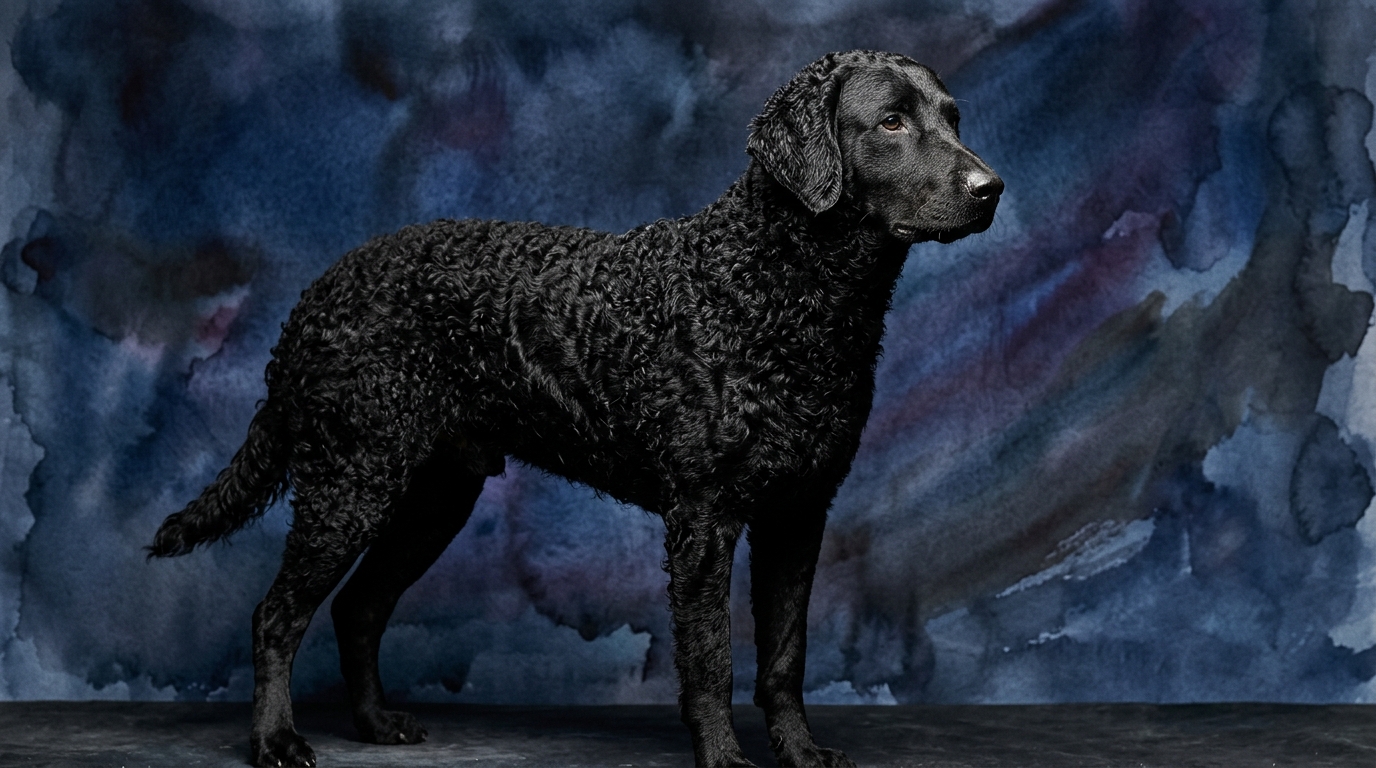
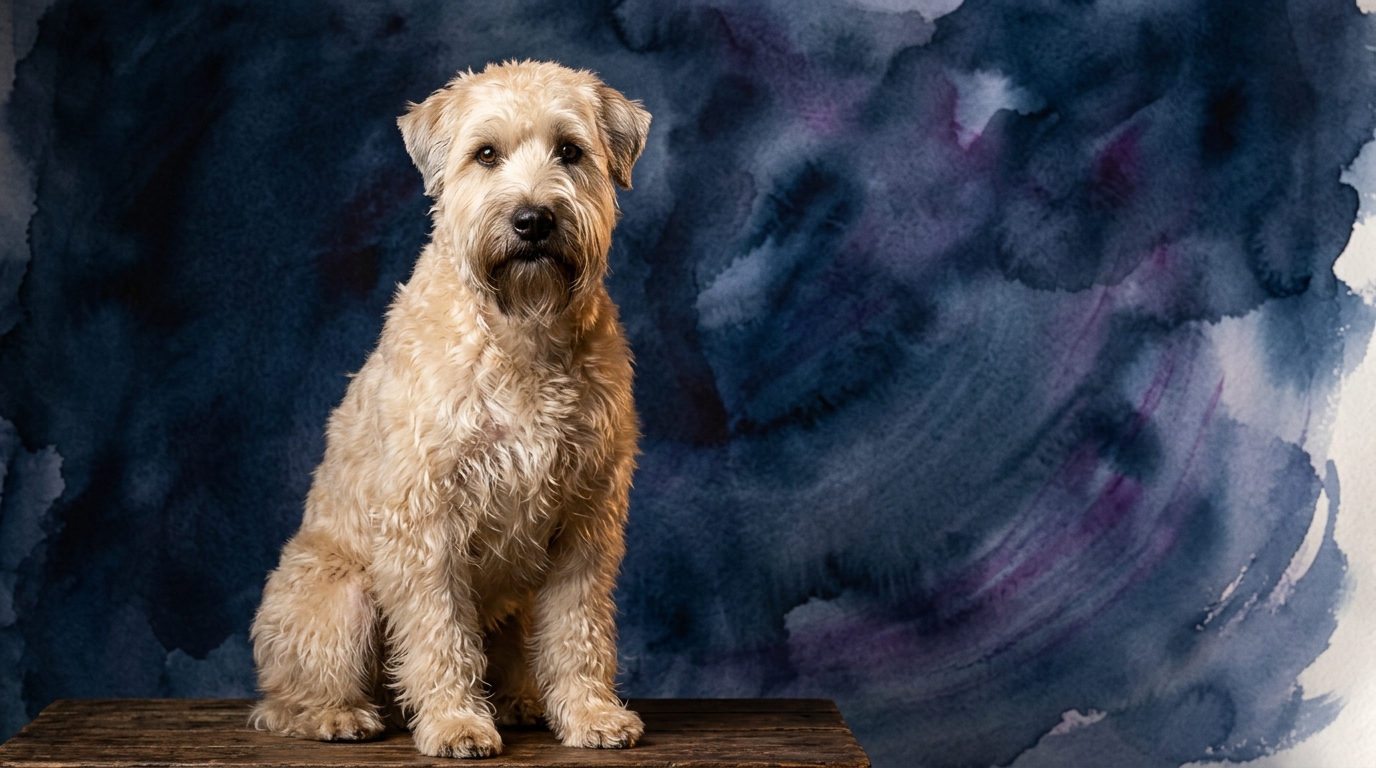
Side-by-side IQ profile
The Cosmic Pet Pet IQ Lab utilizes a five-dimensional framework for canine cognition. The Curly-Coated Retriever, a Sporting group member and Coren-ranked #41, shows a Problem Solving capacity of 3/5, indicating competence in novel situations. Its Training Speed is also 3/5, suggesting a moderate pace for learning commands. Social Intelligence, vital for interaction, registers 3/5, reflecting balanced relational awareness. Instinctive Drive is 3/5, pointing to a moderate inclination for ancestral working roles. The Curly-Coated Retriever truly distinguishes itself in Memory, earning a robust 4/5, signifying impressive recall of learned information and routines.
In contrast, the Soft Coated Wheaten Terrier, a Terrier group member, is not Coren-ranked. Its cognitive profile shows consistency across several dimensions. Problem Solving is 3/5, matching the Curly-Coated Retriever's capacity. Training Speed is 3/5, indicating a similar learning rate, though temperament dictates the method. Social Intelligence is 3/5, reflecting adequate social cue interpretation. Instinctive Drive is 3/5, reflecting typical terrier drives like digging and chasing. The primary divergence for the Wheaten Terrier is its Memory, which scores 3/5, a point lower than the Curly-Coated Retriever, suggesting a slightly less pronounced capacity for long-term recall, making training consistency crucial.
Where Curly-Coated Retriever wins cognitively
The Curly-Coated Retriever’s distinct advantage lies squarely in its superior Memory, assessed at 4/5 compared to the Wheaten Terrier's 3/5. This elevated recall capability means a Curly is generally more adept at retaining a broad repertoire of commands, remembering complex sequences, and recalling learned behaviors over extended periods. For tasks requiring pattern recognition and multi-step instructions, such as advanced obedience, intricate agility courses, or complex retrieving scenarios, this memory strength is a significant asset. A Curly is more likely to remember specific scent trails or the precise mechanics of a previously learned trick, allowing for more nuanced cognitive work. This robust memory also contributes to its Coren rank of #41, reflecting a breed that historically performs well in structured learning environments where consistent recall is rewarded, making them proficient in roles demanding precise, repeatable execution.
Where Soft Coated Wheaten Terrier wins cognitively
While the Soft Coated Wheaten Terrier’s individual scores often align with or are slightly below the Curly-Coated Retriever's, its cognitive strengths manifest differently, rooted in its terrier heritage. Its consistent 3/5 for Problem Solving, Training Speed, Social Intelligence, and Instinctive Drive, in the absence of a Coren ranking, points to a distinct brand of adaptive and self-reliant thinking. Where a Curly excels at following a pre-defined path, a Wheaten Terrier might demonstrate a more independent, persistent approach to solving a novel environmental puzzle, particularly if it involves overcoming an obstacle to reach a perceived "prey" item. Their Instinctive Drive, while 3/5, translates into tenacious focus on a self-assigned task, requiring a specific type of problem-solving not always about handler cooperation. This tenacity, combined with 3/5 Social Intelligence, can mean they are particularly adept at reading their *own family's* subtle cues and adapting their behavior, even if less universally biddable with strangers. Their "wins" are in their capacity for independent thought and persistent, self-directed action.
Which is easier to train and why
Regarding ease of training, the Curly-Coated Retriever generally offers a more straightforward experience. Its Coren rank of #41 signifies historical working intelligence and a cooperative nature. Coupled with its superior Memory (4/5), the Curly quickly grasps and retains new commands, making repetitions highly effective and progress consistent. Their Sporting group heritage also instills a natural desire to work *with* a handler, often eager to please and respond to direction, translating into higher biddability. A Curly is likely to respond to a recall command with greater urgency and consistency, having a stronger memory of positive reinforcement.
The Soft Coated Wheaten Terrier, despite a 3/5 in Training Speed, presents unique challenges rooted in its Terrier temperament. Bred for independent work, terriers often make decisions without direct human guidance, leading to a strong independent streak. While capable of learning, their 3/5 Memory means they require more consistent reinforcement to solidify commands. A Wheaten might understand a command but choose to prioritize an interesting scent or perceived "job" over immediate obedience, demanding an engaging, patient, and consistent trainer. Training a Wheaten involves channeling natural drives and making it feel like a puzzle they *choose* to solve, rather than just following instructions. Owners must prepare for their terrier's characteristic persistence and occasional selective hearing.
Which suits active owners vs relaxed owners
Both the Curly-Coated Retriever and the Soft Coated Wheaten Terrier possess a 3/5 Instinctive Drive, indicating neither breed suits a truly "relaxed" owner. Both require regular physical and mental engagement.
The Curly-Coated Retriever thrives with active owners enjoying structured outdoor activities. Their drive channels into retrieving games, swimming, hiking, or dog sports like agility. They enjoy having a "job" and benefit from consistent mental stimulation engaging problem-solving and memory skills. An active owner for a Curly dedicates time to daily walks, runs, or training sessions, potentially involving water work. Their need for purpose means they appreciate routine and directed energy expenditure.
The Soft Coated Wheaten Terrier also demands an active lifestyle, but prefers more unstructured exploration and "terrier work." Their 3/5 Instinctive Drive translates into a desire to investigate, chase, and dig. Owners enjoying long, varied walks, exploring new environments, or interactive play mimicking hunting behaviors would suit a Wheaten. While they can do dog sports, their independent nature means they value the chase or puzzle more than strict adherence. A Wheaten owner needs to be prepared for a dog that initiates its own games and requires outlets for natural curiosity and tenacious energy, perhaps enjoying off-leash exploration in secure areas. Both breeds are too energetic for sedentary owners, but their activity *style* differs: Curly favors cooperative, task-oriented play, Wheaten enjoys independent, exploratory pursuits.
The Verdict
Choose Curly-Coated Retriever if: You seek a canine partner with strong memory and a cooperative spirit, eager for structured training and activities like retrieving, agility, or obedience, thriving on having a clear purpose and working alongside you.
Choose Soft Coated Wheaten Terrier if: You appreciate an independent, persistent companion with a tenacious problem-solving approach, willing to engage in playful, exploratory activities but requiring a patient hand for training that respects their self-directed nature.
🧠 Find Your Pet's IQ Score
Our Pet IQ Lab assessment covers 25+ tests across 5 cognitive dimensions — personalized to your breed.
Take the Full IQ Test →Frequently Asked Questions
Do Curly-Coated Retrievers make good family pets, considering their cognitive profile?
Yes, Curly-Coated Retrievers can be excellent family pets, particularly in active households. Their 3/5 social intelligence means they form strong bonds, and their 4/5 memory helps them remember household rules and routines, making them adaptable to family life with consistent guidance.
How does the Soft Coated Wheaten Terrier's 3/5 problem-solving manifest in daily life?
A Wheaten Terrier's problem-solving often appears as cleverness and persistence in navigating their environment. This could mean figuring out how to open a cabinet, outsmarting a puzzle toy, or finding creative ways to get attention, requiring owners to be vigilant and consistent with boundaries.
Is one breed more prone to separation anxiety based on their IQ scores?
Neither breed's IQ scores directly indicate a predisposition to separation anxiety, as this is more related to individual temperament and early experiences. However, a Curly's higher social intelligence and desire to work with its handler might make it more prone to distress if left alone for extended periods without adequate mental and physical stimulation compared to a more independent Wheaten.