
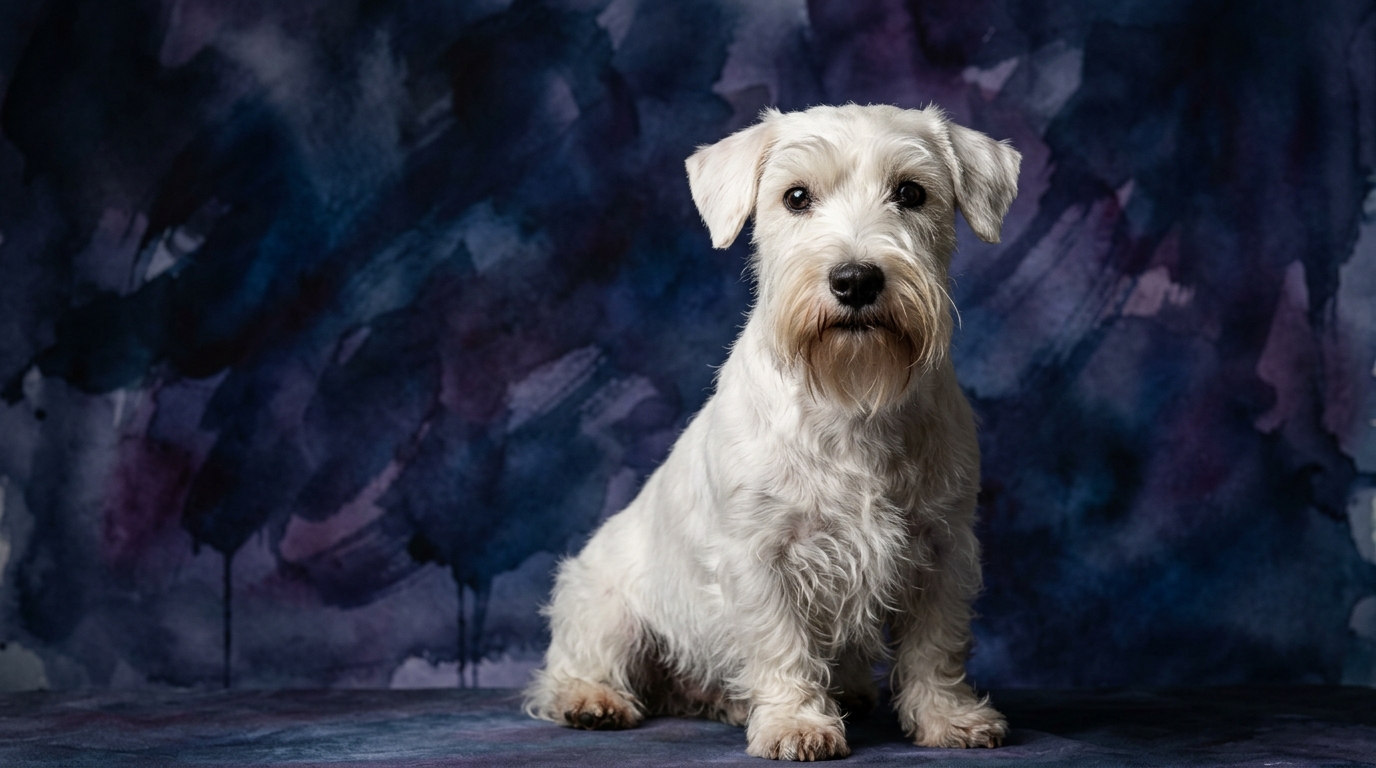
Side-by-Side IQ Profile: Dachshund vs. Sealyham Terrier
At The Cosmic Pet Pet IQ Lab, we evaluate canine intelligence across five key dimensions, providing a nuanced understanding beyond simple obedience. For the Dachshund, a Hound breed ranked #49 by Coren, and the Sealyham Terrier, a Terrier breed without a Coren ranking, their scores reveal distinct cognitive strengths shaped by their breed histories.
The Dachshund's profile highlights its powerful problem-solving ability (4/5), stemming from its badger-hunting past where independent thought was crucial for navigating complex underground tunnels and outwitting prey. Its training speed, however, is rated lower (2/5), not due to a lack of capacity, but a strong self-determination and tendency to prioritize its own agenda. Social intelligence stands at 3/5, indicating deep bonds with its family but often a reserved nature with strangers, while its instinctive drive is an exceptional 5/5, reflecting its profound scenting and digging urges. Memory is a functional 3/5, capable of recalling routines but sometimes overridden by intense drives.
In contrast, the Sealyham Terrier presents a more balanced cognitive profile. Its problem-solving score is 3/5, reflecting practical intelligence applied to flushing vermin and navigating immediate tasks. Training speed is a moderate 3/5, suggesting a greater amenability to instruction, even with typical terrier tenacity. Social intelligence also scores 3/5, indicating an affectionate, sociable nature within its family. Its instinctive drive is 3/5, present and determined for hunting but typically more manageable than the Dachshund's all-consuming drive. Memory is a solid 3/5, aiding in learning and adapting to consistent environments.
Where the Dachshund Excels Cognitively
The Dachshund stands out in two key cognitive dimensions: problem-solving and instinctive drive. Their problem-solving score of 4/5, compared to the Sealyham's 3/5, reflects their historical requirement to independently navigate complex underground environments to corner badgers. This bred a dog capable of intricate spatial reasoning and ingenious strategies to overcome obstacles without direct human guidance. When a Dachshund appears 'stubborn,' it's often their deep problem-solving capacity at work, devising their own, often more efficient, solutions to a perceived task.
Furthermore, their instinctive drive, rated at a powerful 5/5 against the Sealyham's 3/5, is unparalleled. This isn't just about scenting; it's a relentless, all-encompassing focus on a perceived goal. This drive fuels their persistence, allowing them to track scents over long distances and through challenging terrain, demonstrating an extraordinary mental stamina rooted in their original purpose. Their cognitive framework is built around this intense, singular pursuit, making them masters of their specialized hunting niche.
Where the Sealyham Terrier Shows Cognitive Strengths
The Sealyham Terrier distinguishes itself primarily in its training speed, scoring 3/5 compared to the Dachshund's 2/5. While still possessing a terrier's independent spirit, Sealyhams often exhibit a slightly greater eagerness to engage with and follow human instruction. This doesn't mean they are robotic followers, but rather that their tenacity can be more readily channeled into cooperative tasks, making them potentially more receptive to learning new commands and routines within a structured training environment. Their desire to work *with* their handler, even if on their own terms, gives them an edge in this domain.
Additionally, the Sealyham's balanced cognitive profile, with consistent 3/5 scores across problem-solving, social intelligence, instinctive drive, and memory, suggests a well-rounded and adaptable intellect for a working terrier. While they might not reach the extreme peaks of specialized drive seen in the Dachshund, this cognitive consistency allows them to integrate smoothly into diverse family settings, applying their intelligence to a broader range of domestic and companion tasks without overwhelming single-mindedness.
Training Dynamics: Which Breed is Easier to Train?
Based on our IQ metrics, the Sealyham Terrier (training speed 3/5) generally presents as easier to train than the Dachshund (training speed 2/5). This difference is deeply rooted in their behavioral tendencies. Dachshunds, with their formidable instinctive drive and independent problem-solving, often operate on their own agenda. Their historical role demanded self-reliance, meaning they are less inclined to automatically defer to human commands, especially if a compelling scent or digging opportunity arises. This isn't a lack of understanding, but a strong internal motivation that can make consistency and high-value rewards crucial for effective training.
Sealyham Terriers, while still possessing a terrier's characteristic determination, tend to be more amenable to instruction. Their slightly higher training speed suggests they are often more inclined to form a working partnership with their owner. While they will test boundaries and require firm, consistent guidance to channel their natural terrier energy, their desire for interaction and willingness to engage in purposeful activities can make them more responsive to learning commands and adapting to household rules. Training a Sealyham often feels like a collaborative effort, whereas training a Dachshund can sometimes feel like a negotiation with a very clever, independent spirit.
Lifestyle Fit: Active Owners vs. Relaxed Owners
The choice between a Dachshund and a Sealyham Terrier depends significantly on an owner's definition of 'active' and 'relaxed.' Owners who appreciate an independent companion with a profound inner life and specific cognitive needs might find the Dachshund a rewarding match. While they enjoy bursts of outdoor activity, especially scent-tracking and digging, their 'activity' often involves mental engagement with their environment rather than continuous physical exertion. Relaxed owners who can provide consistent mental stimulation, engage in scent games, and manage their strong instincts will find a loyal, though sometimes opinionated, companion. They are not necessarily for owners seeking a dog for long, strenuous runs, but rather for those who appreciate their unique blend of persistence and cleverness.
Sealyham Terriers, with their terrier heritage, generally suit owners who are more actively engaged in consistent, structured exercise and mental challenges. Their instinctive drive, while rated lower than the Dachshund's, still demands outlets for digging, chasing, and purposeful activity. They are often robust and enjoy various outdoor adventures, making them suitable for owners who enjoy regular walks, interactive play, and perhaps even dog sports. While they can enjoy downtime, a Sealyham thrives when given a job or a clear outlet for their energy, making them a better fit for owners who actively participate in their dog's daily physical and mental stimulation.
The Verdict
Choose a Dachshund if you value an independent, clever companion whose strong instincts and problem-solving flair will keep you engaged in managing their unique cognitive strengths, even if it means a longer training journey. They thrive with owners who appreciate their profound internal world and are prepared to channel their intense drives into appropriate activities like scent work.
Opt for a Sealyham Terrier if you seek a resilient, cooperative partner who enjoys purposeful activity and structured engagement, offering a more balanced training experience. They are ideal for owners ready to provide consistent exercise and mental challenges, channeling their terrier tenacity into a fulfilling companionship.
🧠 Find Your Pet's IQ Score
Our Pet IQ Lab assessment covers 25+ tests across 5 cognitive dimensions — personalized to your breed.
Take the Full IQ Test →Frequently Asked Questions
Do Dachshunds forget commands easily due to their lower training speed?
Dachshunds don't necessarily forget commands easily; their training speed score of 2/5 reflects their independent nature and tendency to prioritize strong instincts over immediate compliance. With consistent, highly motivating training, they can retain commands, but their self-determination often means they'll choose to obey when it suits them.
Is a Sealyham Terrier's 3/5 instinctive drive still strong enough to cause trouble?
Yes, a Sealyham Terrier's 3/5 instinctive drive is certainly strong enough to manifest as digging, chasing small animals, or being vocal. While more manageable than a Dachshund's 5/5 drive, it still requires consistent management, secure fencing, and appropriate outlets to prevent unwanted behaviors and ensure their cognitive needs are met.
How does a Dachshund's 4/5 problem-solving manifest in daily life?
A Dachshund's high problem-solving ability often appears as cleverness in navigating their environment, such as figuring out how to open cabinets, escape enclosures, or manipulate owners for treats. They can be incredibly resourceful in achieving their goals, often demonstrating inventive strategies to overcome perceived obstacles.