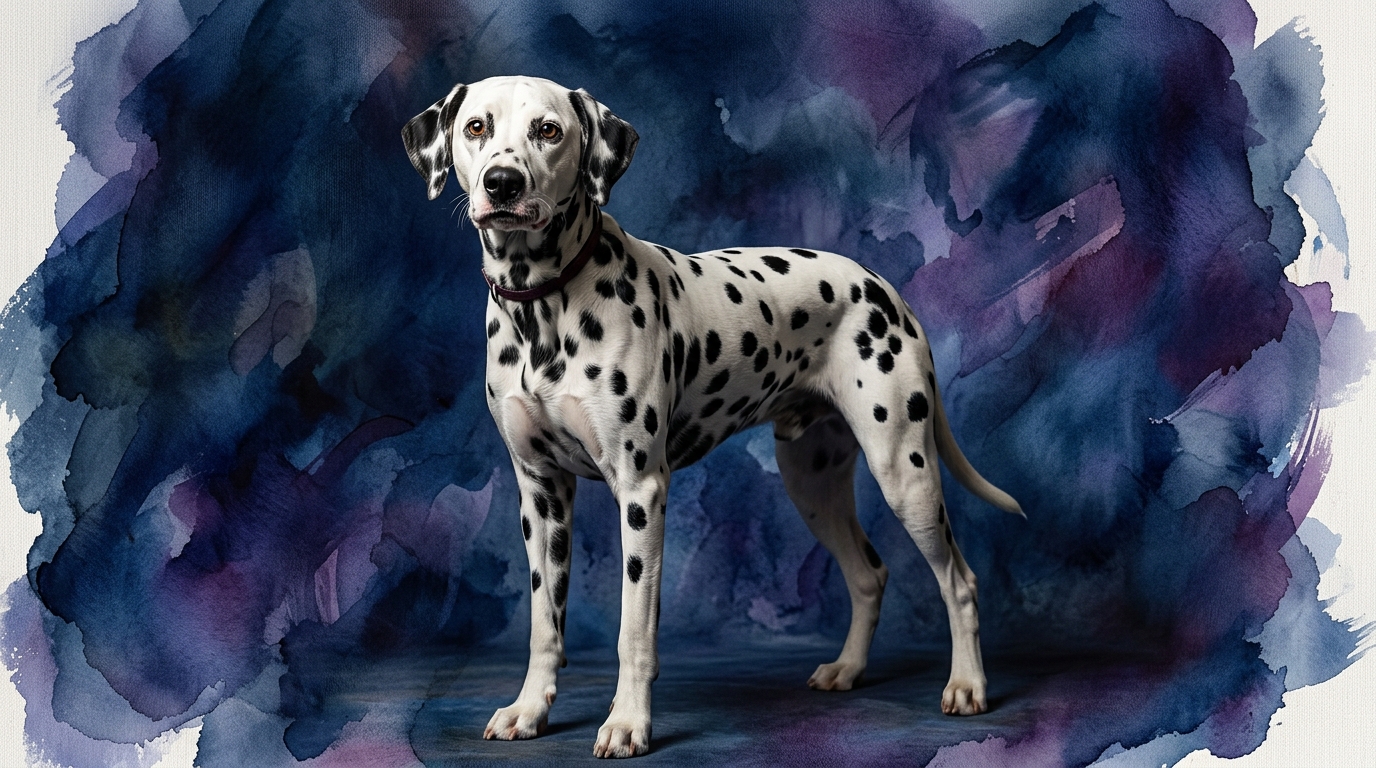

A Side-by-Side Look at Their IQ Profiles
The Cosmic Pet Pet IQ Lab employs a multi-dimensional approach to assess canine cognition, moving beyond simplistic 'smart' labels to reveal specific strengths. For the Dalmatian, a breed historically associated with coaches and firehouses, our data shows a consistent profile of engagement and responsiveness. They score 3/5 in problem-solving, indicating a capacity for navigating moderately complex challenges, and 3/5 in training speed, suggesting they learn new commands at a steady pace. Their social intelligence stands at an impressive 4/5, reflecting a strong ability to interpret human cues and adapt to social situations. Instinctive drive is also high at 4/5, pointing to a robust internal motivation for activity and purpose, complemented by a 4/5 memory for retaining learned behaviors and experiences. The Dalmatian is recognized by Coren as rank #39, placing them in a respectable tier for working and obedience intelligence.
In contrast, the Rat Terrier, a breed honed for vermin control, presents a profile emphasizing practical, independent application of their faculties. They register 3/5 in problem-solving, capable of figuring out solutions to environmental puzzles, and a similar 3/5 in training speed, absorbing lessons effectively with consistent effort. Their social intelligence is rated at 3/5, meaning they are generally receptive to human interaction but might exhibit a more independent streak compared to breeds with higher scores. An instinctive drive of 3/5 aligns with their heritage, demonstrating a persistent, focused energy, particularly when engaged in tasks they find stimulating. Their memory also sits at 3/5, allowing them to recall routines and learned behaviors sufficiently for their roles. The Rat Terrier, while not included in Coren's traditional ranking, showcases a distinct set of cognitive tools tailored to their historical purpose.
Where the Dalmatian Shines Cognitively
The Dalmatian's cognitive profile reveals clear advantages in areas crucial for complex companionship and partnership. Their superior social intelligence, rated at 4/5 compared to the Rat Terrier's 3/5, means Dalmatians are often more attuned to human emotional states and social dynamics. This allows them to pick up on subtle cues, respond with greater empathy, and integrate seamlessly into diverse family structures. They are more likely to seek out and thrive on reciprocal interaction, making them highly responsive to praise and social reinforcement during learning.
Furthermore, the Dalmatian's 4/5 score in memory provides a tangible edge. This robust recall capacity enables them to retain a larger repertoire of commands, remember specific boundaries, and learn intricate routines more readily over time. When combined with their 4/5 instinctive drive, this memory allows them to channel their energy into purposeful activities, such as advanced obedience, agility, or even complex service tasks, remembering multi-step sequences with greater accuracy. This combination of social acumen, strong memory, and inherent drive positions the Dalmatian to excel in roles requiring sustained, nuanced engagement with their human companions.
The Rat Terrier's Unique Cognitive Strengths
While the Rat Terrier's raw scores might not numerically surpass the Dalmatian's in any dimension, their cognitive makeup represents a distinct and highly effective set of strengths, particularly for their historical role. Their problem-solving at 3/5, coupled with a 3/5 instinctive drive, speaks to a focused, tenacious approach to challenges. Unlike the Dalmatian, whose drive often manifests in social partnership, the Rat Terrier's drive is inherently independent and task-oriented, particularly when it comes to pursuit and investigation. This means they can be incredibly persistent in solving practical, physical puzzles, like figuring out how to access a hidden toy or navigate a complex scent trail, even without direct human encouragement.
The Rat Terrier's cognitive profile, though not Coren-ranked, reflects a specialized intelligence for independence and resourcefulness. Their 3/5 social intelligence, while lower than a Dalmatian's, doesn't imply a lack of affection but rather a greater capacity for self-reliance. They are perfectly capable of enjoying companionship but are less reliant on constant human direction to initiate activity or solve problems. This makes them exceptional at tasks requiring independent thought and sustained focus, such as barn hunt or earthdog trials, where their natural drive and problem-solving skills are applied with singular determination.
Training Dynamics: Responsiveness vs. Independence
When considering ease of training, both breeds score 3/5 in training speed, suggesting they absorb new concepts at a moderate pace. However, their differing social intelligence and instinctive drives create distinct training experiences. The Dalmatian, with a 4/5 social intelligence, often exhibits a strong desire to please and a readiness to engage with their trainer, making them highly responsive to positive reinforcement and social praise. They are more likely to maintain focus on the trainer and adapt their behavior based on subtle human cues, which can make the training process feel more collaborative and fluid, particularly for traditional obedience or performance sports requiring precise coordination.
The Rat Terrier, conversely, while capable of learning quickly, brings a more independent spirit to training sessions, influenced by their 3/5 social intelligence and 3/5 instinctive drive, which is often directed towards specific tasks rather than purely social interaction. Their terrier nature can mean they are highly motivated by prey drive or specific rewards, but might also be more prone to independent thought or distraction if a more compelling environmental stimulus arises. Training a Rat Terrier often requires more creativity in motivation, shorter, focused sessions, and a deep understanding of their innate drives to channel their energy effectively. They may challenge boundaries more often, requiring consistent, firm, and fair handling to ensure lessons stick.
Matching Breeds to Lifestyles: Active Engagement
Neither the Dalmatian nor the Rat Terrier are suited for truly relaxed owners in the sense of minimal activity; both possess inherent drives that necessitate regular engagement. The Dalmatian, with an instinctive drive of 4/5, demands significant physical exercise and mental stimulation. Their historical role as carriage dogs means they possess immense stamina and thrive on long runs, hikes, and structured activities like agility or canicross. An owner who can provide daily, vigorous exercise and consistent mental challenges will find a Dalmatian to be a joyful and engaged companion. Their higher social intelligence also means they generally prefer to be active *with* their people, making them excellent partners for active individuals or families.
The Rat Terrier, with a 3/5 instinctive drive, still requires substantial activity, but perhaps with a different emphasis. Their energy is often directed towards focused tasks, such as sniffing, digging, and chasing. While they enjoy walks and playtime, they truly thrive when given opportunities to engage their minds in problem-solving activities related to their prey drive, such as scent work, flirt pole play, or exploring varied environments. An owner who enjoys providing structured 'work' for their dog, even if it's in the backyard or through puzzle toys, will find the Rat Terrier a delightful match. They can adapt to active owners who enjoy focused activities, but might also suit someone who prefers shorter bursts of intense activity interspersed with mental challenges, rather than sustained, long-distance endurance.
The Verdict: When to Choose Each Breed
Choosing between a Dalmatian and a Rat Terrier hinges on the specific blend of companionship and activity you seek, along with your capacity to meet their distinct cognitive needs. Both are engaging, but their methods of engagement differ significantly.
The Dalmatian is an ideal choice for owners seeking a highly social, physically enduring companion who thrives on partnership and shared activities, excelling in environments where their robust memory and social intelligence can be fully utilized in complex training or active family life. The Rat Terrier, conversely, is best suited for owners who appreciate an independent, tenacious spirit, and are prepared to engage a dog whose cognitive strengths lie in focused, task-oriented problem-solving and persistent exploration, often with a clear purpose in mind.
The Verdict
Choose the Dalmatian if you desire a highly social, responsive partner for extensive physical activities and complex training, valuing their strong memory and empathetic engagement.
Opt for the Rat Terrier if you appreciate an independent, tenacious companion who excels at focused tasks and problem-solving, thriving with engaging mental challenges over constant social direction.
🧠 Find Your Pet's IQ Score
Our Pet IQ Lab assessment covers 25+ tests across 5 cognitive dimensions — personalized to your breed.
Take the Full IQ Test →Frequently Asked Questions
Are Dalmatians genuinely hard to train, despite their Coren ranking?
While Dalmatians have a respectable Coren rank and 3/5 training speed, their high energy and instinctive drive (4/5) mean they require consistent, stimulating training from an early age. Their responsiveness to social cues makes them eager learners, but without proper guidance, their stamina can manifest as boisterousness rather than focused effort.
What kind of mental stimulation do Rat Terriers need to thrive?
Rat Terriers, with their 3/5 problem-solving and instinctive drive, thrive on activities that engage their natural hunting and investigative instincts. Scent work, puzzle toys, earthdog trials, or even just regular opportunities to explore new, safe environments are excellent ways to provide the mental stimulation they crave, keeping them focused and content.
How do their social intelligence scores impact household dynamics?
A Dalmatian's 4/5 social intelligence often means they are highly attuned to family members, seeking interaction and being more sensitive to household moods, making them very integrated family members. A Rat Terrier's 3/5 social intelligence suggests they are affectionate but might be more independent, content to observe or pursue their own interests sometimes, without the same constant need for social engagement as a Dalmatian.