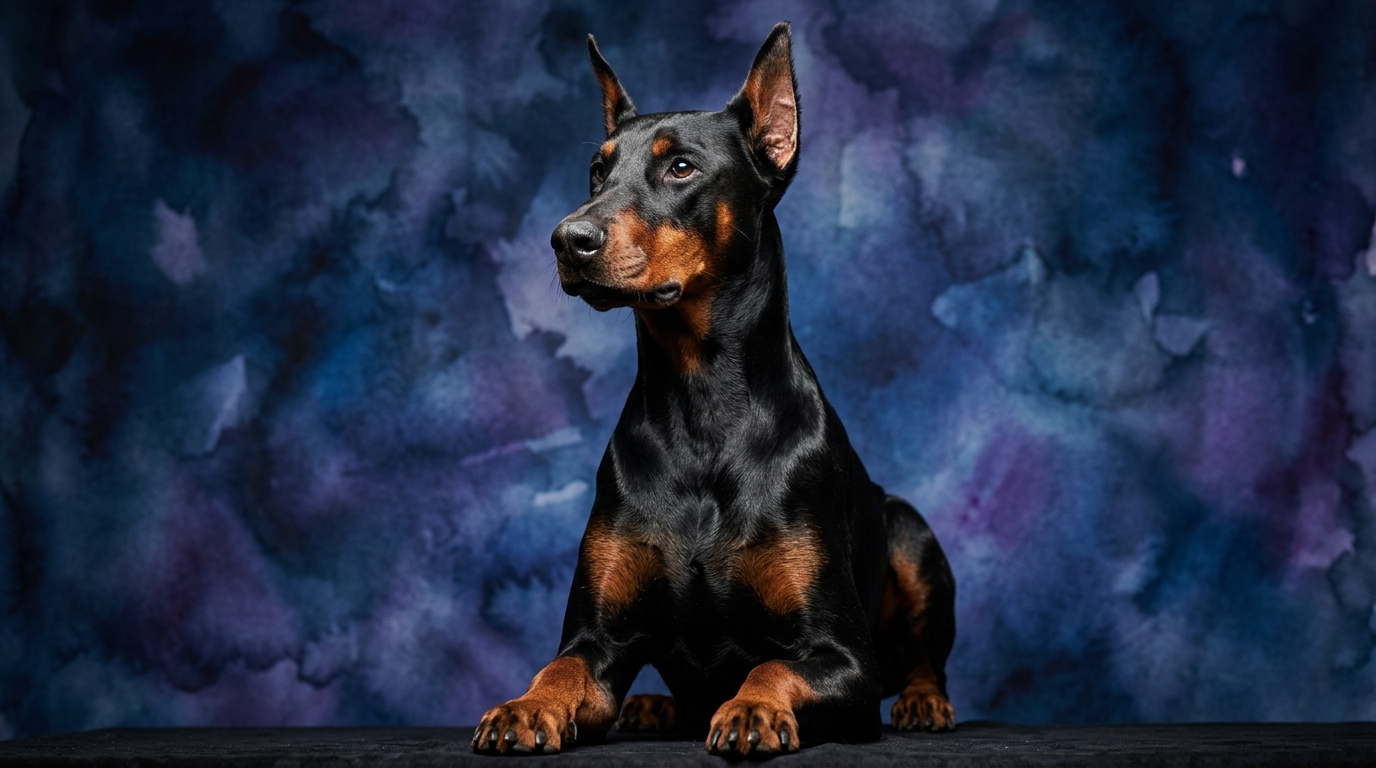

Side-by-Side Cognitive Profiles: A Study in Contrasts
The Cosmic Pet Pet IQ Lab employs a five-dimensional framework to assess canine intelligence, moving beyond simplistic notions of 'smart' to reveal the nuanced cognitive strengths of each breed. Comparing the Doberman Pinscher, a working dog, with the French Bulldog, a companion breed, provides a stark illustration of how evolutionary purpose shapes intellect.
The Doberman Pinscher, ranked #5 by Coren for working intelligence, presents a profile dominated by high scores: Problem Solving 5/5, Training Speed 5/5, Instinctive Drive 5/5, and Memory 5/5, with Social Intelligence at a strong 4/5. This indicates a breed with exceptional analytical capacity, rapid learning, a profound desire for purposeful engagement, and a robust ability to retain complex information and apply it strategically.
In contrast, the French Bulldog, not Coren-ranked, shows a distinct cognitive emphasis: Problem Solving 3/5, Training Speed 3/5, Instinctive Drive 2/5, and Memory 3/5, but a standout Social Intelligence of 5/5. Their scores suggest a less driven approach to abstract tasks or independent problem-solving, a more deliberate learning pace, and a primary focus on understanding and responding to human emotional and social cues, rather than external environmental challenges.
Doberman Pinscher: Precision, Purpose, and Potency
The Doberman Pinscher's cognitive prowess is evident in their top-tier scores for Problem Solving (5/5) and Memory (5/5). This combination allows them to not only grasp complex concepts swiftly but also to retain multi-step commands and intricate routines over extended periods, making them exceptionally adept at tasks requiring strategic thinking and recall. Their Coren rank of #5 underscores their consistent ability to understand new commands with minimal repetition, demonstrating an impressive capacity for abstract learning and generalization.
Complementing this mental acuity are their perfect scores in Training Speed (5/5) and Instinctive Drive (5/5). Their rapid learning is paired with a profound, innate desire to engage and perform, often manifesting as a strong work ethic and a compelling need for a 'job' or purpose. This drive isn't merely for physical activity but extends to mental engagement, compelling them to seek meaning and structure in their interactions and tasks, making them highly responsive to directive guidance and structured challenges.
French Bulldog: The Heart of the Matter
For the French Bulldog, Social Intelligence (5/5) stands as their defining cognitive strength, allowing them to excel as deeply empathetic and intuitive companions. This involves an acute awareness of human emotions, subtle body language, and a profound ability to form deep, reciprocal bonds, making them exceptional at providing emotional support and comfort. Their problem-solving capacity (3/5) often manifests in socially strategic ways, such as employing charming behaviors or vocalizations to elicit attention or comfort, rather than engaging in complex environmental manipulation or abstract puzzle-solving.
Their lower scores in Problem Solving (3/5), Training Speed (3/5), Instinctive Drive (2/5), and Memory (3/5) indicate a cognitive profile less oriented towards independent task completion or self-initiated exploration. French Bulldogs generally prefer to be guided by their human companions, finding contentment in proximity and shared experiences rather than intense, goal-oriented activities. Their learning benefits greatly from positive reinforcement rooted in social connection, making training more about cooperative interaction and shared enjoyment than rigorous mastery of complex skills.
Training Trajectories: Understanding Learning Dynamics
When it comes to training, the Doberman Pinscher's combined 5/5 scores in Training Speed, Problem Solving, and Memory translate into a dog that picks up new commands and routines with remarkable efficiency. They don't just memorize actions; they often understand the 'why' behind them, allowing for quicker generalization and application of learned skills in varied environments. For a Doberman, consistency in training is paramount, as once a concept clicks, it's deeply ingrained, making them highly reliable in complex sequences and obedience trials.
Conversely, the French Bulldog's 3/5 Training Speed means patience is a vital ingredient for their education. While certainly capable of learning, they require more repetition and a more measured pace compared to their Doberman counterparts. Their 5/5 Social Intelligence can be a powerful asset here; they respond best to training that feels like a cooperative, positive interaction, with high-value, socially reinforcing rewards. Making training a fun, bonding experience yields far better results than strict, repetitive drills for these charming companions.
Cognitive Needs: Active Engagement vs. Affectionate Presence
The Doberman Pinscher's high scores across problem-solving, drive, and memory necessitate consistent and challenging mental stimulation. Owners must provide ample outlets for their strategic minds through advanced obedience, puzzle toys, dog sports like agility or Schutzhund, or even focused 'jobs' around the home. Without such engagement, their sharp minds and powerful instinctive drive can lead to boredom and the development of self-directed, potentially undesirable, behaviors as they seek to fulfill their need for purpose.
In contrast, the French Bulldog, with a lower instinctive drive (2/5) and moderate problem-solving (3/5), finds its primary cognitive fulfillment in social interaction and comfort. Their exceptional social intelligence means they thrive on companionship, gentle play, and observing family life, finding deep contentment in emotional connection rather than complex tasks or strenuous physical exertion. Their cognitive needs are largely met through being an integral, cherished part of their human family, receiving affection and gentle attention.
Lifestyle Harmony: Matching Mindset to Home
The Doberman Pinscher is ideally suited for active individuals or families who are experienced with dog ownership and can commit to providing consistent mental and physical challenges. Their cognitive profile makes them excellent candidates for roles requiring focus and dedication, such as service work, competitive dog sports, or as a vigilant family guardian, thriving when given a clear purpose, structured routine, and consistent engagement.
The French Bulldog is best suited for relaxed owners or those with less demanding lifestyles. Their strong social intelligence and lower energy requirements mean they excel as devoted companions who enjoy quiet evenings, short, leisurely strolls, and ample cuddle time. They fit seamlessly into urban environments or homes where their primary role is to be a loving, attentive, and charming presence, content with a less active but deeply connected life.
The Verdict
Choose a Doberman Pinscher if you are an experienced owner seeking a highly trainable, driven, and mentally agile companion for structured activities, advanced training, or a protective role. They thrive with consistent engagement and a clear sense of purpose, reflecting their powerful cognitive abilities.
Opt for a French Bulldog if your lifestyle is more relaxed and you prioritize a deeply affectionate, socially intuitive companion who finds joy in close human connection and gentle interaction. Their strength lies in their ability to integrate seamlessly into family life, offering comfort and charm with a lower demand for complex tasks.
🧠 Find Your Pet's IQ Score
Our Pet IQ Lab assessment covers 25+ tests across 5 cognitive dimensions — personalized to your breed.
Take the Full IQ Test →Frequently Asked Questions
Do Doberman Pinschers get bored easily?
Yes, Doberman Pinschers, with their 5/5 problem-solving and instinctive drive, require significant mental stimulation to prevent boredom. Without engaging tasks or consistent training, their sharp minds can lead to destructive behaviors as they seek their own challenges.
Are French Bulldogs difficult to train?
French Bulldogs are not inherently difficult, but their 3/5 training speed means they learn at a more measured pace compared to breeds with higher scores. Success comes with patience, consistency, and leveraging their 5/5 social intelligence through positive, relationship-based reinforcement rather than strict drills.
Which breed is better with children?
Both breeds can be good with children with proper socialization and training, but their approaches differ. The French Bulldog's 5/5 social intelligence often makes them inherently gentle and tolerant companions, while the Doberman Pinscher's 4/5 social intelligence means they can be protective and devoted, requiring careful supervision to ensure appropriate interactions given their powerful build.