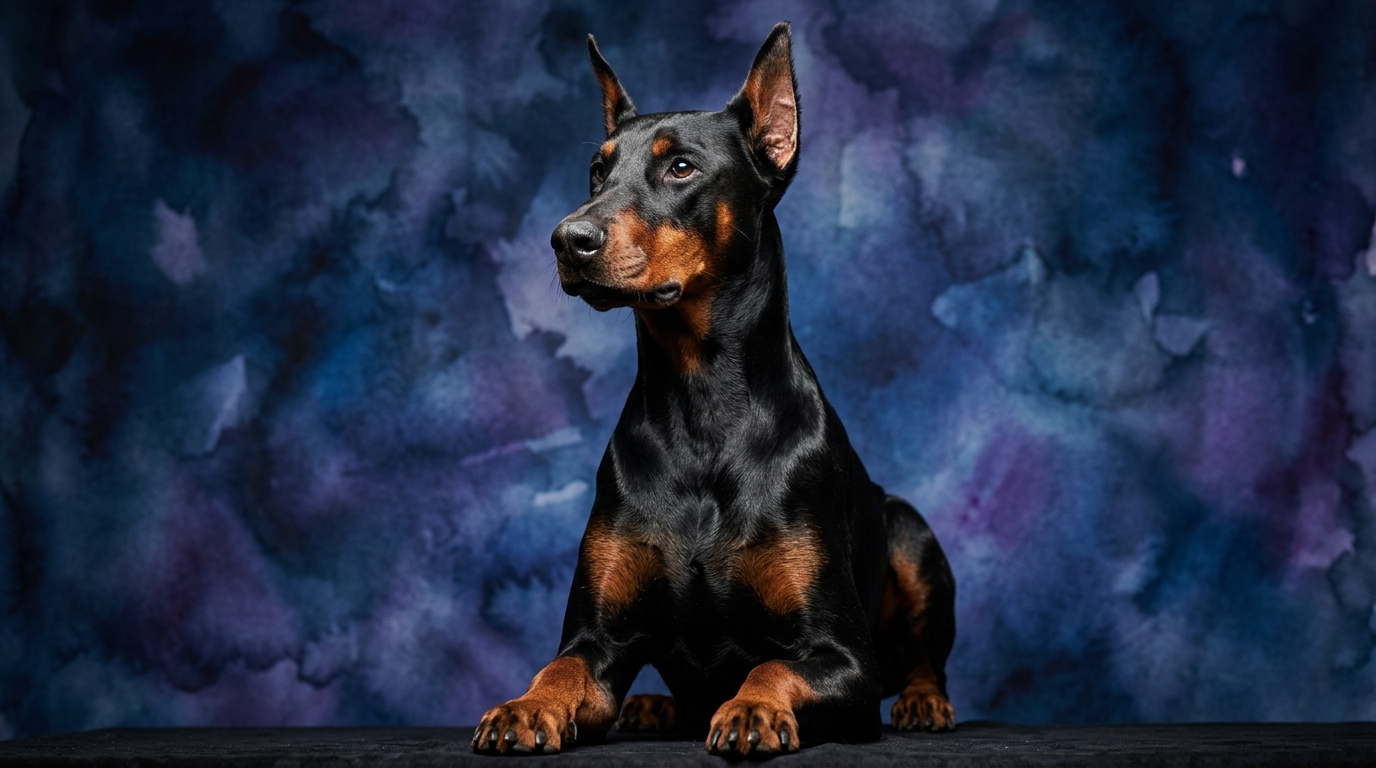

Side-by-Side IQ Profile: Doberman Pinscher vs. Manchester Terrier
The Cosmic Pet Pet IQ Lab assesses canine intelligence across five key dimensions, revealing a clear distinction between these two breeds.
Doberman Pinscher: This breed exhibits exceptional cognitive prowess: Problem Solving (5/5) means they quickly strategize and adapt to new situations. Training Speed (5/5) allows them to absorb commands with remarkable swiftness, often in few repetitions. Their Social Intelligence (4/5) enables deep interpretation of human cues and strong family bonds. An Instinctive Drive (5/5) for protection and tasks compels purposeful engagement, while Memory (5/5) ensures outstanding recall of learned behaviors over time.
Manchester Terrier: The Manchester Terrier presents a balanced, practical intelligence. Problem Solving (3/5) involves a persistent, often trial-and-error approach to challenges. Training Speed (3/5) indicates they learn consistently but require more repetition and patience. Social Intelligence (3/5) means they understand basic cues and form attachments, favoring straightforward interactions. Their Instinctive Drive (3/5) is focused on chasing and exploration, while Memory (3/5) adequately retains daily routines and basic commands.
Where the Doberman Pinscher Excels Cognitively
The Doberman Pinscher's cognitive architecture provides distinct advantages, rooted in their working heritage. Their 5/5 Problem Solving allows them to quickly dissect complex scenarios and devise effective solutions, far beyond simple persistence. Paired with a 5/5 Training Speed, they absorb new commands and intricate sequences with astonishing alacrity, often mastering concepts in a single session. This efficiency makes them prime candidates for advanced obedience, protection work, or competitive sports where rapid skill acquisition is crucial. Furthermore, their 5/5 Memory ensures learned behaviors are retained with remarkable fidelity over long periods, minimizing the need for constant reteaching. Their profound 5/5 Instinctive Drive provides an intrinsic motivation for purposeful engagement, channeling their mental acuity into productive tasks. This combination of strategic thinking, rapid learning, tenacious memory, and inherent drive positions the Doberman as a cognitive powerhouse, excelling in roles demanding high mental engagement and adaptability.
Where the Manchester Terrier's Cognitive Profile Shines
While the Doberman excels in speed and depth, the Manchester Terrier's balanced 3/5 scores offer a different kind of cognitive strength, suited for specific lifestyles. Their 3/5 Problem Solving translates to a focused, persistent approach, often relying on established patterns rather than complex new strategies, making them reliable within routines and less prone to overthinking. The 3/5 Social Intelligence allows for strong bonds and understanding of basic cues without demanding intricate emotional nuances, leading to a more straightforward, yet loyal, companionship. Their 3/5 Instinctive Drive, though not as broad as a Doberman's, is acutely honed for specific terrier tasks like vigilance and prey pursuit, ensuring they remain alert and engaged with their immediate surroundings without requiring constant, high-stakes mental challenges. For owners valuing a competent, dependable companion with a straightforward disposition, the Manchester Terrier's consistent cognitive profile offers a less demanding intellectual partnership.
Training Aptitude: Doberman Pinscher vs. Manchester Terrier
The Doberman Pinscher offers a notably smoother training experience due to its superior cognitive assets. Their 5/5 Training Speed means they grasp new commands and complex sequences with remarkable alacrity, often in just a few repetitions. This rapid learning, coupled with a 5/5 Memory, ensures long-term retention of behaviors and minimizes reteaching. Their 5/5 Problem Solving further aids this, allowing them to generalize skills to new contexts and adapt to evolving commands, making advanced training highly efficient. Conversely, the Manchester Terrier, with 3/5 in Training Speed and Memory, requires more patience and consistency. They learn steadily but demand greater repetition and a slower progression through new concepts. Their 3/5 Problem Solving suggests reliance on trial and error or established routines. Moreover, while Dobermans are intrinsically motivated by their 5/5 instinctive drive for purposeful work, the Manchester Terrier's 3/5 drive might manifest as an independent streak, easily distracted by scents or prey, requiring more effort to maintain focus during training.
Lifestyle Match: Active vs. Relaxed Owners
The Doberman Pinscher, with its exceptional 5/5 Instinctive Drive and 5/5 Problem Solving, is ideally suited for active owners providing significant mental and physical engagement. These dogs thrive with a 'job', be it competitive sports, protection work, or extensive daily training that challenges their sharp minds. Without adequate stimulation, their potent cognitive abilities can lead to boredom and destructive behaviors; they are not content as mere sedentary companions. The Manchester Terrier, with its moderate 3/5 scores, offers a more adaptable profile, suitable for a broader range of owners, including those who are active but less intensely so. While they benefit from regular walks, play, and basic training, their needs are typically less demanding than a Doberman's. Their 3/5 instinctive drive means they enjoy chasing and exploring but don't require constant, high-level mental challenges. They can transition more easily between activity and relaxed companionship, fitting well with families appreciating a capable but less cognitively demanding partner.
The Verdict
Choose a Doberman Pinscher if you are an experienced, active owner eager to channel exceptional problem-solving, rapid learning, and profound instinctive drive into advanced training, sports, or a working role.
Opt for a Manchester Terrier if you appreciate a competent, adaptable companion with a straightforward cognitive style, suitable for consistent moderate activity and a more predictable, less mentally demanding partnership.
🧠 Find Your Pet's IQ Score
Our Pet IQ Lab assessment covers 25+ tests across 5 cognitive dimensions — personalized to your breed.
Take the Full IQ Test →Frequently Asked Questions
Does the Doberman Pinscher's high social intelligence mean they are more emotional?
A Doberman's 4/5 social intelligence indicates a strong capacity to interpret complex human cues and form deep bonds, making them highly attuned to family dynamics and sensitive to their owners' emotions, rather than simply being 'emotional.' This allows for nuanced communication and a strong partnership.
Can a Manchester Terrier excel in dog sports despite lower IQ scores?
Yes, a Manchester Terrier can absolutely excel in dog sports, particularly those that align with their terrier nature like agility, earthdog trials, or obedience, though they may require more consistent repetition and patience in training due to their 3/5 training speed and memory. Their focused drive and physical agility are assets.
How does the difference in instinctive drive impact daily life for these breeds?
The Doberman's 5/5 instinctive drive means they inherently seek purposeful engagement and guard their family, requiring structured activities to satisfy this deep-seated need; without it, they can become restless or develop their own 'jobs.' The Manchester Terrier's 3/5 drive focuses more on chasing and exploration, making them alert to small movements and scents, but typically less intensely driven for broad working tasks.