
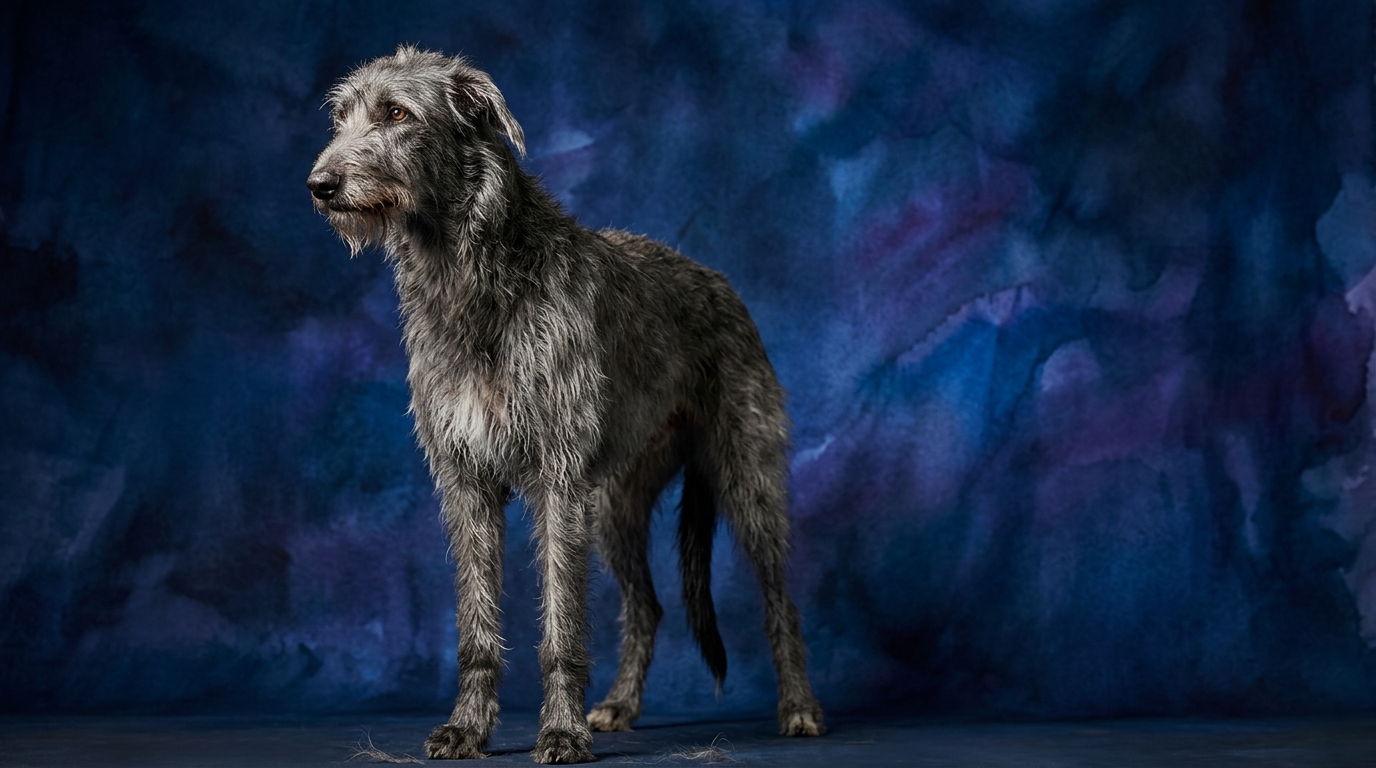
Side-by-Side IQ Profile: English Setter vs. Scottish Deerhound
The Cosmic Pet Pet IQ Lab employs a five-dimensional framework to assess canine intelligence, providing a nuanced understanding beyond simple obedience. For the English Setter, a Coren rank of #37 places it among breeds demonstrating notable working and obedience intelligence, while the Scottish Deerhound, as a sighthound, is not typically evaluated by this metric due to its specialized, independent working style. Let's explore their individual scores.
The English Setter's cognitive profile is marked by a Problem Solving score of 4/5, indicating a strong capacity for independent thought and strategic thinking when faced with novel situations. Their Training Speed also stands at 4/5, signifying a quick grasp of new commands and concepts, often requiring fewer repetitions to achieve proficiency. In Social Intelligence, the English Setter scores 3/5, suggesting a solid ability to interpret human cues and form cooperative bonds, albeit perhaps with a degree of independence. Their Instinctive Drive is rated 3/5, reflecting their inherent desire to hunt and retrieve, a purposeful motivation. Finally, Memory for the English Setter is an impressive 4/5, ensuring that learned behaviors and experiences are retained effectively over time.
In contrast, the Scottish Deerhound presents a consistently balanced profile, scoring 3/5 across all five dimensions. Their Problem Solving at 3/5 suggests a practical intelligence geared towards making swift, independent decisions in the field, rather than complex, multi-step tasks. A Training Speed of 3/5 indicates they are capable learners but may require more patience and tailored approaches compared to breeds with higher scores, often preferring to learn on their own terms. Their Social Intelligence also registers at 3/5, denoting an ability to form deep, albeit often reserved, bonds with their chosen people and understand social dynamics. The Scottish Deerhound's Instinctive Drive, at 3/5, is strongly channeled towards sight-based pursuit, a powerful intrinsic motivation that defines their being. Lastly, their Memory score of 3/5 suggests a functional retention of information, sufficient for their needs but perhaps not as expansive as breeds developed for intricate, sequential tasks.
Where the English Setter Wins Cognitively
The English Setter’s cognitive profile shines brightly in areas demanding proactive thought, rapid learning, and robust retention. With a Problem Solving score of 4/5, they exhibit a superior aptitude for independent reasoning, often assessing new situations and devising strategies rather than waiting for human intervention or trial-and-error. This translates into a dog that can more readily adapt to changing environments or novel commands, showing initiative when faced with an unfamiliar challenge. Their Training Speed of 4/5 further reinforces this advantage; English Setters typically grasp new concepts and commands with fewer repetitions, processing information efficiently and forming associations quickly. This cognitive agility makes them particularly responsive to nuanced training cues and capable of mastering intricate sequences. Furthermore, their Memory score of 4/5 means they retain learned behaviors and lessons for extended periods, reducing the need for constant refreshers and building a solid foundation of reliable responses over time. These combined strengths make the Setter particularly adept at complex obedience, field work, and dog sports that require both physical and mental dexterity.
Where the Scottish Deerhound Excels Cognitively
While the Scottish Deerhound’s individual scores of 3/5 across all five dimensions might suggest a less pronounced cognitive advantage in specific areas compared to the Setter, their strength lies in a balanced, self-reliant intelligence optimized for their historical role. Their Problem Solving at 3/5, though lower than the Setter’s, is perfectly suited for independent pursuit, requiring quick, on-the-spot decisions in open terrain to track and capture prey, rather than complex human-directed tasks. This isn't a deficit but a different kind of cognitive efficiency, prioritizing immediate environmental assessment and action. Similarly, their Instinctive Drive at 3/5, matching the Setter, points to a robust internal motivation, primarily focused on sight-based detection and chase, which is a highly specialized form of intelligence honed over centuries. Their equal Social Intelligence score of 3/5 suggests a comparable capacity for forming bonds and understanding social cues, albeit often expressed with a quiet dignity rather than a boisterous eagerness. The Deerhound's cognitive success is not about outperforming in human-centric tasks, but excelling in their inherent, ancient purpose, showcasing a practical, self-contained intellect that prioritizes independence and keen sensory awareness.
Trainability: English Setter vs. Scottish Deerhound
Based on their respective IQ profiles, the English Setter generally presents as the easier breed to train. Their 4/5 score in Training Speed signifies a quicker uptake of new commands and concepts, requiring fewer repetitions to solidify learning. This is complemented by their superior Problem Solving (4/5), allowing them to grasp the 'why' behind a task more readily and apply learned principles to new variations. Their strong Memory (4/5) ensures that once a behavior is learned, it is retained effectively, leading to consistent performance over time. English Setters are often eager to please and find satisfaction in cooperative tasks, making them highly responsive to positive reinforcement methods. They thrive on engagement and typically enjoy the process of learning new things with their human companions, exhibiting a natural biddability that streamlines training efforts.
In contrast, the Scottish Deerhound, with 3/5 in Training Speed, Problem Solving, and Memory, typically requires a more patient and nuanced training approach. While capable of learning, they may take longer to process and internalize new information, and their independent nature means they might not always see the immediate utility in human-directed tasks, preferring to follow their own instincts. Their social intelligence at 3/5 means they form deep bonds, but their compliance is often born of respect and affection rather than an inherent desire to please at all costs. Training a Deerhound often involves leveraging their innate drives and making tasks intrinsically rewarding, rather than relying solely on eager compliance. Their training success hinges on building a strong relationship, understanding their sighthound motivations, and finding methods that appeal to their quiet dignity and independent spirit, rather than assuming they will be as overtly biddable as a Setter.
Lifestyle Match: Active vs. Relaxed Owners
For owners seeking an active, engaged canine companion, the English Setter is often an excellent match. Their origin as bird dogs means they possess significant stamina and a love for vigorous outdoor activity. Beyond physical exertion, their higher scores in Problem Solving, Training Speed, and Memory indicate a need for consistent mental engagement. They thrive on activities like scent work, obedience trials, agility, or even complex trick training, which satisfy their intelligent and cooperative nature. An active owner who enjoys daily long walks, runs, or structured training sessions will find a Setter to be an enthusiastic partner, eager to learn and participate in a wide array of shared endeavors. Their boundless energy and desire to work demand an owner who can consistently provide both physical outlets and intellectual challenges.
The Scottish Deerhound, while appearing stately and calm indoors, possesses the deep-seated need for intense, albeit brief, bursts of speed and freedom characteristic of a sighthound. They are not built for endless endurance like a Setter, but require opportunities for full-speed gallops in a secure, expansive area to satisfy their powerful instinctive drive for the chase. After their exhilarating sprints, Deerhounds are typically content to be incredibly relaxed and quiet companions indoors, often described as 'couch potatoes.' Therefore, they can suit owners who appreciate quiet companionship at home but are committed to providing daily opportunities for safe, off-leash running, away from traffic or other hazards. They are less about sustained, high-impact activities and more about providing specific, high-intensity outlets for their powerful sighthound instincts, making them suitable for owners who can offer this unique blend of activity and tranquility, understanding their need for both explosive exercise and profound calm.
The Verdict
Choose an English Setter if you desire a highly trainable, cooperative companion for an active lifestyle, thriving on consistent mental stimulation and shared activities like dog sports or field work.
Choose a Scottish Deerhound if you appreciate a dignified, independent companion who requires specific bursts of intense running but otherwise offers a calm, quiet presence, and you value a dog with a unique, self-reliant intelligence.
🧠 Find Your Pet's IQ Score
Our Pet IQ Lab assessment covers 25+ tests across 5 cognitive dimensions — personalized to your breed.
Take the Full IQ Test →Frequently Asked Questions
Are English Setters good family dogs?
Yes, English Setters typically possess a gentle and friendly disposition, making them wonderful family companions. Their social intelligence, rated at 3/5, combined with their cooperative nature, allows them to bond well with children and other pets, though early socialization is always beneficial for harmonious living.
Do Scottish Deerhounds require a lot of exercise?
While Scottish Deerhounds are famously relaxed indoors, they do require significant bursts of high-speed exercise daily to satisfy their sighthound instincts. Providing a safe, fenced area for them to gallop freely for 20-30 minutes is crucial for their physical and mental well-being, complementing their otherwise calm demeanor within the home.
Is the Scottish Deerhound difficult to train due to its independence?
The Scottish Deerhound's independent nature, reflected in its 3/5 training speed, means they may not be as overtly eager to please as some other breeds, but they are certainly trainable. Success comes from patient, positive reinforcement, understanding their sighthound motivations, and making training sessions engaging and rewarding for their unique cognitive style, building a strong, respectful bond.