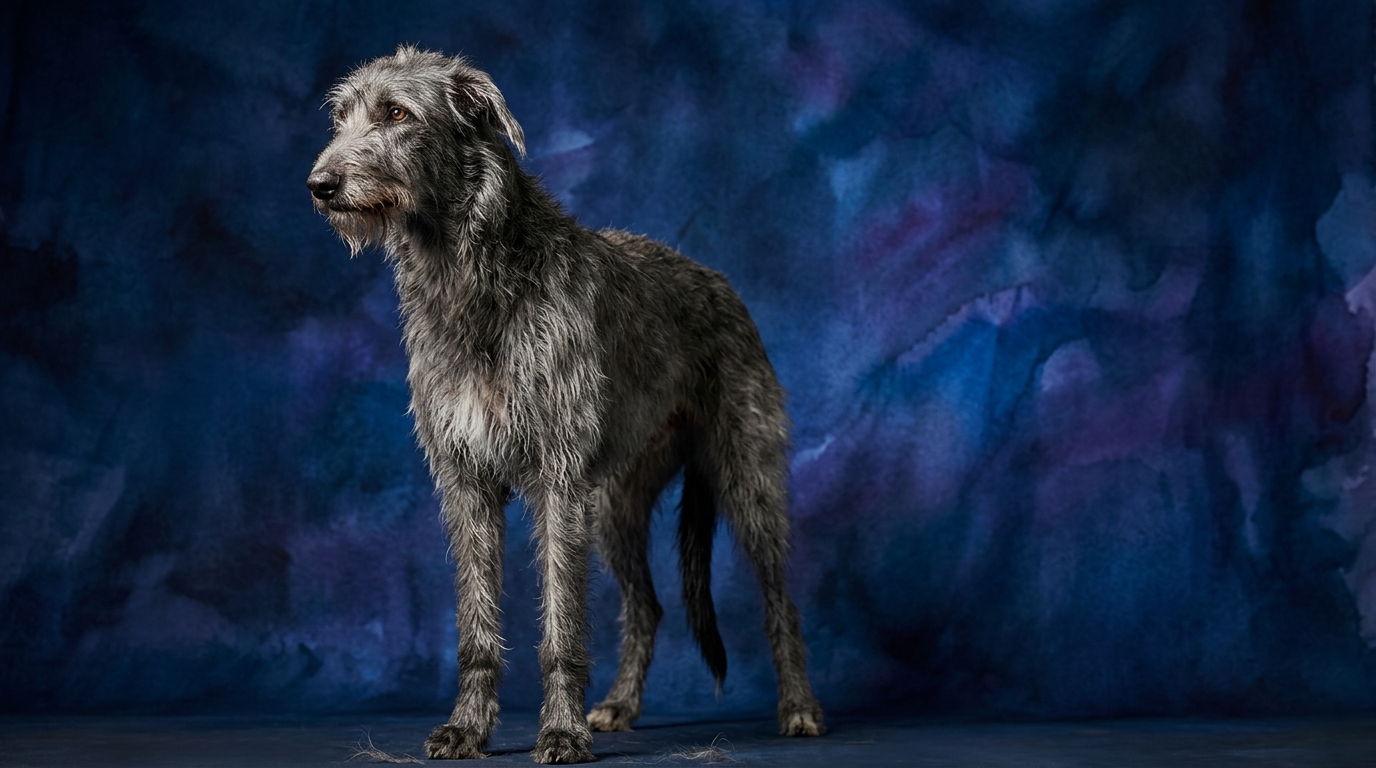
Scottish Deerhound at a glance
| IQ Rank / Score | 18/25 |
|---|---|
| Trainability | ★★★☆☆ (3/5) |
| Social Intelligence | ★★★★☆ (4/5) |
| Lifespan | 10-12 years |
| Shedding | Moderate to high |
| Exercise Needs | High (60+ min/day + training) |
| Origin | Scotland |
The Sighthound Savant: A Unique Cognitive Blueprint
The Scottish Deerhound's primary cognitive distinction lies in their independent, discerning sighthound intelligence, a specialized intellect forged over centuries of hunting large game. They excel in autonomous pursuit, utilizing unparalleled visual acuity for tracking distant movement and astute spatial navigation across vast, varied terrains. Their genius is characterized by swift, precise judgments on the move, often without direct human instruction, prioritizing efficiency and strategy in the chase.
This unique mental architecture combines keen sensory input with self-reliance, manifesting as a thoughtful intellect. They are strategically intelligent, processing environmental cues and adapting their course with a natural grace that speaks to a deep cognitive understanding of their surroundings and purpose. This independence, coupled with a deep, sensitive emotional bond, makes their intelligence a nuanced interplay of ancient instinct and modern companionship.
A Glimpse into the Deerhound's Brain: IQ Profile
The Scottish Deerhound's cognitive profile, as assessed by The Cosmic Pet's Pet IQ Lab, reveals a thoughtful and instinct-driven intellect. Their **problemSolving** scores a 3, reflecting practical, real-world solutions related to navigation and obstacle avoidance over abstract puzzles. **TrainingSpeed** is also a 3; while not slow learners, their independent spirit and sensitive nature mean they thrive with patient, positive reinforcement, learning best when tasks align with natural inclinations or deepen their bond.
Where Deerhounds truly shine is in their intrinsic motivations and social acumen. Their **socialIntelligence** is a notable 4, marked by a gentle disposition, deep empathy, and a strong, discerning bond with their family, making them highly attuned to human emotions. An impressive **instinctiveDrive** of 5 highlights their powerful sighthound heritage, with an innate urge to chase and a keen predatory focus. Finally, their **memory** earns a solid 4, crucial for recalling routes, commands learned with understanding, and the beloved faces of their companions.
Noble Pursuit: Instinctive Genius in Action
At the core of the Scottish Deerhound's intelligence is their formidable instinctive drive, a legacy of centuries spent as the ultimate deer hunters. This isn't merely a desire to chase; it's a complex cognitive process involving rapid visual processing, predictive analytics of prey movement, and strategic energy conservation. Their eyes are their primary intellectual tool, scanning horizons for the slightest flicker of movement, instantly calculating trajectories and angles to intercept.
This hunting intelligence demands immense focus and endurance. A Deerhound assesses distance and terrain with remarkable accuracy, choosing the most efficient path. Their ability to work independently, often at a significant distance from their handler, showcases deep understanding of their role and autonomous decision-making capability. This specialized intelligence means they are constantly 'thinking' in terms of visual cues, speed, and spatial relationships.
The Heart of a Giant: Social & Emotional Acuity
Beyond their hunting prowess, Scottish Deerhounds possess exceptionally high social and emotional intelligence. They are renowned for their gentle, affectionate nature and profound sensitivity to human emotions. A Deerhound forms deep, almost telepathic bonds with their family, often picking up on subtle cues, making them incredibly empathetic companions. This sensitivity means they thrive in environments of calm and positive interaction, shying away from harsh words.
Their social acumen extends to interactions with other dogs and strangers, typically displaying quiet dignity and tolerance once socialized. They are not boisterous but possess a quiet confidence, observing new situations before engaging. This thoughtful approach to social dynamics reflects a sophisticated understanding of their place within a 'pack' – canine or human – and a preference for harmony.
Training the Thoughtful Hunter: Methods & Motivations
Training a Scottish Deerhound requires understanding their unique cognitive makeup rather than an expectation of robotic obedience. While their training speed might not match a Border Collie, their ability to learn is significant when approached with patience and positivity. They respond poorly to harsh methods, becoming withdrawn due to sensitivity; positive reinforcement, reward-based training, and a trusting relationship are paramount.
Deerhounds learn best when tasks are presented as cooperative ventures or games that appeal to their natural instincts, such as lure coursing, or activities that reinforce their bond. Consistency is key, as is making training enjoyable and stimulating without being overly repetitive. Once they truly understand a command, they retain it effectively, provided they are motivated to comply through gentle encouragement and respect for their independent spirit.
Beyond the Chase: Adaptability & Problem-Solving
While not known for manipulating complex puzzle toys, the Scottish Deerhound's problem-solving intelligence manifests primarily in practical, real-world scenarios. Their historical role demanded adaptive thinking: finding the path of least resistance around obstacles, navigating unfamiliar terrain, or discerning safe routes. This translates into daily life as a dog capable of understanding routines and strategizing to obtain a favored toy.
Their excellent memory aids this adaptability. They quickly learn the layout of their home, remember walk routes, and recall behaviors that earn rewards. While they might not be the first to solve a complex brain game, their intelligence allows them to smoothly integrate into households, understanding social rules and adapting to various environments with a calm, discerning presence.
The Shadow of the Past: Historical Cognitive Demands
The Scottish Deerhound's intelligence is deeply rooted in their historical purpose, demanding sophisticated strategic hunting. A surprising fact is their primary role wasn't merely to kill the deer, but to track and run it down to exhaustion, holding it at bay for the hunter to make the final kill. This required almost telepathic understanding of distance, pace, and the deer's movements, allowing them to conserve energy and act with precise, independent judgment over vast, rugged terrains, rather than simply brute force.
This unique hunting strategy necessitated an intelligence balancing intense focus with self-preservation and nuanced tactical thinking. They had to be perceptive, discerning when to push and pace themselves, and how to maneuver a powerful animal. This historical cognitive demand shaped a breed that is thoughtful, strategic, and capable of profound independent action, making them intelligent, calculating athletes with a deep understanding of their environment and quarry.
3 At-Home Tests to Measure Your Scottish Deerhound's IQ
These tests are adapted from peer-reviewed ethology research. No equipment is needed beyond items you have at home. Run each test 5–10 times for reliable results.
The Myth: "Scottish Deerhounds are untrainable or unintelligent because they often appear aloof and lack the eager-to-please attitude of more traditional working breeds."
✅ Deerhounds are highly intelligent, but their cognitive strengths lie in independent thought, visual processing, and deep emotional connection rather than robotic obedience; they require thoughtful, positive reinforcement and thrive when tasks align with their natural instincts or foster their strong bond with a human, demonstrating intelligence in a different, profound domain.
Scottish Deerhound vs. Similar Breeds
🧠 What's Your Dog's IQ Score?
Our full Pet IQ Lab assessment includes 12+ tests across 5 cognitive dimensions, calibrated for Scottish Deerhounds specifically.
Take the Full IQ Test →Frequently Asked Questions
How smart is a Scottish Deerhound?
Our Pet IQ Lab framework scores cognition across five dimensions (max 25). The Scottish Deerhound totals 18/25 — high for a domestic dog. The full article breaks down each dimension with at-home tests.
Are Scottish Deerhounds easy to train?
Scottish Deerhounds can learn most cues, but expect to repeat lessons and keep sessions short. They score 3/5 on Training Speed in our breed profile.
Are Scottish Deerhounds good with children and other pets?
Yes — their Social Intelligence rates 4/5 in our Pet IQ Lab framework. With early socialization and supervised play, most Scottish Deerhounds integrate well into families with respectful children and other pets.
Do Scottish Deerhounds need a lot of mental stimulation?
Absolutely. With Problem Solving 3/5 and Instinctive Drive 5/5, Scottish Deerhounds need daily mental work — puzzle feeders, scent games, training sessions, or nose-work — to avoid boredom.
How much exercise does a Scottish Deerhound need?
Scottish Deerhounds need active engagement. Plan for 45-60 minutes of exercise and training per day, plus mental stimulation.
How good is a Scottish Deerhound's memory?
Scottish Deerhounds score 3/5 on memory. They remember high-value associations well; less-used cues fade without refresher sessions.
What is the typical lifespan of a Scottish Deerhound?
Typical lifespan is 10-12 years for a large dog like the Scottish Deerhound.
The Scottish Deerhound offers a fascinating study in specialized canine intelligence, blending ancient hunting sagacity with profound emotional depth. Their unique cognitive profile challenges conventional notions of 'smart,' reminding us that true brilliance comes in many forms, especially in the noble, discerning heart of a giant.