
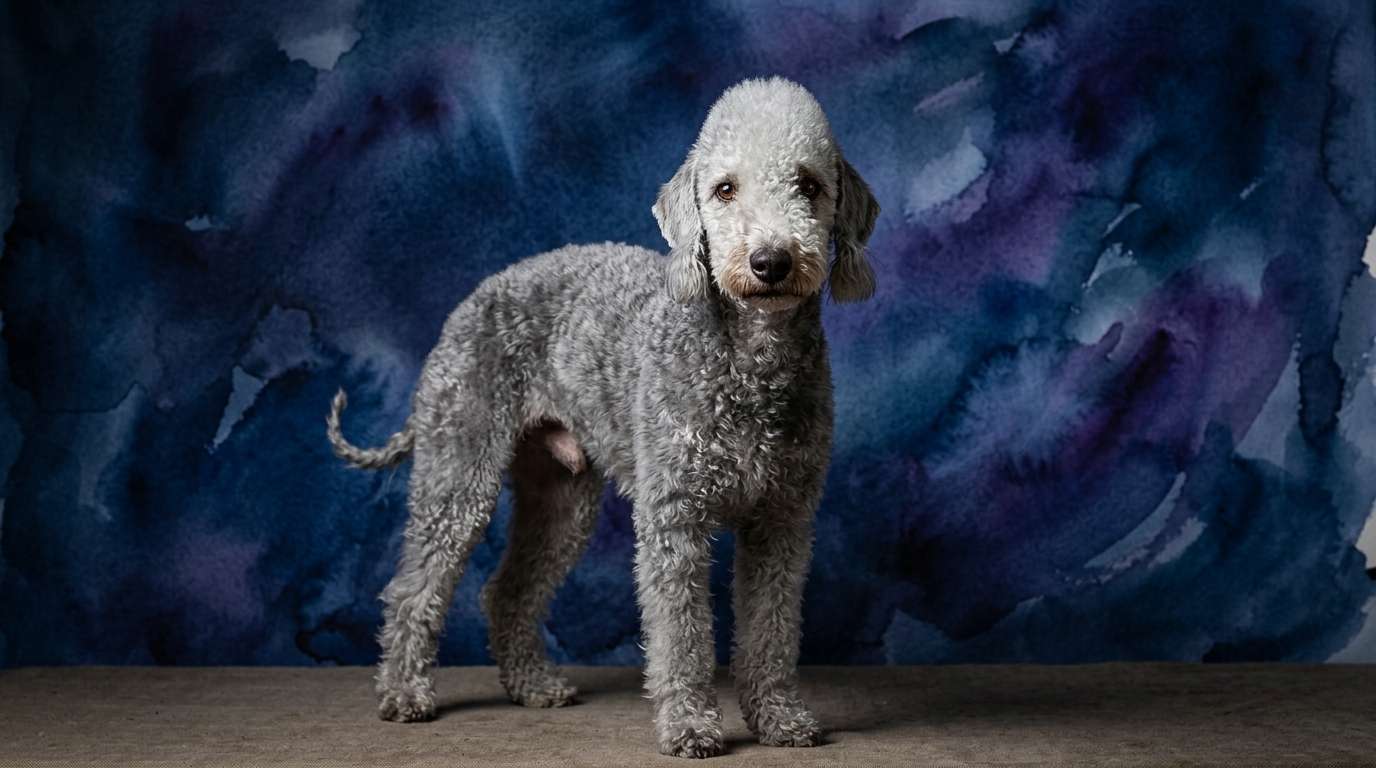
Side-by-Side Cognitive Profiles: The Cosmic Pet Pet IQ Lab Scores
The German Shepherd holds a Coren rank of #3, signifying a remarkable capacity for understanding and obeying new commands quickly. Our IQ Lab scores reflect this: Problem Solving 5/5 indicates an exceptional ability to navigate complex situations, adapt strategies, and understand causality. Training Speed 5/5 means they grasp new cues with minimal repetition, eager to learn and perform. Social Intelligence 5/5 highlights their keen perception of human emotions, intentions, and social hierarchies, making them highly attuned companions and partners. Instinctive Drive 5/5 points to a powerful innate motivation for purposeful work, whether herding, guarding, or service, coupled with strong focus. Memory 5/5 ensures they retain learned behaviors and experiences over long periods, building a vast repertoire of knowledge.
The Bedlington Terrier is not Coren-ranked, suggesting a different cognitive approach. Their IQ Lab scores are consistently 3/5 across all dimensions. Problem Solving 3/5 indicates they solve practical problems, often through independent thought, but may not seek human guidance as readily for complex tasks. Training Speed 3/5 means they learn at a moderate pace, requiring more consistent repetition, sometimes exhibiting characteristic terrier independence. Social Intelligence 3/5 suggests they form strong bonds and understand family dynamics, but might be less broadly socially attuned or eager to please strangers. Instinctive Drive 3/5 reflects their terrier heritage—a motivation often centered around prey drive, digging, and exploration, rather than cooperative tasks. Memory 3/5 implies they retain information adequately for daily life and basic commands, but perhaps with less long-term recall for intricate sequences.
Where the German Shepherd Excels Cognitively
The German Shepherd's uniform 5/5 scores reflect a mind built for intricate understanding and execution. Its Problem Solving at 5/5 means it rapidly analyzes novel situations, like navigating an obstacle course or opening a complex latch, often demonstrating foresight. The 5/5 Training Speed isn't just about quick learning; it's an inherent desire to engage with human instruction, processing new commands with minimal repetition and showing impressive generalization. Their Social Intelligence, also 5/5, allows them to read subtle shifts in human body language and tone, anticipating needs or reacting appropriately, crucial for service and therapy work. The 5/5 Instinctive Drive translates into powerful, directed motivation, whether the methodical precision of a herding dog or the unwavering focus of a search-and-rescue canine. Finally, their 5/5 Memory ensures complex command chains, intricate scent patterns, or past experiences are retained with remarkable fidelity, contributing to their reliability in demanding roles.
Where the Bedlington Terrier Shows Its Cognitive Strengths
While the Bedlington Terrier's 3/5 scores suggest a less complex cooperative cognitive profile, they highlight a different mental agility rooted in their terrier lineage. Their Problem Solving at 3/5 often manifests as resourceful independence; they devise their own solutions to access a desired item or explore a scent, sometimes creatively circumventing rules. The 3/5 Training Speed, while slower, is paired with tenacity that, once a concept is grasped, results in solid retention, even if initial learning requires more patience. Their Social Intelligence at 3/5 means they form deep, though sometimes selective, bonds with immediate family, often displaying nuanced understanding of household routines. The 3/5 Instinctive Drive is a focused, persistent energy, perfectly suited for pursuing small prey; this drive translates into a determined spirit in play and exploration, showcasing a unique cognitive persistence. Their 3/5 Memory allows them to remember important routines, family members, and boundaries within their familiar environment, contributing to their reliability as a companion.
Ease of Training: German Shepherd vs. Bedlington Terrier
Comparing the ease of training reveals a significant divergence. The German Shepherd, with its 5/5 Training Speed and 5/5 Social Intelligence, is often a handler's dream. Bred to work closely with humans, they possess an innate eagerness to please and rapidly form associations between commands and actions. Their exceptional memory and problem-solving skills allow them to quickly extrapolate from learned behaviors to new situations, making advanced obedience and complex tasks relatively straightforward. They thrive on structure and consistency, finding deep satisfaction in cooperative work.
Conversely, the Bedlington Terrier, with its 3/5 Training Speed and 3/5 Social Intelligence, presents a different journey. Terriers are renowned for independence and sometimes stubbornness; historically bred to work alone, making their own decisions. This translates to a dog that might question commands, decide if a request is worth effort, or become easily distracted. Training a Bedlington requires more patience, creativity, and strong motivators, often involving play or high-value treats. While trainable, their learning curve is generally steeper, and responses might not be as immediate or consistent, reflecting distinct cognitive priorities.
Ideal Owners: Active Engagement vs. Relaxed Companionship
The cognitive and behavioral profiles align with different owner lifestyles. The German Shepherd, with its uniformly high IQ scores and powerful instinctive drives (5/5), thrives with active, engaged owners providing consistent mental and physical stimulation. These dogs require structured training, puzzle toys, problem-solving opportunities, and often a "job," like advanced obedience or agility. Owners appreciating a canine partner eager for collaboration and dedicating significant time to training will find the German Shepherd incredibly rewarding. Their cognitive needs demand an owner who can channel their intelligence and drive productively.
The Bedlington Terrier, while active and enjoying play, often suits owners seeking a more relaxed, yet still engaging, companionship. Their 3/5 instinctive drive is geared more towards independent exploration, digging, and chasing, rather than complex cooperative tasks. While benefiting from regular exercise, they might not demand the same intensity or structure of mental "work." Owners appreciating a dog with a spirited, independent personality, content with family companionship and less demanding structured activity, will find the Bedlington a delightful fit. They still require consistent training and enrichment, but their cognitive needs are often met through less formal means, allowing for a more flexible lifestyle.
The Verdict
Opt for a German Shepherd if you seek a highly trainable, collaborative partner eager for complex tasks, demanding consistent mental engagement and a purposeful role.
Select a Bedlington Terrier if you desire an independent, spirited companion who enjoys active play but thrives with less formal mental stimulation and values family-centric interaction.
🧠 Find Your Pet's IQ Score
Our Pet IQ Lab assessment covers 25+ tests across 5 cognitive dimensions — personalized to your breed.
Take the Full IQ Test →Frequently Asked Questions
Does a lower IQ score mean a dog isn't smart?
Not at all. IQ scores reflect specific cognitive aptitudes and how a breed's intelligence aligns with human expectations for training and cooperation. A 3/5 score indicates a different focus or pace of learning, not a lack of intelligence.
Can a Bedlington Terrier excel in obedience competitions?
Yes, with consistent, patient, and engaging training methods, a Bedlington Terrier can certainly excel in obedience. While their independence requires a different approach than a German Shepherd, their tenacity and capacity for learning allow them to achieve high levels of performance.
How do breed instincts impact training for these two?
German Shepherds, with their herding and working instincts (5/5 instinctive drive), are predisposed to cooperative tasks and following direction. Bedlington Terriers, with their hunting instincts (3/5 instinctive drive), are more inclined towards independent action and chasing, requiring training that harnesses or redirects these natural tendencies effectively.