
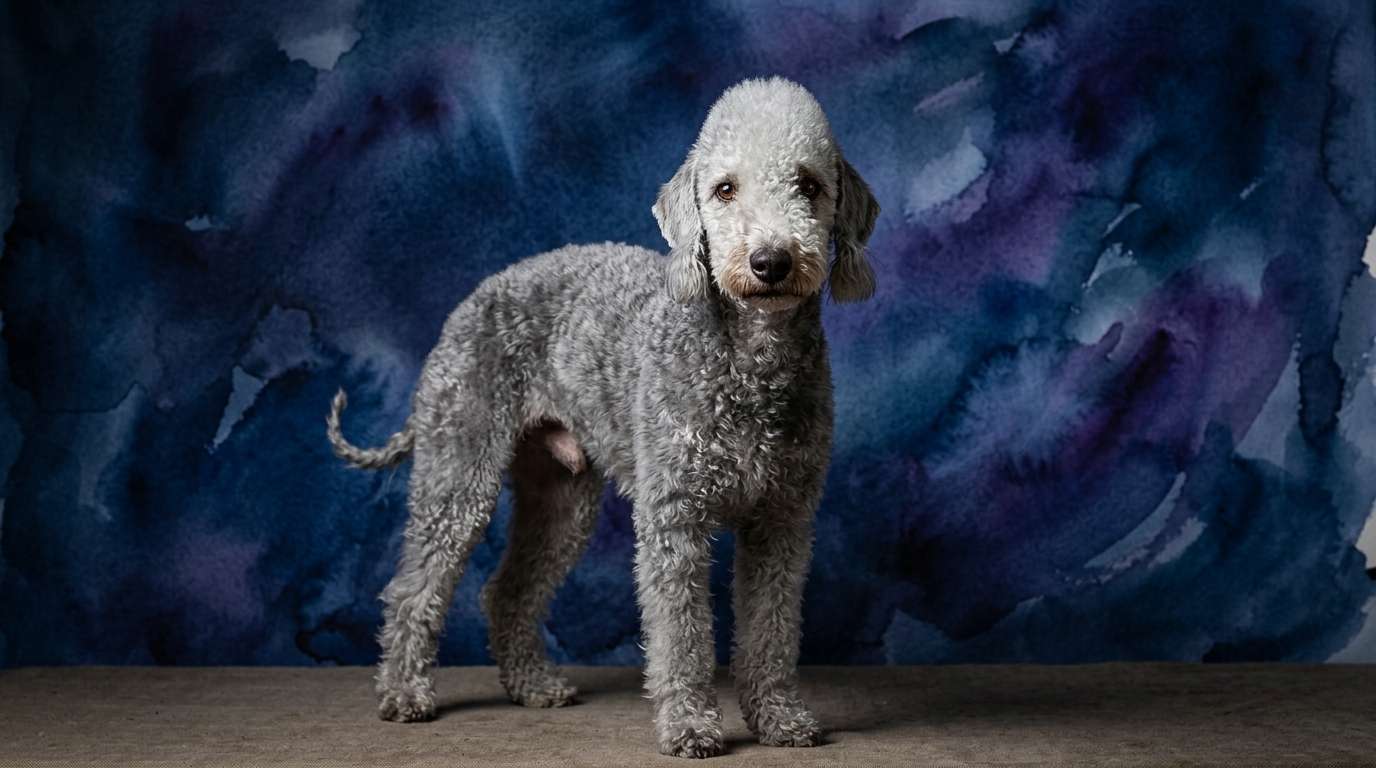
Side-by-Side IQ Profile: Poodle (Standard) vs. Bedlington Terrier
The Cosmic Pet Pet IQ Lab employs a five-dimensional framework to assess canine intelligence, offering a nuanced understanding beyond simple ranking. For the Standard Poodle, we observe a remarkable consistency across most cognitive measures, reflecting a versatile and adaptable mind. Their profile shows Problem Solving at 5/5, Training Speed at 5/5, Social Intelligence at 5/5, Instinctive Drive at 4/5, and Memory at 5/5. This robust score set places them in an elite category for overall cognitive function.
The Bedlington Terrier presents a different, yet equally valid, cognitive blueprint. While not Coren-ranked, their scores reveal a more specialized intelligence rooted in their terrier heritage. Their profile indicates Problem Solving at 3/5, Training Speed at 3/5, Social Intelligence at 3/5, Instinctive Drive at 3/5, and Memory at 3/5. These scores suggest a practical, focused intellect, less geared towards abstract learning but highly effective within their natural predispositions.
Where the Standard Poodle Excels Cognitively
The Standard Poodle's dominance in Problem Solving (5/5) is evident in their capacity for abstract thought and strategic planning. They don't merely react to stimuli; they often analyze situations and devise multi-step solutions. This manifests in their ability to navigate complex puzzle toys, figure out how to open latches, or even anticipate the next step in a familiar routine without direct cues.
Their exceptional Training Speed (5/5) stems from a potent combination of focus, eagerness to engage, and rapid comprehension. They absorb new commands and multi-step sequences with minimal repetition, often generalizing learned concepts to novel situations. This cognitive flexibility, paired with their outstanding Memory (5/5), allows them to retain vast amounts of information over extended periods, making them superb candidates for advanced obedience, agility, and service work.
Furthermore, the Standard Poodle's Social Intelligence (5/5) is a cornerstone of their cognitive superiority. They are profoundly attuned to human emotions, body language, and subtle vocal inflections. This allows them to seamlessly integrate into family dynamics, anticipate needs, and adapt their behavior to different social contexts, fostering deep and responsive partnerships with their human companions.
Where the Bedlington Terrier Shines Cognitively
While their general cognitive scores are moderate, the Bedlington Terrier's strength lies in a highly specialized, instinct-driven intelligence. Their Problem Solving (3/5) is particularly effective when applied to practical, immediate challenges related to their historical role as vermin hunters. They excel at assessing environmental cues to locate and pursue, demonstrating a tenacious focus on a specific, tangible goal rather than abstract puzzles.
The Bedlington's Instinctive Drive (3/5), though numerically lower than the Poodle's, represents a different kind of cognitive advantage. It's a self-directed, persistent drive for tasks like digging, chasing, and exploring. This allows them to operate with significant autonomy in their chosen pursuits, often requiring less human direction once a goal is identified. Their cognitive 'win' here is in their unwavering focus and independent execution of specific, instinctual missions.
Their Memory (3/5) is perfectly adequate for retaining routines, familiar people, and commands that are consistently reinforced and align with their interests. While they may not recall extensive, complex sequences as effortlessly as a Poodle, their memory is robust for what matters in their world, allowing them to navigate their environment and social circle effectively.
Ease of Training: Poodle vs. Bedlington
When it comes to ease of training, the Standard Poodle clearly holds an advantage, largely due to their 5/5 Training Speed and high Social Intelligence. A Poodle often requires only a few repetitions to grasp a new command, eagerly offering behaviors they believe will earn praise or reward. Their desire to engage and their remarkable memory mean they rarely 'forget' a command once learned, making training sessions productive and often joyous experiences for both dog and owner. They are adept at generalizing commands to new environments or situations, reflecting a flexible learning style.
The Bedlington Terrier, with a 3/5 Training Speed, presents a more deliberate training journey. Their independent terrier nature means they might understand a command but choose not to execute it if a more compelling scent or activity captures their attention. Training a Bedlington often requires more patience, creativity, and consistent positive reinforcement to make learning feel like a collaborative game rather than a chore. Owners must be prepared for their self-reliance and potential for selective hearing when their instincts are piqued, understanding that their 'difficulty' isn't a lack of capacity but a different motivational framework.
Suitability for Active vs. Relaxed Owners
The Standard Poodle's high cognitive scores across the board mean they thrive with active owners who are prepared to provide consistent mental stimulation in addition to physical exercise. An 'active owner' for a Poodle isn't just about long walks; it's about engaging them in dog sports like agility, obedience, or rally, teaching complex tricks, providing challenging puzzle toys, and integrating them into daily problem-solving scenarios. A relaxed owner who cannot meet these cognitive demands might find a Standard Poodle becomes bored, leading to undesirable behaviors born from an underutilized mind.
The Bedlington Terrier can potentially suit both active and more relaxed owners, but with specific considerations. Their physical activity needs are moderate, enjoying regular walks and playtime. However, their strong terrier instincts for digging, chasing, and exploring require consistent outlets. A 'relaxed' owner must still be prepared to provide opportunities for these instinctual behaviors, perhaps through supervised digging areas or scent games, and understand their independent streak. An active owner could engage them in earth dog trials, lure coursing, or agility, but must tailor training to their self-reliant approach and make activities feel intrinsically rewarding rather than purely command-driven.
The Verdict: When to Choose Each Breed
Choosing between a Standard Poodle and a Bedlington Terrier hinges on your lifestyle, training philosophy, and what you seek in a canine companion's cognitive profile.
The Standard Poodle is an ideal choice for owners who desire a highly interactive, adaptable companion eager to learn complex tasks, participate enthusiastically in dog sports, or perform service work, and who are prepared to provide consistent, varied mental engagement. Their cognitive prowess makes them incredibly versatile partners in almost any endeavor requiring sharp intellect and responsiveness.
The Bedlington Terrier is best suited for owners who appreciate an independent, tenacious companion with a unique charm, are prepared for a more deliberate and patient training approach, and who can provide structured outlets for their specific terrier instincts. They thrive in environments where their self-reliance and specialized drives are understood and channeled effectively.
The Verdict
Choose the Standard Poodle if you seek an intellectually engaged, highly trainable companion eager to master complex tasks and thrive on consistent mental stimulation. They excel as partners in diverse activities, from dog sports to service work.
Opt for the Bedlington Terrier if you appreciate an independent spirit and tenacious drive, are prepared for a more patient, instinct-focused training approach, and can provide outlets for their unique terrier behaviors.
🧠 Find Your Pet's IQ Score
Our Pet IQ Lab assessment covers 25+ tests across 5 cognitive dimensions — personalized to your breed.
Take the Full IQ Test →Frequently Asked Questions
Can Bedlington Terriers excel in dog sports?
Yes, Bedlington Terriers can certainly excel in various dog sports, particularly those that capitalize on their speed, agility, and keen prey drive, such as agility, earth dog trials, or lure coursing. Success often comes from an owner's ability to make training engaging and leverage their independent spirit rather than relying solely on strict command adherence.
Do Standard Poodles get bored easily?
Absolutely. Their exceptional cognitive capacity means Standard Poodles require consistent and varied mental stimulation to remain content. Without sufficient engagement through training, challenging puzzles, or diverse activities, they can indeed develop boredom-driven behaviors like excessive barking, destructive chewing, or general restlessness, underscoring their need for an active mind.
How do their social intelligence scores impact household dynamics?
The Standard Poodle's 5/5 social intelligence means they are highly attuned to family emotions and dynamics, often seamlessly integrating and adapting their behavior to the mood of the household. The Bedlington Terrier's 3/5 means they form deep bonds with their immediate family but might be more selective in their social interactions, potentially reserved with strangers or less overtly expressive of their understanding of complex human social cues, requiring a bit more patience in new social settings.