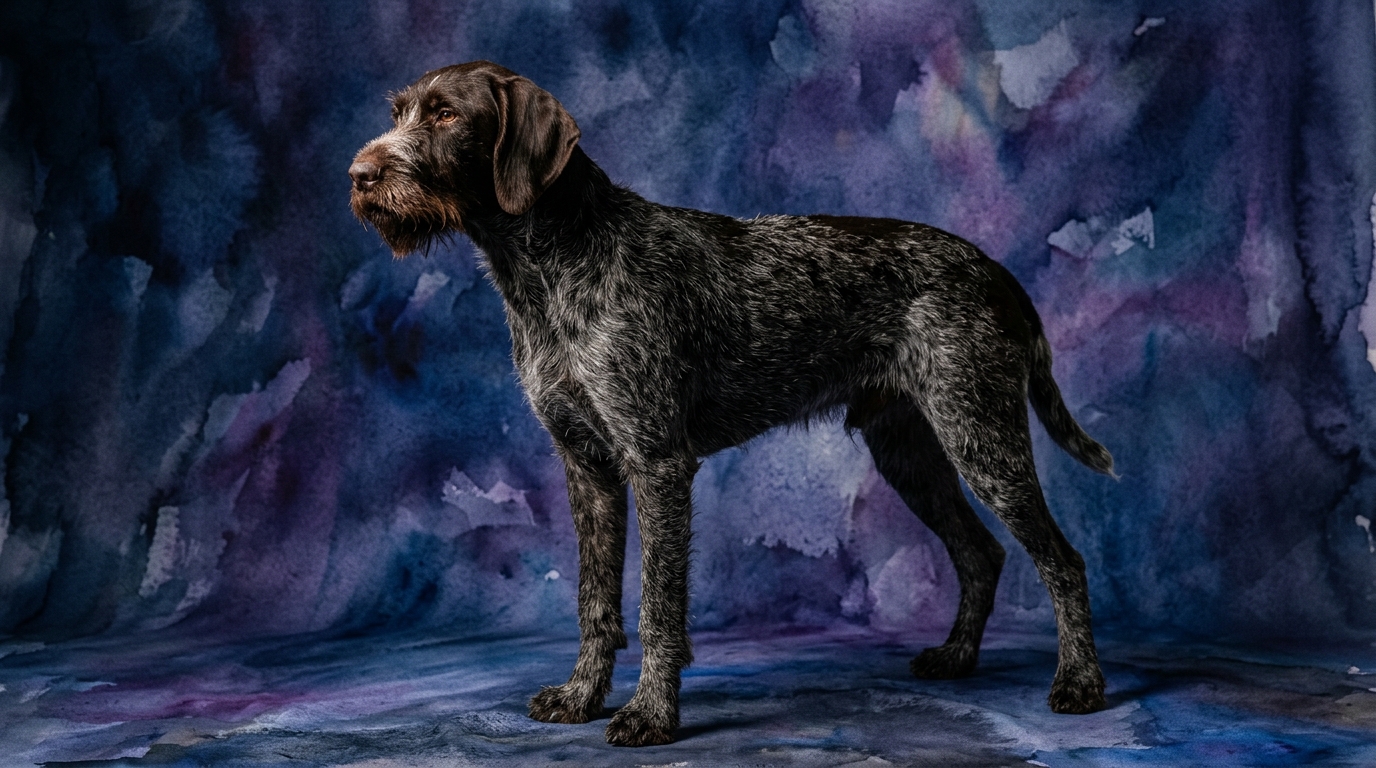

Side-by-Side Cognitive Profiles
The Cosmic Pet Pet IQ Lab offers a structured look into canine cognition, assessing breeds across five key dimensions. Understanding these profiles helps us appreciate the nuanced mental architecture of each dog, moving beyond generalized notions of 'smartness' to specific aptitudes.
**German Wirehaired Pointer (GWP):** This breed excels in adaptability and complex task mastery. Their Problem Solving is rated at 4/5, indicating a strong capacity to analyze situations and devise solutions, often in varied outdoor environments. Training Speed stands at 4/5, reflecting their quick grasp of new commands and eagerness to cooperate. Social Intelligence is 3/5, suggesting they read human cues well and form strong bonds, though their working independence can surface. Their Instinctive Drive is 3/5, a balanced prey drive channeled effectively for hunting without being overwhelming. Finally, Memory is 4/5, showcasing their ability to retain complex sequences and learned behaviors over time, crucial for intricate field work.
**Parson Russell Terrier (PRT):** Bred for persistence and agility in pursuit, the PRT demonstrates a different set of cognitive strengths. Their Problem Solving is 3/5, meaning they are resourceful, particularly in overcoming physical obstacles, often relying on tenacity to achieve their goals. Training Speed is 3/5; they are capable learners but can be independently minded, requiring consistent and engaging methods. Social Intelligence is 3/5, indicating they interact meaningfully with their human companions but can be assertive in social contexts. An Instinctive Drive of 3/5 highlights their intense focus on quarry, reflecting their heritage in flushing game from burrows. Memory is 3/5, allowing them to recall learned behaviors, though their immediate instincts can sometimes take precedence.
Where the German Wirehaired Pointer Shines Cognitively
The German Wirehaired Pointer's cognitive advantages become apparent in scenarios demanding versatility and collaboration. Their superior Problem Solving (4/5) means they can more readily adapt to novel challenges, such as navigating an unfamiliar agility course or figuring out how to retrieve a specific item from a complex setup. This isn't just about raw intellect; it's about a flexible mind that can process new information and apply prior learning to find solutions.
Furthermore, the GWP's higher Training Speed (4/5) combined with their strong Memory (4/5) gives them a distinct edge in learning intricate sequences and retaining them. This breed is often quicker to generalize commands, applying a learned behavior in different contexts without extensive re-training. Their cooperative nature, influenced by their role as a hunting partner, means they are often more attuned to human direction and subtle cues, making them highly responsive to advanced obedience or complex sporting demands where precision and teamwork are paramount.
Where the Parson Russell Terrier Excels Cognitively
The Parson Russell Terrier's cognitive strengths are rooted in their terrier heritage, emphasizing tenacity and independent pursuit. While their Problem Solving is rated 3/5, this doesn't imply a lack of mental prowess but rather a different approach; they excel at persistent, focused effort, particularly when driven by their strong Instinctive Drive (3/5). For instance, a PRT might relentlessly work at a puzzle toy until it's solved, or methodically dig to reach a perceived 'target', demonstrating a remarkable single-mindedness that can outlast many other breeds.
Their strength lies in their decisive action and resourcefulness in challenging, often confined, situations. This breed is adept at figuring out how to squeeze into tight spaces or overcome physical barriers through sheer determination, rather than intricate strategic planning. This inherent drive and focused persistence, while sometimes challenging in training, makes them exceptionally effective in tasks requiring unwavering dedication, such as earthdog trials where their natural instincts are fully engaged.
Training Dynamics: GWP vs. Parson Russell Terrier
When considering ease of training, the German Wirehaired Pointer generally presents a more straightforward path. Their Training Speed of 4/5 signifies that they typically grasp new commands and routines with greater alacrity. This is complemented by their higher Memory (4/5) and a social intelligence that predisposes them to work in partnership. A GWP is often motivated by the desire to please their handler and engage in collaborative tasks, making them receptive to positive reinforcement methods and capable of mastering complex multi-step commands for activities like hunting, agility, or competitive obedience.
The Parson Russell Terrier, with a Training Speed of 3/5, is certainly capable of learning, but their strong instinctive drive and independent problem-solving (3/5 for both) can present unique challenges. Their focus can be easily diverted by environmental stimuli, especially if it triggers their prey drive. Training a PRT requires exceptional consistency, creativity, and patience to maintain their engagement and overcome their inherent tenacity. While they learn, they often require more repetition and motivation tailored to their spirited nature, sometimes preferring to follow their nose or instincts over a known command if the perceived reward isn't immediate or compelling enough.
Matching Breeds to Lifestyles: Active vs. Engaged Owners
Neither the German Wirehaired Pointer nor the Parson Russell Terrier are suited for truly 'relaxed' owners in the conventional sense; both demand significant mental and physical engagement. However, their specific needs align with different types of active lifestyles. The GWP thrives with owners who enjoy collaborative outdoor pursuits, such as hiking, running, or field work. Their versatile nature makes them excellent partners for various dog sports like advanced obedience, agility, or scent work, requiring an owner who can consistently provide structured mental and physical challenges.
The Parson Russell Terrier, on the other hand, suits owners who appreciate a dog with boundless energy and a tenacious spirit, and who are prepared to channel that drive into appropriate outlets. This might include vigorous games of fetch, extensive digging opportunities in a designated area, or participation in earthdog trials where their natural instincts are celebrated. Owners must be prepared for consistent, engaging play and training that respects their independent, spirited nature, ensuring their active minds and bodies are adequately stimulated to prevent boredom-driven behaviors.
The Verdict
Choose the German Wirehaired Pointer if you seek a highly trainable, versatile companion for collaborative outdoor adventures, dog sports, or dedicated field work, valuing a strong working partnership.
Opt for the Parson Russell Terrier if you desire a spirited, tenacious, and independent dog for vigorous outdoor play and activities like earthdog trials, and are prepared for consistent, engaging training to channel their boundless energy.
🧠 Find Your Pet's IQ Score
Our Pet IQ Lab assessment covers 25+ tests across 5 cognitive dimensions — personalized to your breed.
Take the Full IQ Test →Frequently Asked Questions
Which breed is generally more focused during training sessions?
The German Wirehaired Pointer, with a Training Speed of 4/5 and higher Memory, tends to be more consistently focused during training sessions. Their cooperative nature and desire to work with their handler generally make them less prone to distraction compared to the independent Parson Russell Terrier.
Do both breeds have a strong prey drive?
Yes, both breeds possess a strong instinctive drive (3/5 for both), rooted in their hunting heritage. However, the GWP's drive is often more channeled and balanced for collaborative retrieval and pointing, while the PRT's drive is geared towards tenacious pursuit and flushing in confined spaces, requiring different management approaches.
Which breed adapts better to varied living situations and tasks?
The German Wirehaired Pointer generally exhibits greater adaptability to varied living situations and tasks due to their higher problem-solving capacity (4/5) and versatile background. They are often more comfortable with changes in routine or environment and can adjust to a broader range of activities beyond their core instincts.