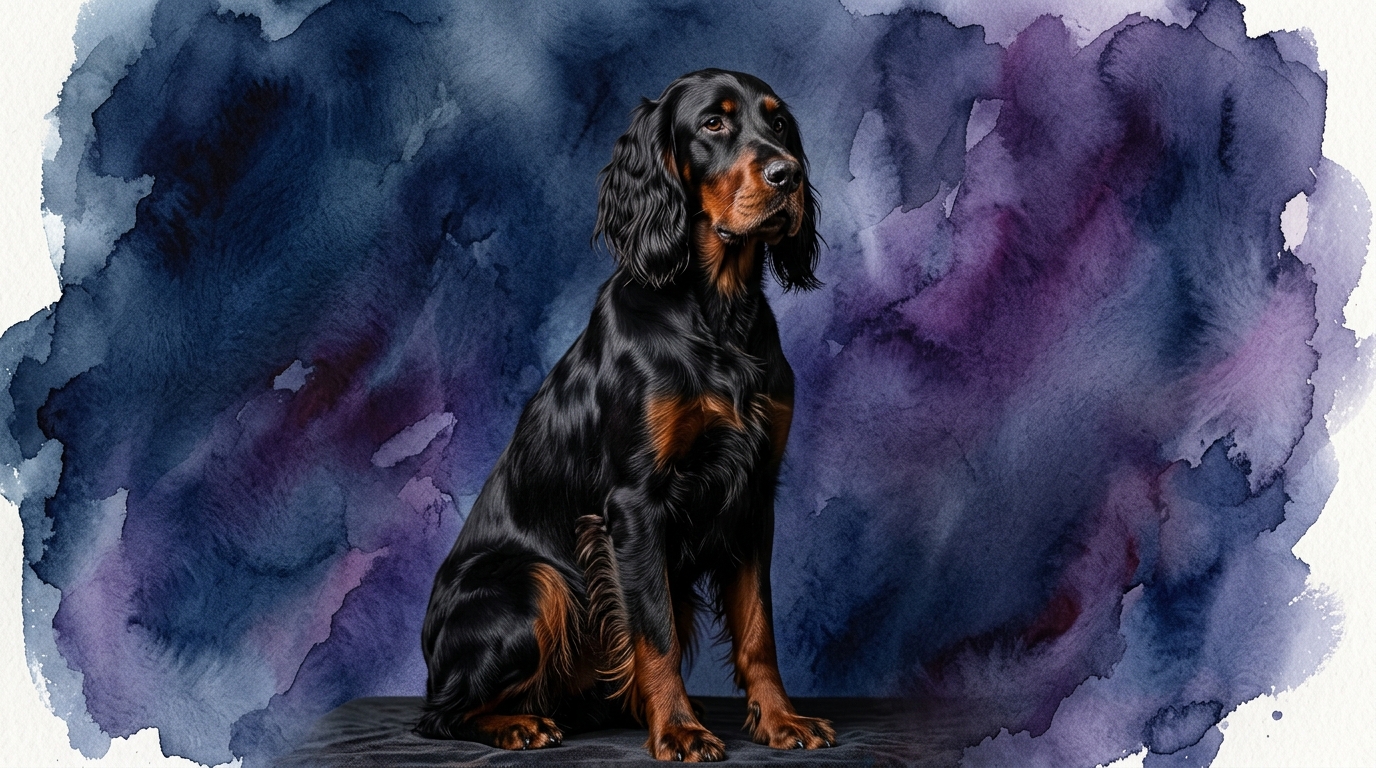

Side-by-Side IQ Profile: Gordon Setter vs. American Eskimo Dog
The Gordon Setter’s cognitive profile highlights a formidable intellect geared for purpose and precision. With a 4/5 in problem-solving, they adeptly navigate complex scenarios, quickly devising solutions to novel challenges like retrieving an out-of-reach toy or mastering intricate sequences. Their training speed, also rated 4/5, means new commands and routines are absorbed swiftly, reflecting a keen eagerness to learn from consistent instruction. While their social intelligence and instinctive drive stand at a solid 3/5, indicating good social awareness and a moderate working drive, their 4/5 memory ensures that once a lesson is learned, it remains firmly ingrained, contributing to highly reliable recall and skill retention over time.
In contrast, the American Eskimo Dog presents a beautifully balanced cognitive landscape, with consistent 3/5 scores across the board. Their problem-solving ability, rated 3/5, demonstrates competence in figuring things out, often through observation or logical deduction, allowing them to navigate their environment effectively. A 3/5 training speed signifies they are reliably trainable, grasping commands with clear, patient instruction, even if not instantaneously. Similarly, their 3/5 social intelligence fosters strong bonds and appropriate interactions within the family, while their 3/5 instinctive drive translates to a manageable desire for engagement, often expressed as alertness or companionship. Finally, their 3/5 memory ensures that learned behaviors stick, requiring reasonable refreshers rather than constant re-teaching.
Where the Gordon Setter Wins Cognitively
The Gordon Setter clearly distinguishes itself in areas demanding swift cognitive processing and retention. Its 4/5 score in problem-solving indicates a dog that can quickly assess novel situations and formulate effective strategies. For instance, a Gordon Setter might more readily figure out how to retrieve a toy stuck under furniture using tools or creative maneuvers, or navigate a complex agility course with less prompting, adapting to unexpected obstacles on the fly.
This breed's superior training speed, also rated at 4/5, means new commands and complex sequences are absorbed with notable efficiency. Owners often report that Gordon Setters "get it" faster, requiring fewer repetitions to master a skill, from basic obedience to intricate field work. Coupled with a 4/5 memory, this ensures that once a lesson is learned, it remains firmly ingrained, making advanced training and reliable recall over long distances more attainable outcomes.
Where the American Eskimo Dog Wins Cognitively
While the American Eskimo Dog's individual scores are consistently 3/5, this very consistency represents a cognitive strength: a balanced and predictable intellect. Their 3/5 in problem-solving means they are competent, not easily stumped by everyday challenges, and can often devise practical solutions through observation or logical deduction, albeit sometimes requiring a bit more processing time than a higher-scoring breed.
Their uniform 3/5 across training speed, social intelligence, instinctive drive, and memory points to a well-integrated cognitive system. This balance translates into a dog that is reliably trainable without being overly demanding, socially aware without being highly sensitive, and driven enough to engage without being overwhelmingly intense. This makes them adaptable companions for a variety of home environments, offering a steady and dependable cognitive presence without the peaks and valleys that might accompany more specialized intellects.
Which Is Easier to Train and Why
Based on their respective IQ profiles, the Gordon Setter generally presents as the easier breed to train. Its 4/5 score in training speed signifies a quicker uptake of commands and routines. This difference is often visible in their initial learning phases; a Gordon Setter typically requires fewer repetitions to solidify a new behavior, demonstrating a keen eagerness to engage and understand what is being asked of them.
Furthermore, the Gordon Setter's 4/5 problem-solving ability contributes significantly to its trainability. They are more apt to generalize learned commands to new situations and can troubleshoot minor training hurdles independently, such as figuring out how to correctly position themselves for a "stay" command even if the environment changes. In contrast, while the American Eskimo Dog is certainly trainable with its 3/5 training speed, they may benefit from more structured repetition and consistent reinforcement to achieve the same level of mastery, and might require more direct guidance when faced with novel training scenarios.
Which Suits Active Owners vs. Relaxed Owners
For active owners seeking a canine partner for demanding pursuits, the Gordon Setter aligns well with their lifestyle. Its combination of 4/5 problem-solving, 4/5 memory, and a respectable 3/5 instinctive drive means it thrives on mental and physical challenges. These dogs excel in activities requiring focus, strategic thinking, and endurance, such as hunting, competitive obedience, agility, or extensive hiking. They possess the cognitive toolkit to remember intricate routes, solve complex agility obstacles, and maintain concentration during prolonged field work, making them ideal for owners who enjoy consistent engagement and advanced training.
The American Eskimo Dog, with its consistent 3/5 across all cognitive dimensions, offers a more balanced cognitive profile that can suit both moderately active and more relaxed owners, provided their social and exercise needs are met. While they enjoy activity and can certainly participate in dog sports, their instinctive drive is not as intense as some sporting breeds, meaning they can adapt more readily to a home environment that prioritizes companionship and routine walks over rigorous daily expeditions. Their solid social intelligence (3/5) ensures they integrate well into family life, making them excellent companions for owners who appreciate a steady, engaged presence without the constant demand for highly stimulating intellectual work.
The Verdict
Choose the Gordon Setter if you are an active individual or family eager to engage in advanced training, dog sports, or field work, valuing a partner with exceptional learning speed, problem-solving skills, and memory.
Opt for the American Eskimo Dog if you seek a balanced, adaptable companion who is reliably trainable, socially aware, and thrives on consistent routine and companionship, fitting into a moderately active home.
🧠 Find Your Pet's IQ Score
Our Pet IQ Lab assessment covers 25+ tests across 5 cognitive dimensions — personalized to your breed.
Take the Full IQ Test →Frequently Asked Questions
Is the Gordon Setter difficult to manage due to its instincts?
With an instinctive drive score of 3/5, the Gordon Setter possesses natural urges for activities like scenting and retrieving, but these are manageable. Early training and channeling these drives into structured play or dog sports can prevent them from becoming overwhelming, fostering a well-adjusted companion.
Do American Eskimo Dogs require extensive mental stimulation despite their 3/5 problem-solving score?
While their problem-solving is rated 3/5, American Eskimo Dogs still benefit greatly from regular mental engagement. Puzzle toys, training sessions, and varied walks help keep their minds sharp and prevent boredom, ensuring they remain content and stimulated without needing highly complex intellectual challenges daily.
How does memory impact daily life for these two breeds?
The Gordon Setter's 4/5 memory means they recall commands and routines quickly, making training more efficient and reliable over time, even with gaps in practice. The American Eskimo Dog's 3/5 memory is still very functional, allowing them to retain learned behaviors, though they might benefit from more frequent refreshers to maintain peak performance, particularly with less common commands.