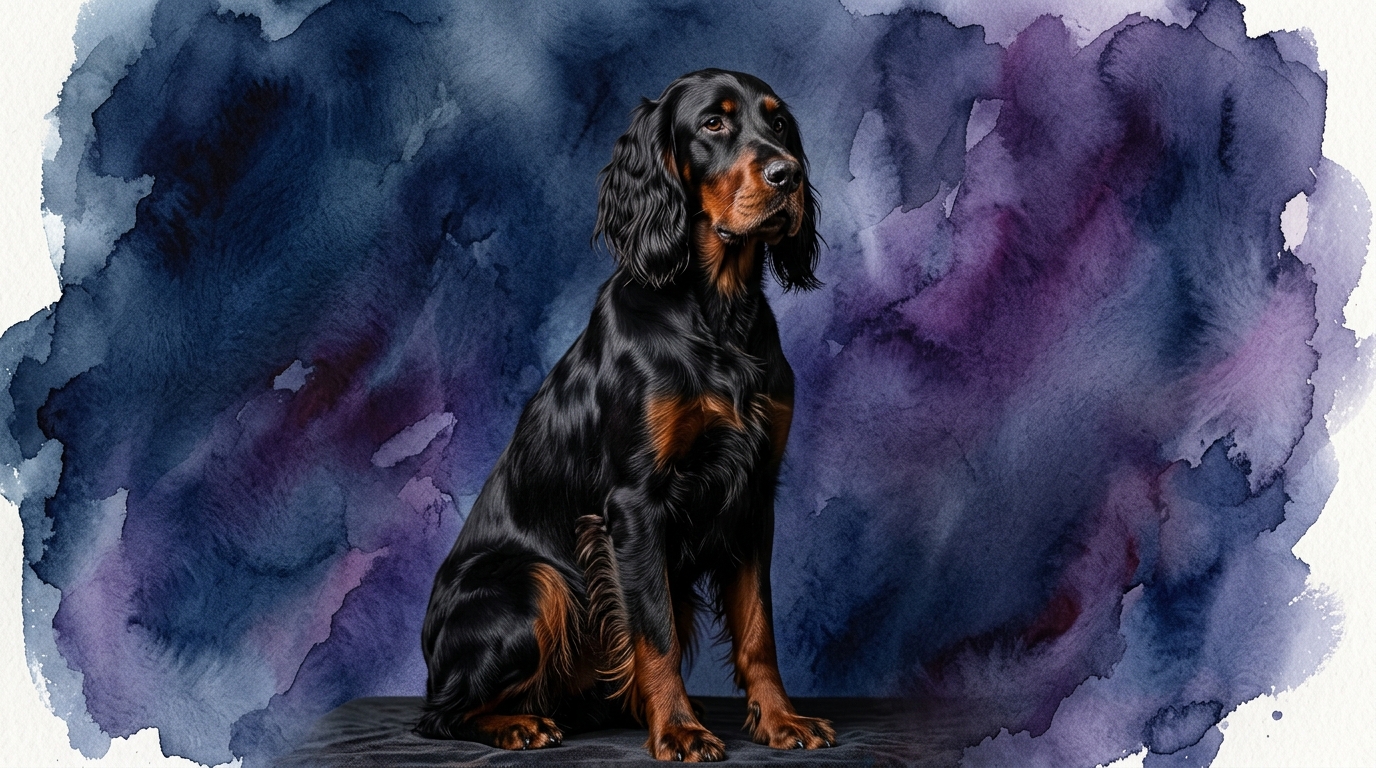

Side-by-Side IQ Profile: Gordon Setter vs. Glen of Imaal Terrier
The Gordon Setter, a majestic member of the Sporting Group, holds a commendable Coren rank of #39, indicating its strong capacity for learning and obedience. Its cognitive blueprint is characterized by a Problem Solving score of 4/5, reflecting an aptitude for independent thought and strategic action, a trait honed by their historical role in locating and pointing game. Their Training Speed, also at 4/5, showcases a readiness to absorb and execute commands quickly, indicative of a focused attention span and a desire to cooperate in structured learning. In terms of Social Intelligence, they rate 3/5, capable of forming deep bonds and understanding human cues, though perhaps less overtly 'people-pleasing' than some other sporting breeds. An Instinctive Drive of 3/5 centers on their natural inclination for scent work and bird finding, a persistent urge to hunt and explore. Finally, their Memory, rated 4/5, allows them to retain complex sequences of commands and recall past experiences, aiding in consistent performance and long-term skill acquisition.
In contrast, the Glen of Imaal Terrier, a sturdy Terrier breed, is not Coren-ranked, suggesting its specific brand of cognition might not align perfectly with obedience-focused metrics, emphasizing independent thought over eager compliance. Their Problem Solving score of 3/5 points to a practical, independent approach, often employing persistence and physical determination to overcome obstacles, reflecting their badger-hunting heritage. Training Speed for the Glen is 3/5; while capable of learning, their pace is more deliberate, coupled with a strong-willed nature that demands patience and engaging methods. Their Social Intelligence is 3/5, fostering close bonds with immediate family but often displaying a reserved demeanor with strangers, valuing their own space. The Instinctive Drive, also 3/5, is deeply rooted in their terrier purpose: a tenacious, fearless pursuit of prey, often involving digging and tunneling. Their Memory, rated 3/5, allows them to retain information adequately, particularly when it pertains to routines or tasks they deem personally rewarding, though perhaps not with the same breadth or speed as breeds designed for complex, varied commands.
Where the Gordon Setter Wins Cognitively
The Gordon Setter's cognitive strengths distinctly shine in areas demanding cooperative learning and recall. Their Problem Solving score of 4/5 indicates a capacity for analytical thought and adaptation, making them adept at navigating complex environments or learning multi-step tasks. This is further bolstered by their Training Speed of 4/5, which means they grasp new concepts and commands with fewer repetitions than many breeds, demonstrating a focused attention and a willingness to engage with their handler's instructions. Furthermore, their Memory, also rated 4/5, allows them to build upon learned behaviors, retaining intricate sequences and long-term training, which is invaluable for advanced obedience, field work, or dog sports. These combined attributes suggest a dog that thrives on intellectual engagement alongside a human partner, excelling in structured learning where consistent application of rules and recall of information are paramount.
Where the Glen of Imaal Terrier Wins Cognitively
While the Glen of Imaal Terrier's individual scores might not always surpass the Gordon Setter's, their unique cognitive profile represents a distinct strength in specific contexts. Their Problem Solving at 3/5, combined with their Instinctive Drive of 3/5, speaks to an unwavering tenacity and resourcefulness when faced with a challenge, particularly one that taps into their historical role of flushing quarry from dens. This isn't about quick obedience, but rather a persistent, independent determination to achieve a goal, often through trial-and-error and sheer will. Their moderate Social Intelligence, while not overtly effusive, fosters a deep, loyal bond with their chosen family, allowing them to excel in environments where a steadfast, discerning companion is valued over a universally gregarious one. They possess a robust, self-reliant intelligence, making them master strategists in their own specific domain, demanding respect for their independent thought processes.
Which is Easier to Train and Why
Comparing training ease, the Gordon Setter clearly holds an advantage due to its 4/5 Training Speed and 4/5 Memory. These breeds were developed to work in close cooperation with hunters, requiring them to learn and execute commands promptly and consistently over varied terrain and distractions. Their natural inclination is to attend to their handler, process instructions efficiently, and remember them for subsequent applications. In contrast, the Glen of Imaal Terrier, with its 3/5 Training Speed, requires a more nuanced approach. Terriers, by nature, are independent thinkers, bred to work autonomously underground without direct handler supervision. This translates to a dog that might question commands or prioritize its own agenda if not adequately motivated. Training a Glen demands greater patience, creative engagement, and a deep understanding of their terrier drive, whereas the Gordon Setter often approaches training as a collaborative partnership, eager to please and quick to learn.
Which Suits Active Owners vs. Relaxed Owners
The Gordon Setter, with its background as a sporting dog and strong problem-solving and training speed scores, is ideally suited for active owners who can provide consistent mental and physical engagement. They thrive on structured activities like advanced obedience, agility, field trials, or long, exploratory hikes where their innate drive and memory can be put to good use. Owners who enjoy teaching new skills and participating in dog sports will find a willing and capable partner in a Gordon. Conversely, 'relaxed' owners, in the sense of preferring less structured, more independent canine companions, might find the Glen of Imaal Terrier a better fit, albeit with a caveat. While Glens are not hyperactive, their strong instinctive drive (3/5) for digging and exploration means they still require regular, stimulating activity to prevent boredom. However, their independent nature and deliberate training speed mean they might be content with shorter, focused 'work' sessions or exploring a secure yard, rather than constant handler-directed exercise. They are not a sedentary breed, but their exercise needs might be met differently, favoring quality of engagement over sheer quantity of handler-led activity.
The Verdict
Choose the Gordon Setter if you seek a cooperative, intelligent partner for structured training, dog sports, and active outdoor pursuits, valuing a strong memory and quick learning.
Opt for the Glen of Imaal Terrier if you appreciate an independent, tenacious companion with a unique problem-solving approach, suited to owners who understand and respect a terrier's self-reliant spirit.
🧠 Find Your Pet's IQ Score
Our Pet IQ Lab assessment covers 25+ tests across 5 cognitive dimensions — personalized to your breed.
Take the Full IQ Test →Frequently Asked Questions
Does Coren's ranking fully capture a breed's intelligence?
Coren's ranking primarily assesses obedience and working intelligence, focusing on how quickly a dog learns new commands and obeys known ones. It doesn't fully encompass other dimensions like problem-solving persistence, social nuance, or instinctive drives, which are equally important facets of canine cognition.
How does the 'Instinctive Drive' score impact daily life?
Instinctive Drive refers to a breed's innate urges, like hunting, herding, or guarding. A strong drive means these behaviors will be more prominent and require appropriate outlets or management, influencing activities like leash walking, yard security, and training focus.
Can a Glen of Imaal Terrier excel in obedience despite its training speed score?
Absolutely. While their training speed score of 3/5 suggests they may take longer to learn than some breeds, a Glen of Imaal Terrier can certainly excel in obedience with patient, consistent, and highly motivating training methods that tap into their natural determination and desire for engagement.