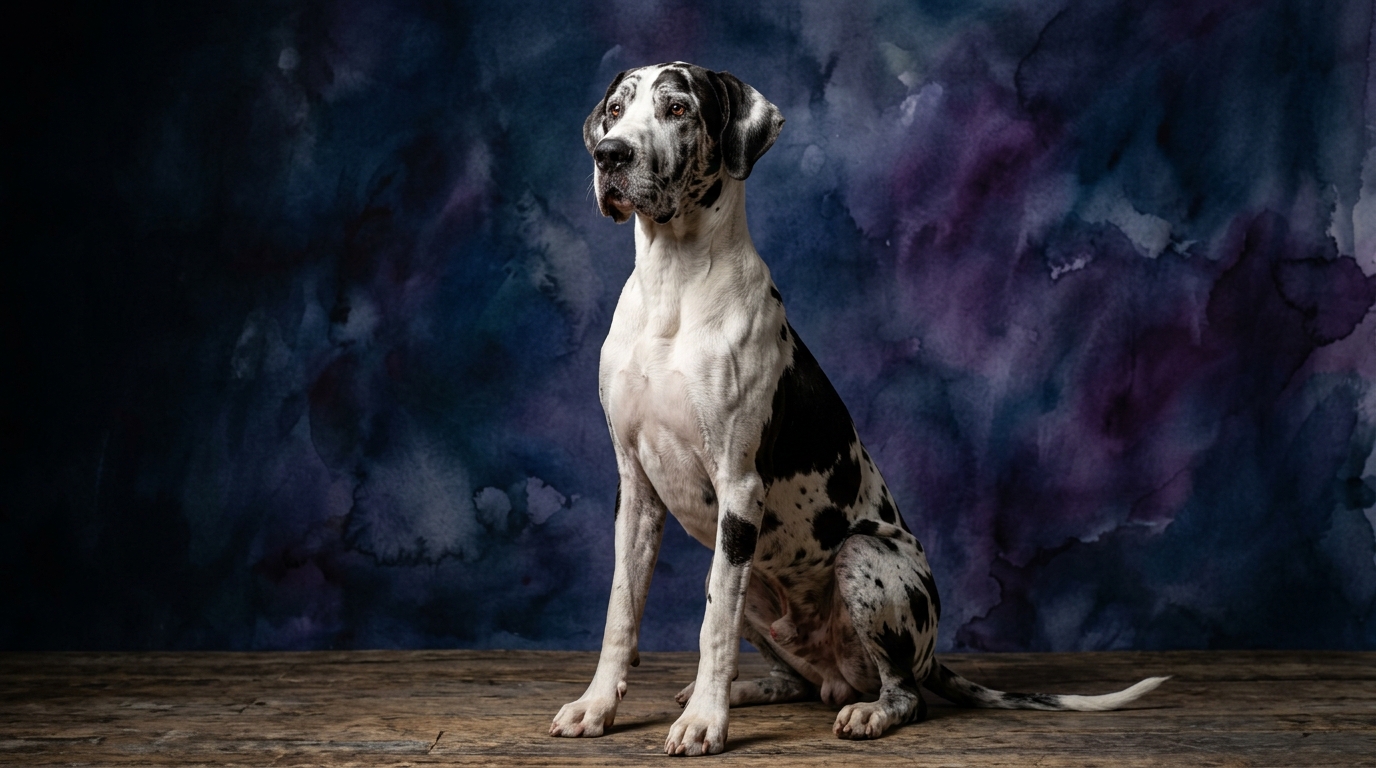

Side-by-Side Cognitive Profiles
**Great Dane (Coren Rank #48)**: This majestic working breed exhibits a balanced cognitive profile. Their **Problem Solving (3/5)** involves a thoughtful, sometimes ponderous approach, relying on observation and a bit of trial and error rather than quick, agile strategizing. **Training Speed (3/5)** is moderate, meaning they grasp new commands with steady repetition, thriving on patience and consistent instruction. Where Great Danes truly excel is in **Social Intelligence (4/5)**, showing a deep emotional perceptiveness, keenly attuned to human moods and family dynamics, fostering profound empathetic bonds. Their **Instinctive Drive (3/5)** leans towards watchful companionship and protective presence rather than active hunting. Finally, their **Memory (3/5)** is solid and reliable for learned routines and experiences, though complex sequences may require refreshers.
**Russian Toy (Not Coren-Ranked)**: This spirited toy breed also presents a consistent cognitive score across dimensions. Their **Problem Solving (3/5)** demonstrates a blend of curiosity and persistence, often utilizing their compact size to explore tight spaces or retrieve hidden items. **Training Speed (3/5)** is moderate, as they are generally eager to please, though short, engaging sessions are best for their attention span. **Social Intelligence (3/5)** is moderate; they form deep bonds with primary caregivers and pick up on immediate family cues but might not extend their social radar as broadly to new people. Their **Instinctive Drive (3/5)** manifests as strong companion drive and a vigilant nature, making them surprisingly alert watchdogs. Their **Memory (3/5)** is reliable for daily interactions and learned commands with consistent practice.
Where the Great Dane Shows Cognitive Strength
The Great Dane's cognitive edge largely rests in its superior **social intelligence (4/5)**. This isn't merely about being friendly; it's a profound capacity for emotional attunement. A Great Dane can often sense a subtle shift in a family member's mood, offering a comforting nudge or a quiet, supportive presence without explicit prompting. They excel at understanding complex household dynamics, frequently acting as intuitive, empathetic companions who recognize when a child needs gentle supervision or when a family member requires solace. For instance, a Great Dane might instinctively position itself between a child and a perceived threat, not through aggressive display, but by its sheer presence and calm demeanor, demonstrating a nuanced protective instinct rooted in advanced social awareness. This sophisticated social processing allows them to integrate seamlessly into family life, acting as intuitive, empathetic companions.
Where the Russian Toy Shows Cognitive Strength
While the data shows equal scores in specific dimensions, the Russian Toy's inherent agility and compact size often lend a practical advantage in certain cognitive applications. Their smaller stature means they can navigate tight spaces, retrieve small dropped items, or alert to subtle sounds with an efficiency a Great Dane cannot match. Though rated 3/5 for problem-solving like the Great Dane, a Russian Toy might, for example, more readily figure out how to squeeze under a low barrier to reach a toy, or how to manipulate a small object with their delicate paws. This isn't about raw intellectual superiority but about how their physical attributes enable specific problem-solving behaviors. Their quick, nimble movements allow for rapid exploration and interaction with their environment, which can translate into faster learning in tasks requiring fine motor skills or navigating confined areas. Their vigilance, an aspect of their instinctive drive, means they are often the first to notice and react to subtle changes in their surroundings, making them excellent, albeit tiny, sentinels.
Training Dynamics: Great Dane vs. Russian Toy
Both breeds are rated 3/5 for training speed, suggesting a moderate learning curve. However, real-world training experiences can diverge due to their physical and social predispositions. The **Great Dane's superior social intelligence (4/5)** often makes them more eager to please and more attuned to their trainer's intentions and emotions. They respond well to positive reinforcement and a calm, consistent approach, frequently understanding the "why" behind a command through their deep bond with their owner. Their sheer size, however, means that early, consistent training is non-negotiable for safety and manageability; an untrained Great Dane presents significant challenges in everyday life.
The **Russian Toy**, while also a 3/5 in training speed, might present different challenges. Their smaller stature means they are less physically imposing if untrained, but their potential for "small dog syndrome" – where owners overlook training due to their size – can lead to behavioral issues. Their moderate social intelligence (3/5) means they might not be as inherently driven to anticipate or please their owner's emotional state, requiring more explicit and engaging training methods. Their vigilance and propensity for barking, an aspect of their instinctive drive, can be a specific training focus. Both require patience and consistency, but the Great Dane's strong social bond can often be leveraged more effectively in training, while the Russian Toy might need more creative engagement to maintain focus and motivation.
Lifestyle Suitability: Active vs. Relaxed Owners
The **Great Dane** generally suits owners who appreciate a more relaxed, yet structured, companionship. While they are large and require daily walks and space to stretch, their energy levels tend to be moderate once past puppyhood. They are not typically high-octane dogs demanding constant vigorous activity. Their calm demeanor and preference for being near their family make them excellent companions for owners who enjoy leisurely strolls, quiet evenings at home, and a dog that is content to lounge nearby. Their social intelligence means they thrive on close family interaction rather than intense physical challenges.
The **Russian Toy**, despite its size, often possesses a surprising amount of energy and can be quite spirited. They are well-suited for active owners who enjoy engaging with their dogs in varied activities, from short, brisk walks to indoor games and even dog sports like agility or obedience trials where their nimbleness shines. Their moderate instinctive drive means they appreciate mental stimulation and opportunities to explore. For relaxed owners, a Russian Toy might demand more consistent interactive play to prevent boredom, though their small size makes managing their energy easier in confined spaces. They can adapt to a relaxed lifestyle if their cognitive and physical needs are met through structured play and interaction rather than extensive outdoor adventures.
The Verdict
Choose a Great Dane if you seek a deeply empathetic, gentle giant companion who integrates seamlessly into family life with a calm presence, thrives on social connection, and requires moderate but consistent physical and mental engagement.
Choose a Russian Toy if you desire a spirited, vigilant, and highly portable companion who enjoys interactive play, can adapt to various living situations, and offers a lively presence, provided their specific training and engagement needs are met.
🧠 Find Your Pet's IQ Score
Our Pet IQ Lab assessment covers 25+ tests across 5 cognitive dimensions — personalized to your breed.
Take the Full IQ Test →Frequently Asked Questions
Are Great Danes difficult to train due to their size?
While their size necessitates early and consistent training for safety and manageability, Great Danes are rated 3/5 for training speed. Their strong social intelligence means they are often eager to please and respond well to positive, patient methods, making them trainable despite their imposing stature.
Do Russian Toys bark a lot?
Russian Toys often exhibit a vigilant nature, which can manifest as barking, particularly to alert their owners to new sounds or visitors. This is part of their instinctive drive (3/5) and can be managed with consistent training that focuses on appropriate alerting behaviors and quiet commands.
Can a Great Dane live in an apartment?
A Great Dane can adapt to apartment living if they receive sufficient daily exercise and mental stimulation. Despite their size, they are not typically high-energy dogs indoors and enjoy lounging. However, their social intelligence means they thrive on close family interaction, and their need for space to stretch out comfortably should be considered.