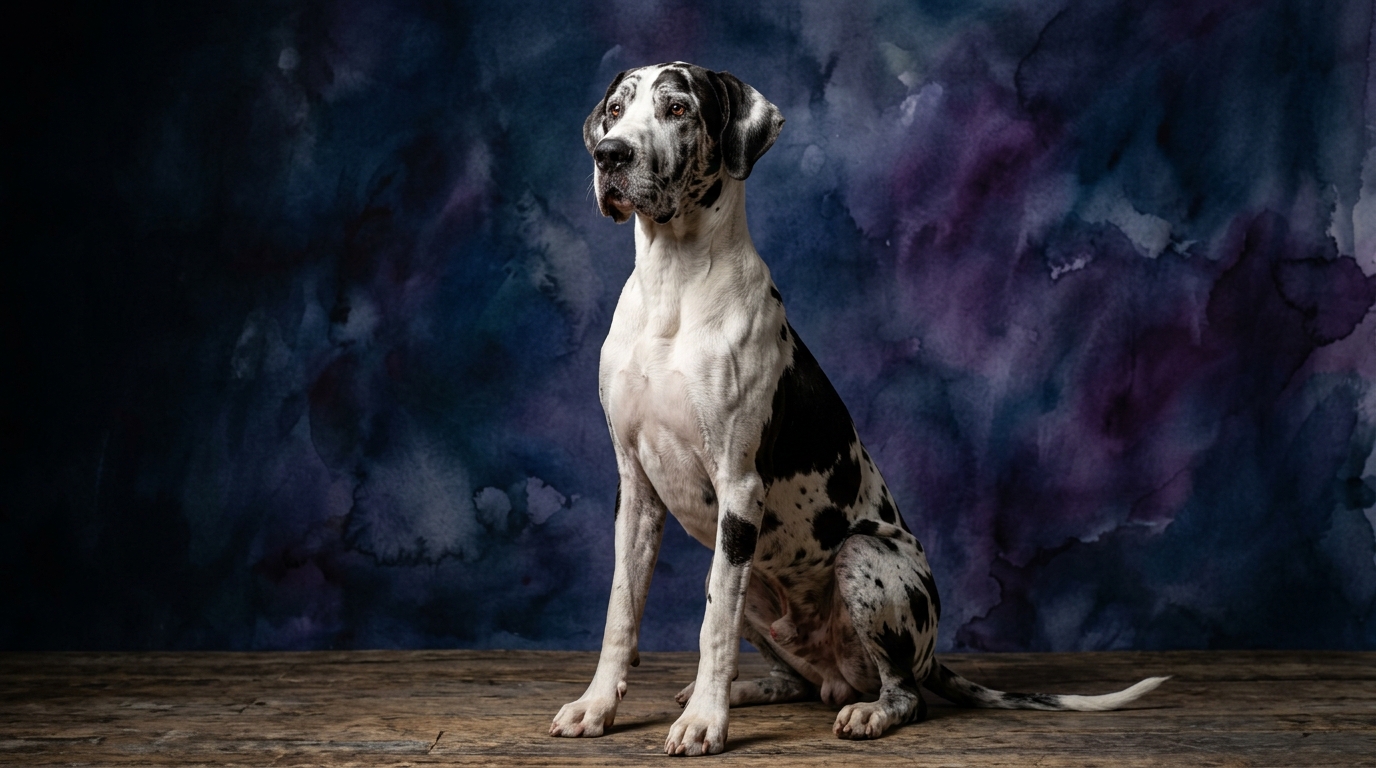

Side-by-Side IQ Profile: Great Dane vs. Shih Tzu
At The Cosmic Pet Pet IQ Lab, we evaluate canine cognition across five key dimensions. For the Great Dane, a Working breed, its Coren rank is #48. Its problem-solving ability scores 3/5, indicating a moderate capacity to figure out tasks, often requiring some guidance rather than immediate independent innovation. Training speed is also 3/5, meaning they learn new commands reliably with consistent effort but are not instantaneous learners. Social intelligence is a strong 4/5, reflecting a deep understanding of human emotions and social cues, allowing for sensitive interactions. Instinctive drive sits at 3/5, suggesting a moderate level of inherent predispositions like guarding or tracking, which can be channeled. Finally, memory is 3/5, indicating a solid retention of learned information and routines.
The Shih Tzu, a Toy breed, holds a Coren rank of #70. Its problem-solving ability matches the Great Dane at 3/5; they can navigate moderately complex challenges but might lean on trial and error or human assistance. Training speed, however, is 2/5, indicating they require more repetition and motivation to grasp new commands, often taking a longer time to solidify learning. Where the Shih Tzu truly excels is in social intelligence, scoring a perfect 5/5, demonstrating an exceptional capacity to interpret and respond to human emotions and intentions. Instinctive drive is lower at 2/5, meaning they typically have less inclination towards primal behaviors like hunting or guarding. Their memory is rated 3/5, on par with the Great Dane, allowing them to recall familiar routines and learned behaviors effectively.
Where the Great Dane Wins Cognitively
The Great Dane’s cognitive advantage primarily stems from its balanced and consistent performance across several key metrics. With a problem-solving score of 3/5 and a training speed of 3/5, these dogs demonstrate a reliable capacity for learning and applying new information. This steady aptitude means they are generally more capable of understanding and executing multi-step commands or engaging in structured tasks that require a sequence of actions. For instance, a Great Dane might more readily learn a complex agility course or a multi-part retrieval task, where understanding spatial relationships and remembering a sequence of cues are critical. Their moderate instinctive drive (3/5) also provides a more robust foundation for engaging with various training scenarios, making them more adaptable to diverse learning environments compared to a dog with a very low drive. This blend of moderate problem-solving and training speed, paired with a solid instinctive engagement, positions the Great Dane as a more versatile learner for tasks requiring both mental processing and physical execution within a structured framework.
Where the Shih Tzu Wins Cognitively
The Shih Tzu's unparalleled cognitive strength shines brightest in its exceptional social intelligence, earning a perfect 5/5. This score significantly surpasses the Great Dane’s respectable 4/5 in the same domain, highlighting a profound difference in their emotional acumen. Shih Tzus are masterful interpreters of human non-verbal cues, facial expressions, and vocal tones, allowing them to intuitively grasp their human companions' emotional states. This isn't just about recognizing happiness; it extends to discerning subtle shifts in mood, anticipating needs, and offering comfort with remarkable precision. For example, a Shih Tzu might instinctively cuddle closer to an owner feeling unwell or offer a gentle nudge when sensing distress, responding with an empathy that transcends mere learned behavior. Their cognitive framework is geared towards fostering deep, intuitive bonds, making them extraordinarily attuned to the nuances of human-dog relationships. While their training speed might be more deliberate, their acute social intelligence enables them to navigate complex social situations with an innate understanding that often compensates for slower command acquisition, making them superb emotional companions.
Which is Easier to Train and Why
When evaluating ease of training, the Great Dane generally offers a more straightforward experience due to its higher training speed (3/5) compared to the Shih Tzu's (2/5). Great Danes, with their moderate ability to pick up commands, respond well to consistent, positive reinforcement, and are often motivated by praise and food rewards. Their moderate instinctive drive (3/5) means they are less likely to be overwhelmed by external distractions or purely self-serving impulses during training sessions, allowing them to focus on the task at hand. For instance, teaching a Great Dane to stay for an extended period in a distracting environment might take fewer repetitions because they possess the mental fortitude to maintain focus and understand the reward for compliance.
In contrast, the Shih Tzu’s slower training speed necessitates more patience, repetition, and a greater variety of motivational techniques to keep them engaged. Their lower instinctive drive (2/5) might mean they lack a strong inherent desire to perform tasks for external rewards beyond companionship, and their small size combined with their comfort-seeking nature can sometimes make them less inclined to exert effort for a command if they perceive it as inconvenient. For example, convincing a Shih Tzu to consistently come when called might require more creative incentives and a more controlled environment, as their attention can easily drift towards a more comfortable spot on the couch or a novel scent, prioritizing their immediate comfort over a learned command.
Which Suits Active Owners vs. Relaxed Owners
For owners seeking an active and engaged companion who can participate in structured activities and learn a variety of routines, the Great Dane is often a more suitable match. Their moderate problem-solving and training speed, coupled with a balanced instinctive drive, means they can thrive in environments that offer consistent mental stimulation through obedience training, scent work, or even tasks around the home. They appreciate the challenge of learning new skills and applying them, aligning well with owners who enjoy dedicating time to structured training sessions and engaging in purposeful activities with their dog. While not marathon runners, their larger size and moderate drive enable them to handle more physical and cognitive demands.
Conversely, the Shih Tzu is an ideal companion for more relaxed owners who prioritize emotional connection and low-key companionship. Their exceptional social intelligence makes them superb emotional support animals, thriving on close physical proximity, shared quiet moments, and intuitive interaction. While they enjoy short, leisurely walks, their cognitive strengths are best appreciated in a home environment focused on affectionate interaction, gentle play, and consistent reassurance rather than rigorous training schedules or demanding physical feats. Their primary desire is often to be near their human, soaking up affection and offering their profound emotional understanding in return, making them perfect for those who cherish a serene and deeply connected relationship.
The Verdict
When seeking a canine companion capable of learning a broad range of commands with moderate consistency and participating in structured activities, the Great Dane offers a rewarding partnership. Choose a Great Dane if you value a dog with a balanced cognitive profile for reliable training and a deep, sensitive social connection.
For those who prioritize an incredibly empathetic and emotionally attuned companion, content with a more relaxed lifestyle and less intensive training, the Shih Tzu is an unparalleled choice. Opt for a Shih Tzu if you seek a profound social bond and a dog whose primary cognitive strength lies in understanding and responding to human emotions.
🧠 Find Your Pet's IQ Score
Our Pet IQ Lab assessment covers 25+ tests across 5 cognitive dimensions — personalized to your breed.
Take the Full IQ Test →Frequently Asked Questions
Do Great Danes or Shih Tzus learn tricks faster?
Great Danes typically learn tricks faster due to their 3/5 training speed, requiring less repetition for new commands. Shih Tzus, with a 2/5 training speed, need more patience and consistent motivation to master new tricks.
Which breed is more sensitive to human emotions?
The Shih Tzu is more sensitive to human emotions, scoring 5/5 in social intelligence, indicating an exceptional ability to read and respond to human moods. Great Danes are also sensitive at 4/5, but the Shih Tzu's empathy is truly outstanding.
Are Great Danes or Shih Tzus better at solving puzzles?
Both Great Danes and Shih Tzus are rated 3/5 in problem-solving, suggesting they have a similar capacity for figuring out moderately complex puzzles. Neither breed is exceptionally quick to innovate solutions independently.