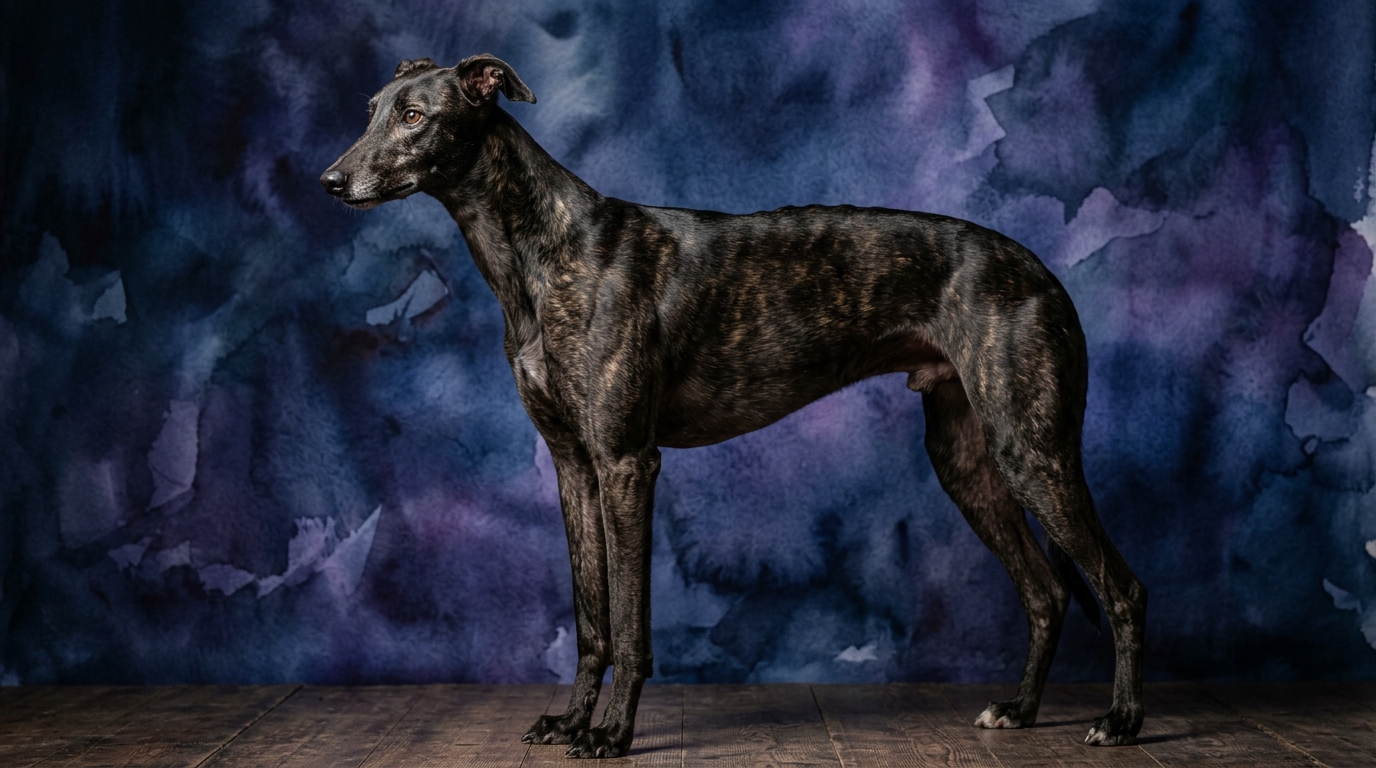
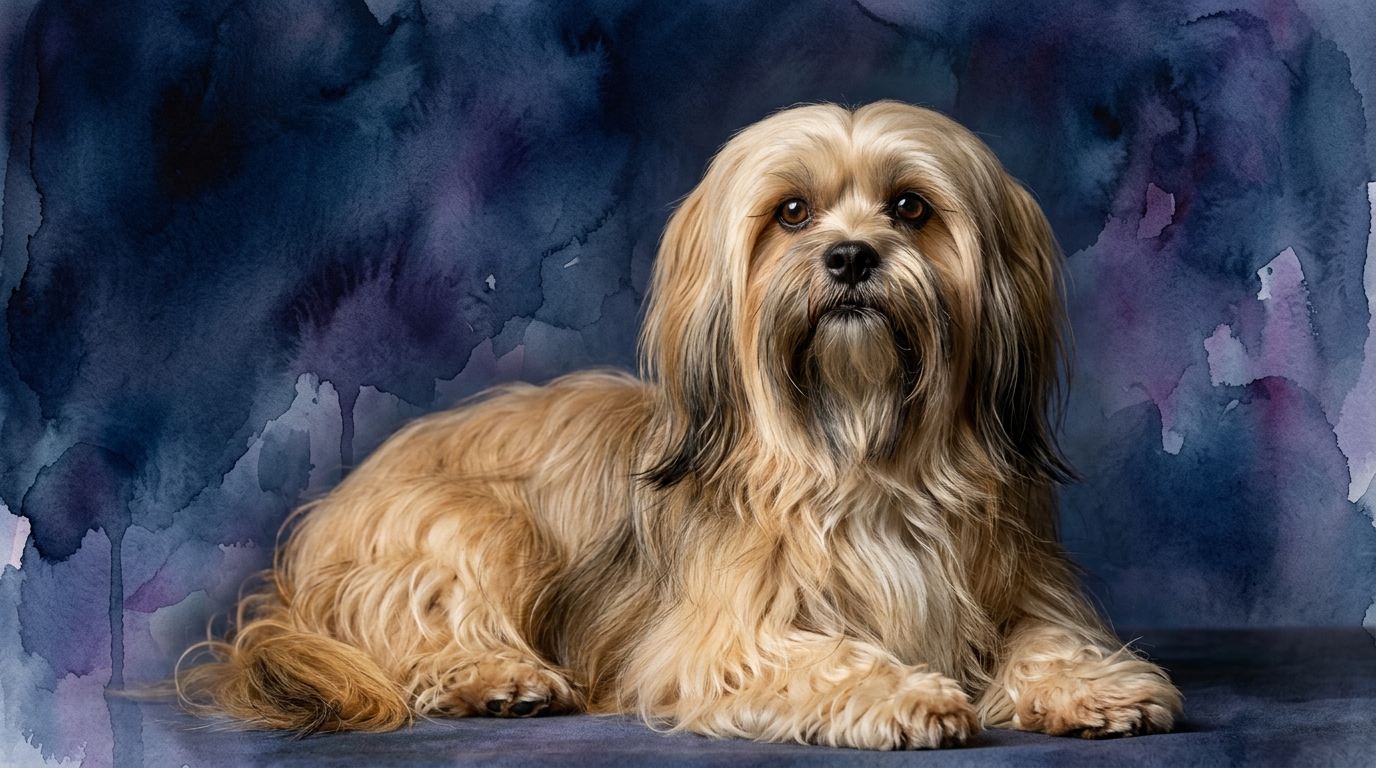
Side-by-Side IQ Profile: Greyhound vs. Lhasa Apso
To understand the unique cognitive landscapes of the Greyhound and the Lhasa Apso, we turn to The Cosmic Pet Pet IQ Lab's five core intelligence dimensions. While both breeds occupy different positions on the Coren ranking (Greyhound #46, Lhasa Apso #68), these scores offer a more granular view of their mental aptitudes.
The Greyhound, a member of the Hound group, exhibits a Problem Solving score of 3/5. This means they are adept at navigating direct paths or overcoming simple obstacles, especially when a clear, motivating target is involved. Their Training Speed is 2/5, indicating that while capable of learning, they often require patience, consistency, and engaging methods to hold their attention. Social Intelligence stands at 3/5; they form deep bonds and understand human cues moderately well, but might not always be driven by a strong desire to overtly please. Their Instinctive Drive is a commanding 5/5, reflecting an unparalleled prey drive and an inherent need to run and chase. Finally, their Memory is rated 3/5, meaning they retain routines and learned commands adequately, though complex sequences might require consistent reinforcement.
The Lhasa Apso, a Non-Sporting breed, also scores 3/5 for Problem Solving. Their problem-solving often manifests as persistence in achieving a goal, such as finding a comfortable perch or cleverly getting attention, drawing on their historical role as vigilant companions. Their Training Speed is 3/5, suggesting a moderate learning pace, often requiring clear and consistent methods, as their independent streak can sometimes make them appear less receptive. Social Intelligence matches the Greyhound at 3/5; they are observant of their human companions, understanding subtle shifts in mood, and capable of forming strong, protective attachments. Their Instinctive Drive is 3/5, reflecting strong guardian instincts and a propensity to alert to intruders or unusual sounds, rather than a strong prey drive. Like the Greyhound, their Memory is 3/5, retaining learned behaviors and routines well, especially those that contribute to their comfort or role within the household.
Where the Greyhound Shines Cognitively
The Greyhound's cognitive prowess is most evident in its extraordinary Instinctive Drive, rated a perfect 5/5. This isn't merely a physical attribute; it's a profound mental state of intense, singular purpose. When a Greyhound sights a lure or a moving object, their mind locks onto it with an efficiency and focus that few other breeds can match. This high drive translates into a specific type of problem-solving where they excel at finding the most direct, energy-efficient path to their goal, demonstrating a clear, linear intelligence geared towards pursuit.
Their problem-solving, while rated 3/5 generally, becomes remarkably efficient in high-drive scenarios. They quickly assess their environment for the fastest route, demonstrating an acute spatial awareness tied directly to their chasing instincts. This specific cognitive strength makes them unmatched in activities that tap into their innate desire to run and track, showcasing a specialized intelligence honed over centuries for speed and pursuit rather than complex abstract thought.
Where the Lhasa Apso Demonstrates Cognitive Strengths
The Lhasa Apso's cognitive strengths often manifest in their nuanced approach to their environment and social interactions. With a Training Speed of 3/5 compared to the Greyhound's 2/5, Lhasa Apsos often show a slightly more consistent willingness to engage in structured learning, provided the motivation aligns with their independent nature. They learn for themselves, often internalizing commands that improve their comfort or security, rather than solely to please an owner.
Their Problem Solving, also rated 3/5, is particularly strong in navigating their home territory and understanding social dynamics. A Lhasa Apso might cleverly manipulate a situation to gain a favored spot on the couch or use their vocalizations to effectively communicate their desires. Their ingrained guardian instincts mean they are constantly processing environmental cues, making them adept at identifying novelties or potential threats within their domain, a different but equally valid form of intelligence compared to the Greyhound's pursuit-oriented focus.
Which is Easier to Train and Why?
When considering ease of training for basic obedience, the Lhasa Apso generally holds a slight edge due to its higher Training Speed score of 3/5. While they possess an independent streak, their moderate learning pace and historical role as alert companions mean they are often attentive to their surroundings and their human's cues. Their guardian instincts can be leveraged in training, as they are often motivated by the desire to maintain order and security within their perceived territory. Consistent, positive reinforcement methods typically yield good results, even if they require a firm but fair hand to navigate their occasional stubbornness.
Greyhounds, despite their overall cognitive capacity, can present a more unique training challenge, reflected in their 2/5 Training Speed. Their powerful Instinctive Drive (5/5) means their minds are frequently preoccupied with potential movement, scents, or the sheer joy of running. This can make consistent engagement in repetitive obedience training difficult, as their focus is easily diverted by more compelling external stimuli. They learn best with short, engaging sessions, highly rewarding positive reinforcement, and a deep understanding of their sighthound nature. Owners must recognize that a Greyhound's 'slowness' to learn a command isn't a lack of intelligence, but often a prioritization of their innate drives over human-imposed tasks.
Suitability for Active vs. Relaxed Owners
The Greyhound, surprisingly for a breed synonymous with speed, is often affectionately dubbed a '45 mph couch potato.' While they possess an incredible capacity for bursts of intense speed, they are equally content, if not more so, to spend long hours lounging. Active owners who can provide regular, secure opportunities for their Greyhound to run freely – ideally in a fenced yard or a designated off-leash park – will find them a perfect fit. However, once their exercise needs are met, they transition seamlessly into a relaxed, affectionate housemate, making them suitable for owners who appreciate quiet companionship at home.
The Lhasa Apso, with its moderate exercise requirements, is an excellent match for more relaxed owners who appreciate a vigilant yet calm companion. While they enjoy daily walks and mental stimulation, they do not require extensive, high-impact physical activity. Their compact size and adaptable nature make them suitable for apartment living or less physically demanding lifestyles. Owners should be prepared to engage their Lhasa Apso's clever mind with puzzles and consistent training, as their intelligence thrives on interaction and purpose, even if their body demands less rigorous activity.
The Verdict
Choose the Greyhound if you appreciate a calm, affectionate companion who thrives on intense, short bursts of exercise in a secure environment and can manage a strong chase instinct with understanding.
Opt for the Lhasa Apso if you seek a watchful, independent, and clever companion for a less physically demanding lifestyle, offering steadfast companionship with a moderate training commitment.
🧠 Find Your Pet's IQ Score
Our Pet IQ Lab assessment covers 25+ tests across 5 cognitive dimensions — personalized to your breed.
Take the Full IQ Test →Frequently Asked Questions
Do Greyhounds require a lot of exercise daily?
While Greyhounds are famous for their speed, they are often described as '45 mph couch potatoes.' They require short, intense bursts of exercise in a securely fenced area, followed by long periods of rest and lounging. Daily walks are beneficial, but marathon runs are not typically necessary.
Are Lhasa Apsos good with other pets?
Lhasa Apsos can coexist peacefully with other pets, especially if introduced thoughtfully and socialized from a young age. Their independent and sometimes territorial nature means supervision is key, but many live happily with other dogs or cats.
How do their Coren rankings (#46 vs #68) reflect their overall cognitive ability?
The Coren ranking primarily measures 'working and obedience intelligence,' indicating how quickly a dog learns and obeys commands. A higher rank (like Greyhound's #46) suggests they grasp commands with fewer repetitions than a lower-ranked breed (like Lhasa Apso's #68), though both demonstrate unique cognitive strengths beyond this specific metric.