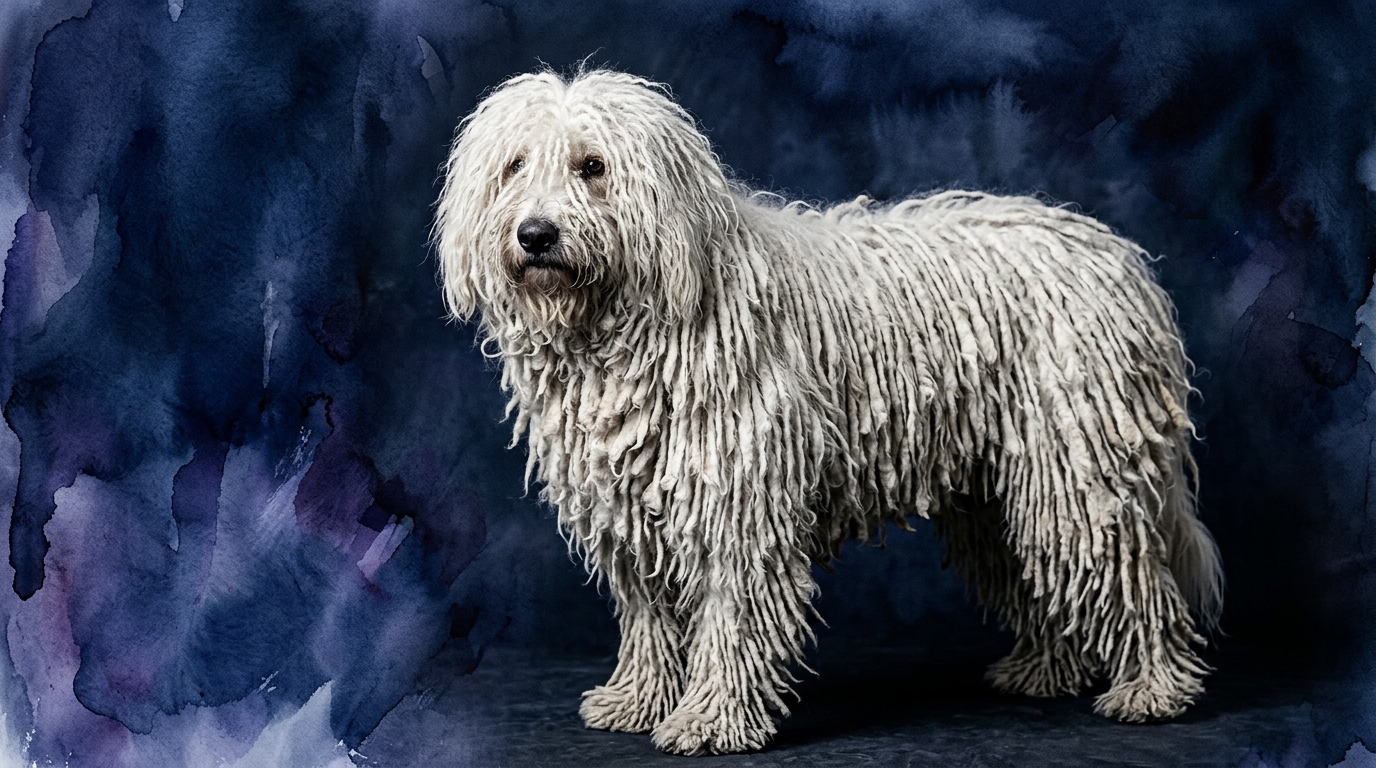

Side-by-Side Cognitive Profiles: Komondor and Pointer
At The Cosmic Pet Pet IQ Lab, we evaluate canine cognition across five key dimensions, each scored from 1 to 5. Despite both the Komondor and Pointer scoring a consistent 3/5 across the board, the manifestation of these scores differs profoundly, rooted in their breed-specific purposes. Understanding these nuances is key to appreciating their individual cognitive strengths.
For the **Komondor**, a Working breed ranked #67 by Coren:
**Problem Solving (3/5):** A Komondor's problem-solving acumen is characterized by independent, strategic thinking, particularly when assessing perceived threats to their territory or family. They are not quick to follow novel commands but excel at evaluating complex environmental cues to make their own decisions regarding security, often requiring minimal human intervention once a potential issue is identified. Their cognitive strength here lies in autonomous threat assessment and resolution, rather than solving puzzles for human entertainment.
**Training Speed (3/5):** Komondors learn at a moderate pace, but their training is less about rapid command acquisition and more about convincing them of a command's utility and logical consistency within their guardian mindset. Repetitive drills might be met with skepticism; they learn best when tasks are presented as practical applications of their protective instincts, with their learning curve significantly influenced by their inherent independence.
**Social Intelligence (3/5):** A Komondor's social intelligence is highly discerning and selective. They form deep, unwavering bonds with their primary family and "flock," demonstrating a keen understanding of their inner circle's emotional states and needs. However, their social acumen often includes a cautious, reserved approach to strangers, requiring careful introductions and a clear demonstration of non-threat before acceptance. They read intentions well but are not universally gregarious.
**Instinctive Drive (3/5):** The Komondor's instinctive drive is overwhelmingly protective and territorial. This 3/5 score reflects a powerful, deeply ingrained need to guard, survey, and defend. This isn't a drive for retrieving or chasing, but rather for vigilance and confrontation when necessary, making them highly attuned to their surroundings for anything amiss. This powerful instinct shapes much of their behavior and cognitive focus.
**Memory (3/5):** Komondors exhibit a robust memory, particularly for routines, boundaries, and past interactions with individuals. They remember perceived threats or trusted individuals for extended periods, contributing to their consistent guarding behavior. Their memory also serves their independent nature, allowing them to recall successful strategies for managing their territory or dealing with specific situations without constant reinforcement.
Turning to the **Pointer**, a Sporting breed (not Coren-ranked):
**Problem Solving (3/5):** A Pointer's problem-solving at 3/5 is typically focused on tasks related to their hunting heritage. This involves navigating varied terrain to locate game, interpreting scent trails, and understanding wind direction. They excel at figuring out how to achieve a goal within a structured hunting context, such as finding the most efficient path to cover ground or identifying the precise location of a hidden bird. Their problem-solving is less about independent decision-making and more about task-oriented execution.
**Training Speed (3/5):** Pointers demonstrate a moderate training speed, often eager to please and receptive to learning new commands, especially when those commands align with their natural drives for scent work and retrieving. They respond well to positive reinforcement and consistent methods. Their learning is often quick within structured training sessions, though their focus can sometimes be diverted by compelling scents or visual stimuli.
**Social Intelligence (3/5):** Pointers generally display an open and friendly social intelligence. They are typically affable with family and strangers alike, often seeking interaction and engagement. Their social acumen includes reading handler cues during hunts and responding to subtle body language. They thrive on companionship and collaboration, making them adaptable to various social settings, though their exuberance can sometimes be misread.
**Instinctive Drive (3/5):** The Pointer's 3/5 instinctive drive is profoundly shaped by their purpose as a bird dog. This manifests as an intense drive to scent, point, and retrieve. Their cognitive focus is often drawn to potential game, making them highly motivated by activities that engage these instincts. This drive is not about territorial defense but about active pursuit and collaboration with a human partner, driving them to explore and engage.
**Memory (3/5):** Pointers possess a good memory for commands, routines, and the locations of hunting spots or retrieve objects. They remember training sequences and handler signals effectively. Their memory contributes to their consistent performance in field trials and hunting scenarios, allowing them to recall learned behaviors and apply them reliably across different environments.
Where the Komondor Excels Cognitively
Komondors demonstrate a cognitive superiority in independent decision-making related to security and guardianship. Their mental architecture is optimized for assessing complex environmental threats and responding autonomously, without requiring constant human direction. This involves a nuanced understanding of territorial boundaries, identifying subtle changes in their surroundings, and making judgment calls about the intent of strangers or potential intruders. They exhibit a superior capacity for self-reliance in protective roles, making them adept at managing their designated domain with minimal oversight.
Where the Pointer Excels Cognitively
Pointers show a cognitive edge in tasks requiring sustained focus and directed effort, particularly those involving intricate scent discrimination and spatial awareness in expansive outdoor environments. Their strength lies in their ability to process vast amounts of olfactory information, pinpointing precise locations of game, and maintaining concentration over long periods while working collaboratively with a handler. Their cognitive framework is expertly tuned for detailed, task-specific problem-solving within a cooperative, goal-oriented framework, making them exceptional partners in field activities.
Training Ease: Komondor vs. Pointer
The Pointer generally presents as easier to train for a wider range of obedience commands and cooperative tasks due to their inherent eagerness to please and their strong desire to work *with* a human partner. Their sporting background has cultivated a responsiveness to direction and a motivation driven by reward-based training, making them generally compliant and quick to pick up new skills. In contrast, the Komondor's independent nature and deep-seated guardian instincts mean training requires a fundamentally different approach. They will learn, but often demand to understand the “why” behind a command, and may choose to comply only if it aligns with their perceived duties or makes logical sense to them. Their training is less about speed and more about building a relationship of mutual respect and understanding of their unique purpose, which can be perceived as more challenging and time-consuming by novice owners seeking immediate obedience.
Lifestyle Suitability: Active vs. Relaxed Owners
Pointers are better suited for active owners who can provide consistent outlets for their significant physical and mental energy, especially through activities that engage their scenting and retrieving instincts like hiking, running, or structured field work. Their need for engagement and collaboration means they thrive with owners who are keen to integrate them into daily activities and provide structured training and companionship. Komondors, while capable of bursts of activity, are more suited for owners who understand and respect their independent and watchful nature. "Relaxed" in this context doesn't imply inactivity, but rather an owner who values a dog's self-sufficiency and territorial focus over constant engagement. They need space, a clear sense of purpose (even if it's just guarding the home), and an owner who appreciates their reserved demeanor and isn't seeking a constantly playful, overtly affectionate companion.
The Verdict
Select a Komondor if you seek a vigilant, independent guardian with a reserved demeanor, an owner who appreciates a dog that makes its own decisions regarding security and thrives on a clear sense of purpose.
Opt for a Pointer if you're an active individual seeking an enthusiastic, cooperative companion eager for engagement in outdoor activities, particularly those involving scent work and collaborative tasks.
🧠 Find Your Pet's IQ Score
Our Pet IQ Lab assessment covers 25+ tests across 5 cognitive dimensions — personalized to your breed.
Take the Full IQ Test →Frequently Asked Questions
Do Komondors and Pointers learn at the same pace?
While both breeds score 3/5 in training speed, their learning styles differ significantly. Pointers are generally more eager to please and respond well to traditional, reward-based training, often appearing to learn commands faster. Komondors, due to their independent nature, learn at a moderate pace but require training that convinces them of a command's utility rather than just rote repetition.
Which breed is more affectionate with strangers?
Pointers typically display a more open and friendly social intelligence, often being affable with strangers and seeking interaction. Komondors, conversely, are reserved and cautious with unfamiliar individuals, forming deep bonds with their family but requiring clear demonstrations of non-threat before accepting newcomers into their circle.
Can a Komondor or Pointer live in an apartment?
Neither breed is ideally suited for apartment living due to their inherent needs. A Komondor requires space to survey and guard, thriving with a secure yard to fulfill its territorial instincts. A Pointer needs ample room for physical exercise and mental stimulation, especially activities that engage its sporting drives, making a house with a yard or regular access to open spaces preferable.