
Side-by-Side Cognitive Profiles: Decoding Their Moderate Scores
At The Cosmic Pet Pet IQ Lab, both the Komondor and the Soft Coated Wheaten Terrier consistently achieve a 3/5 rating across all five cognitive dimensions: Problem Solving, Training Speed, Social Intelligence, Instinctive Drive, and Memory. While these identical scores might suggest similar mental capabilities, a closer look reveals how their breed-specific applications of these moderate strengths diverge significantly, shaped by centuries of selective breeding for distinct roles.
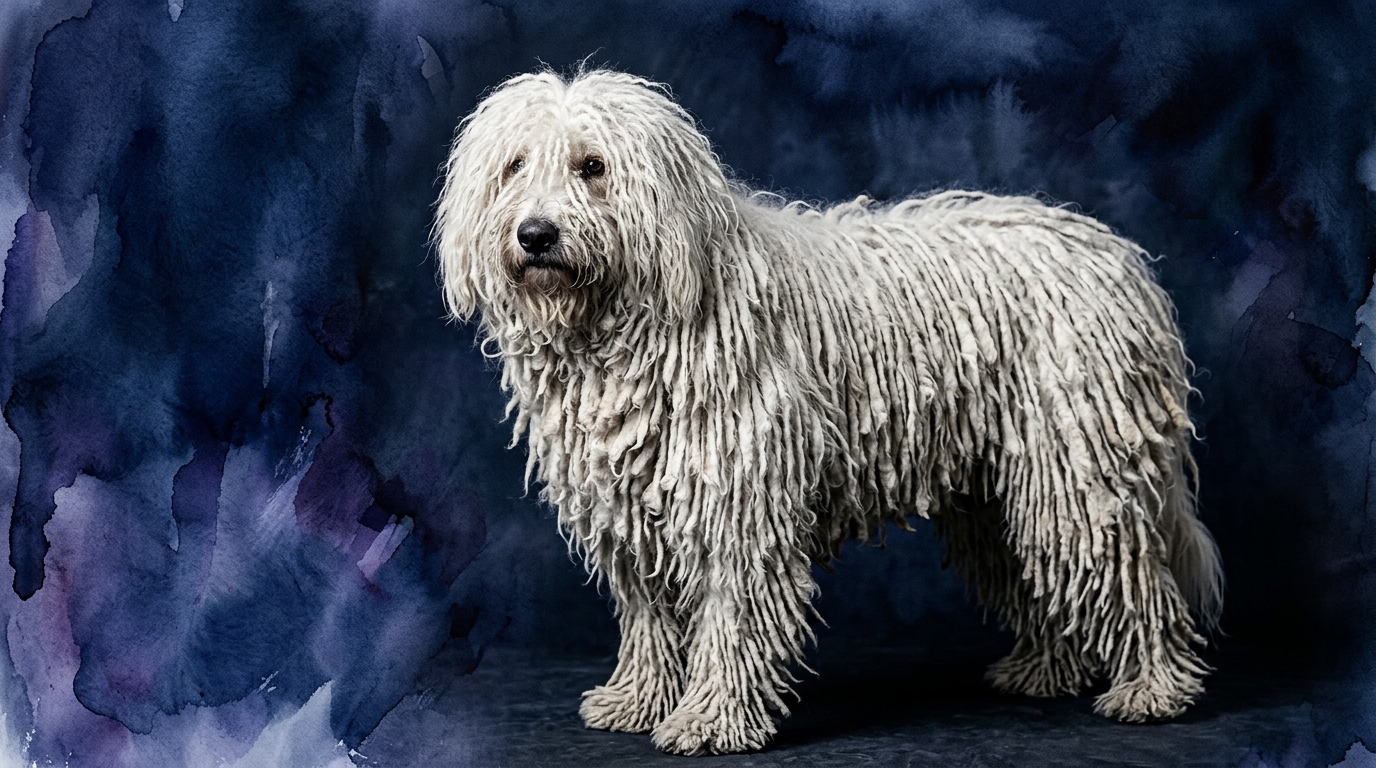
For the Komondor, a majestic Working group dog and livestock guardian, a 3/5 in **Problem Solving** translates into an impressive ability to independently assess and mitigate threats to its flock or family. This isn't about solving human-designed puzzles, but rather strategizing how to deter a predator or navigate a complex outdoor environment to protect its charges. Its **Training Speed** at 3/5 reflects a thoughtful, independent nature; commands are learned reliably, but often after the Komondor has processed their utility from its guardian perspective, requiring patience and consistency from the trainer. **Social Intelligence** (3/5) is profoundly directed towards its 'flock' – whether sheep or human family – enabling it to discern familiar members from strangers and understand subtle cues within its social unit, albeit often with a reserved demeanor towards outsiders. Its **Instinctive Drive** (3/5) is powerfully rooted in protective and territorial behaviors, an innate urge to patrol, observe, and intervene when perceived threats arise, often operating with minimal human input. Finally, its **Memory** (3/5) is crucial for recalling regular patrol routes, recognizing familiar faces, and remembering past threats or successful deterrent strategies, building a comprehensive mental map of its domain.
The Soft Coated Wheaten Terrier, a lively Terrier group member, applies its 3/5 cognitive scores in a manner indicative of its versatile farm dog heritage. Its **Problem Solving** (3/5) is expressed through its pursuit of vermin, figuring out how to get into tight spaces, or overcoming obstacles to reach a desired object. This involves quick, practical thinking for immediate, often physical tasks. A 3/5 in **Training Speed** means they are generally eager to please but also possess a classic terrier spiritedness; they can learn quickly when motivated, but their independent streak and tendency for self-amusement can sometimes make sustained focus challenging. Their **Social Intelligence** (3/5) is outwardly focused on engaging with their human family, reading moods, and participating enthusiastically in household activities. They thrive on interaction and are perceptive to human emotions, often seeking to be at the center of attention. Their **Instinctive Drive** (3/5) manifests as a strong urge to chase, dig, and explore, typical of terriers bred for pest control, driven by a lively curiosity to investigate their surroundings. Their **Memory** (3/5) is adept for recalling routines, game rules, and the location of favored toys or people, enabling them to retain learned commands and experiences effectively within a family context.
Where the Komondor Excels Cognitively
The Komondor’s cognitive strengths shine particularly in areas demanding independent strategic thinking and unwavering vigilance, directly stemming from its livestock guardian role. This breed excels in sustained, autonomous problem-solving within dynamic environments, such as assessing multiple potential threats to its charges and prioritizing responses without human command. For instance, a Komondor might distinguish between a harmless passing hiker and a genuine predatory animal, adjusting its deterrent strategy accordingly. Its cognitive prowess is deeply tied to its territorial awareness, allowing it to maintain an extensive mental map of its domain and the individuals within it, exhibiting an almost preternatural ability to detect anomalies. This consistent, long-term focus on protection, coupled with an innate understanding of livestock behavior and predator patterns, represents a unique cognitive advantage. The Komondor's memory is particularly robust for environmental details and threat recognition, allowing it to build a comprehensive 'database' of its surroundings and react based on accumulated experiences, demonstrating a profound, context-specific intelligence.
Where the Soft Coated Wheaten Terrier Excels Cognitively
The Soft Coated Wheaten Terrier demonstrates cognitive advantages in areas requiring quick adaptability, reactive problem-solving, and engaging social interaction. Their terrier heritage imbues them with a sharp, immediate cognitive processing ability, particularly effective in fast-paced situations like tracking and outmaneuvering small prey or navigating complex play scenarios. A Wheaten might quickly figure out how to retrieve a toy from under furniture or adapt its play style to different companions. Their social intelligence is geared towards active engagement and reciprocal interaction, making them highly responsive to human cues in games, training, and everyday life. This breed exhibits a particular knack for understanding and participating in joint activities, demonstrating a willingness to collaborate in problem-solving tasks initiated by their owners. Their memory is excellent for routines, learned tricks, and the intricacies of social play, allowing for fluid, interactive experiences. This combination of quick wit and social eagerness makes them adept at learning new games and engaging in varied, stimulating activities.
Which is Easier to Train and Why
When considering ease of training, the distinction between these two breeds lies not in a raw capacity to learn, but in their inherent motivations and approach to human direction. The Soft Coated Wheaten Terrier, with its eager-to-please nature and desire for human companionship, often appears 'easier' to train for standard obedience commands. They are generally keen to participate in training sessions, motivated by praise, treats, and the joy of interaction. However, their terrier spiritedness can introduce challenges; they can be easily distracted by novel stimuli, and their independent streak means they may prioritize an interesting scent or a potential chase over a 'stay' command. Consistent, engaging, and positive reinforcement-based training with short, fun sessions is most effective to harness their enthusiasm and manage their occasional stubbornness.
The Komondor presents a different training landscape. Their independence, a cornerstone of their ancestral guarding role, means they are bred to make decisions autonomously. This can translate into a slower 'Training Speed' not because they lack cognitive ability, but because they may question the necessity or logic of a command from their perspective as a guardian. They are not inherently disobedient, but they are discerning. Training a Komondor requires immense patience, understanding of their inherent purpose, and a strong, trusting relationship. They respond best to fair, consistent methods that respect their independent nature and channel their protective instincts appropriately. While they will reliably learn what is expected of them, achieving instant, eager compliance for tasks unrelated to their guarding duties may take more time and a deeper understanding of their unique psychology. Therefore, while the Wheaten might offer more immediate gratification in a typical obedience class, the Komondor’s training demands a more profound commitment to understanding its intrinsic motivations.
Which Suits Active Owners vs. Relaxed Owners
The lifestyle needs of these two breeds diverge significantly, making them suitable for different types of owners. The Soft Coated Wheaten Terrier is undeniably better suited for active owners. This breed possesses a lively energy level and a playful disposition that demands consistent physical exercise and mental engagement. Wheatens thrive on daily walks, romps in a secure yard, and participation in family activities like hiking or playing fetch. Their cognitive profile, with its emphasis on quick problem-solving and social interaction, means they require owners who can provide regular opportunities for mental stimulation through training, puzzle toys, and interactive games. A sedentary lifestyle would likely lead to boredom and potentially destructive behaviors for a Wheaten, making them an ideal companion for individuals or families who embrace an active, engaging routine.
In contrast, the Komondor, while possessing a formidable physical presence, does not require the same high-intensity, constant activity as a Wheaten. Their physical activity often takes the form of patrolling a large yard or property, observing their surroundings with a watchful eye. They are not typically a breed for long-distance running partners or intense agility courses. However, this does not mean they suit 'relaxed' owners in the sense of minimal engagement. Komondors need mental activity related to their guarding instincts, even if they don't have livestock. They require structured environments where they feel they have a 'job' to do, and owners who understand and respect their independent, protective nature. They suit owners who can provide ample space, consistent boundaries, and appreciate a dog that is a quiet, steadfast presence rather than a constant playmate. A Komondor thrives with an owner who is calm, confident, and can provide a secure environment where their innate guarding drives can be appropriately channeled, rather than suppressed.
The Verdict
Choose the Komondor if you seek a dedicated, independent guardian with a profound sense of purpose, appreciating a dog that thinks for itself and offers quiet, steadfast protection within a structured environment.
Opt for the Soft Coated Wheaten Terrier if you desire an energetic, engaging companion who thrives on interaction, play, and participation in family life, requiring consistent activity and mental stimulation.
🧠 Find Your Pet's IQ Score
Our Pet IQ Lab assessment covers 25+ tests across 5 cognitive dimensions — personalized to your breed.
Take the Full IQ Test →Frequently Asked Questions
Do Komondors get along with other pets?
Komondors are bred to protect their 'flock,' which can include other animals in their household if introduced properly and early. Their guarding instincts mean they may be wary of strange animals, but they can form strong, protective bonds with resident pets.
Are Soft Coated Wheaten Terriers good for first-time dog owners?
While affectionate, Wheatens possess a spirited terrier nature that benefits from experienced handling and consistent training. Their energy levels and occasional stubbornness can be a challenge for novices without proper preparation and commitment to their needs.
How do their protective instincts differ?
The Komondor's protective instinct is primarily defensive and territorial, focused on deterring threats to their perceived domain or family with a watchful presence. The Wheaten's instinct is more reactive and prey-driven, rooted in their terrier heritage of dispatching vermin, though they are also devoted family guardians who will alert to perceived threats.