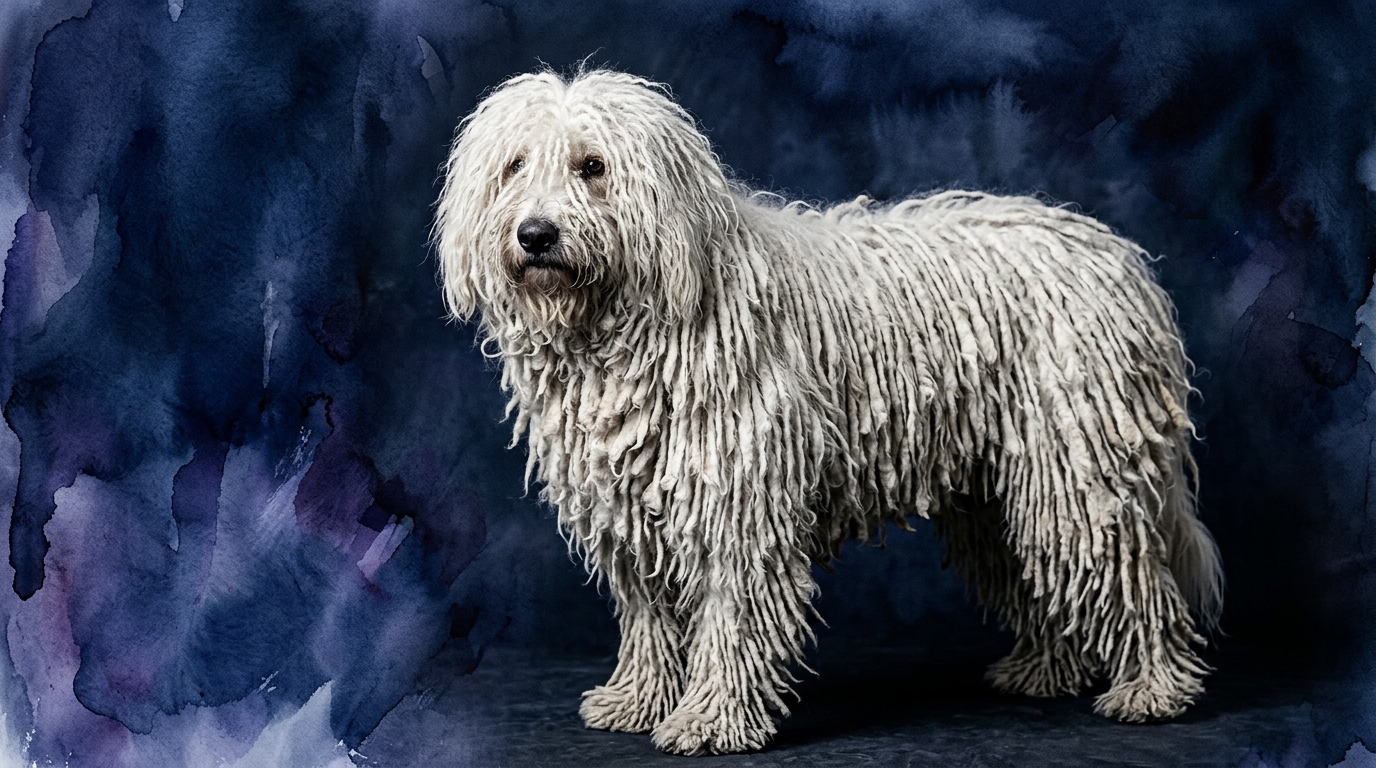

Side-by-Side Cognitive Profile: Komondor vs. West Highland White Terrier
The Cosmic Pet Pet IQ Lab's assessment reveals a nuanced picture of intelligence for these two distinct breeds, moving beyond simplistic notions of 'smart' to detail specific cognitive strengths. The Komondor, a formidable Working dog, registers a Coren rank of #67, reflecting its historical role as an independent livestock guardian. Its IQ scores are consistently balanced: Problem Solving 3/5, Training Speed 3/5, Social Intelligence 3/5, Instinctive Drive 3/5, and Memory 3/5. This consistent scoring across all dimensions suggests a well-rounded, reliable cognitive profile tailored for self-sufficiency and vigilance in its traditional duties.
In contrast, the West Highland White Terrier, a lively member of the Terrier group, boasts a higher Coren rank of #47, indicating a greater aptitude for obedience and working intelligence as defined by Coren's metrics. While its Problem Solving (3/5), Training Speed (3/5), Social Intelligence (3/5), and Instinctive Drive (3/5) scores mirror the Komondor's, the Westie distinguishes itself with a superior Memory score of 4/5. This elevated memory capacity hints at a cognitive design optimized for retaining complex information and learning sequences, a crucial asset for a breed historically tasked with intricate hunting scenarios and close human partnership.
The Coren ranks themselves offer an initial glimpse into their cognitive leanings; the Westie's higher placement suggests a more direct amenability to human-directed tasks and command-following, aligning with its role as a companion and pest controller. The Komondor's lower rank, however, should not be misconstrued as a deficit in intelligence but rather an indicator of its profound independence and a cognitive style that prioritizes autonomous decision-making over immediate human compliance, a trait essential for its centuries-old guardian responsibilities.
Where the Komondor's Cognition Excels
The Komondor's cognitive prowess truly shines in its capacity for self-reliant problem-solving within its specialized domain. Its 3/5 problem-solving score isn't about deciphering complex puzzles for human amusement, but about independently assessing environmental threats, distinguishing friend from foe, and strategically protecting its flock without direct human command. This involves a sophisticated understanding of territory, predator behavior, and the dynamics of its charges, demonstrating a practical, situation-specific intelligence that is crucial for its guardian role.
Its social intelligence, also rated 3/5, is deeply specialized and profoundly effective within its designated social circle. This isn't a broad, gregarious social intelligence, but rather an intense, discerning loyalty directed towards its family or 'flock.' A Komondor excels at understanding the subtle cues of its familiar humans and animals, forming an unwavering bond that fuels its protective instincts. This focused social awareness allows it to act as a vigilant sentinel, making independent judgments about who belongs and who poses a threat, a cognitive strength honed over centuries of isolated guardianship.
Furthermore, the Komondor's consistent 3/5 in instinctive drive underscores its unwavering commitment to its primary purpose. This isn't a restless, general drive, but a deeply ingrained, purposeful motivation to guard and protect. This cognitive fortitude ensures a Komondor remains steadfast and dedicated to its duties, even in challenging or solitary conditions. Its memory, while 3/5, is entirely sufficient for recalling the routines, boundaries, and individuals within its guarded domain, providing a stable foundation for its consistent performance.
Where the West Highland White Terrier's Cognition Shines
The West Highland White Terrier's standout cognitive strength lies in its superior Memory, scoring an impressive 4/5. This enhanced ability to retain information is invaluable for a breed that historically engaged in intricate hunting tasks, requiring the recall of complex scent trails, the precise location of burrows, and learned strategies for outsmarting small prey. For modern Westies, this translates into a remarkable capacity for learning and remembering a wide array of commands, tricks, and routines, making them highly receptive to consistent training and mental challenges.
While its Problem Solving is rated 3/5, similar to the Komondor, the Westie's application of this skill often manifests differently. Combined with its keen memory and instinctive drive, its problem-solving is typically geared towards navigating confined spaces, persistently pursuing objectives, or creatively overcoming obstacles to reach a desired outcome. This might involve figuring out how to retrieve a toy from an awkward spot or deducing patterns in interactive puzzle toys, demonstrating a nimble and persistent cognitive approach.
The Westie's higher Coren rank of #47 further highlights its cognitive advantages in human-directed learning. This rank signifies a greater inherent capacity for understanding and executing obedience commands, often with fewer repetitions compared to breeds with lower rankings. This trainable nature, coupled with its robust memory, positions the West Highland White Terrier as a dog that can quickly grasp and reliably perform a diverse repertoire of learned behaviors, making it a rewarding partner for owners who enjoy engaging in training and canine sports.
Training Dynamics: Komondor vs. Westie
When it comes to ease of training, the nuanced cognitive profiles of these breeds lead to distinct experiences. The Komondor, with its 3/5 Training Speed and strong Instinctive Drive for guardianship, is not inherently slow to learn, but its independence means it processes commands through the lens of its primary purpose. A Komondor is bred to make autonomous decisions to protect its flock, which translates into a thoughtful, often deliberate, approach to human directives. Training requires immense patience, consistency, and a profound understanding of its self-reliant nature; expecting blind obedience will likely lead to frustration. Real behavioral differences include its tendency to weigh commands against its perceived responsibilities, making it a partner rather than a subordinate in the training process.
The West Highland White Terrier, despite also scoring 3/5 in Training Speed, often presents as 'easier' to train in traditional obedience contexts due to its superior 4/5 Memory and higher Coren rank. This memory advantage allows Westies to retain commands and learned behaviors more readily and for longer periods. However, their 3/5 Instinctive Drive, rooted in their terrier hunting heritage, means they can be highly focused on scents, prey drive, and their own agenda, leading to moments of characteristic terrier stubbornness. Effective training for a Westie leverages positive reinforcement, keeps sessions engaging to combat boredom, and channels their natural curiosity and persistence, rather than attempting to dominate their spirited will. Their spirited nature means they are generally more inclined to engage enthusiastically with their human trainers, provided the activity is stimulating.
Matching Cognition with Lifestyle: Active vs. Relaxed Owners
The Komondor's cognitive makeup makes it an intriguing choice for specific types of 'active' owners, though not necessarily those seeking a physically high-energy companion for constant jogs. Its cognitive needs demand an owner who is actively engaged in managing, socializing, and understanding a large, independent breed that thinks for itself. Owners must be mentally prepared to respect its strong guardian instincts and self-sufficient problem-solving. A Komondor thrives with owners who provide a secure, spacious environment, consistent boundaries, and who are proactive in early socialization to channel its protective nature appropriately. It is not suited for truly 'relaxed' owners who desire a passive, low-maintenance mental companion, as its independent mind requires thoughtful interaction and oversight.
Conversely, the West Highland White Terrier's cognitive profile aligns well with owners who are 'active' in a more traditional sense, seeking a dog for regular physical activity and consistent mental engagement. Its curiosity, superior memory, and instinctive drive (3/5) mean it requires daily walks, engaging play sessions, and ongoing training to prevent boredom and potential mischief. Owners who enjoy interactive games, teaching new tricks, and providing puzzle toys will find the Westie a rewarding partner. It is less suited for 'relaxed' owners who prefer minimal interaction or cannot commit to meeting its needs for mental and physical stimulation, as an under-stimulated Westie can become restless or destructive, using its problem-solving skills to create its own entertainment.
The Verdict
Choose the Komondor if you seek a vigilant, independent guardian with a reserved nature, and you are prepared for its specific training needs and grooming commitment. It thrives with owners who respect its self-sufficient intelligence and provide a structured, secure environment.
Opt for the West Highland White Terrier if you desire a spirited, curious companion eager for engagement and mental challenges, and you can offer consistent training and ample opportunities for activity. It suits owners who appreciate a lively personality and a solid memory for learning.
🧠 Find Your Pet's IQ Score
Our Pet IQ Lab assessment covers 25+ tests across 5 cognitive dimensions — personalized to your breed.
Take the Full IQ Test →Frequently Asked Questions
Do Komondors get along with other pets?
Komondors, especially when raised with them from a young age, can integrate well with other household pets, viewing them as part of their 'flock.' However, their strong protective instincts mean proper introductions and ongoing supervision are crucial, particularly with new animals, to ensure harmonious cohabitation.
Are Westies good apartment dogs?
West Highland White Terriers can adapt to apartment living provided they receive sufficient daily exercise and mental stimulation from their owners. Their compact size is an advantage, but their energy levels and potential for vocalization (barking) necessitate dedicated owners who can meet their needs for activity and training within a confined space.
What grooming needs do these breeds have?
The Komondor requires extensive and unique grooming to maintain its corded coat, preventing matting and ensuring hygiene, which is a significant, specialized time commitment. The West Highland White Terrier, while not as demanding, needs regular brushing and occasional hand-stripping or clipping to keep its double coat healthy and tidy, preventing skin issues and excessive shedding.