
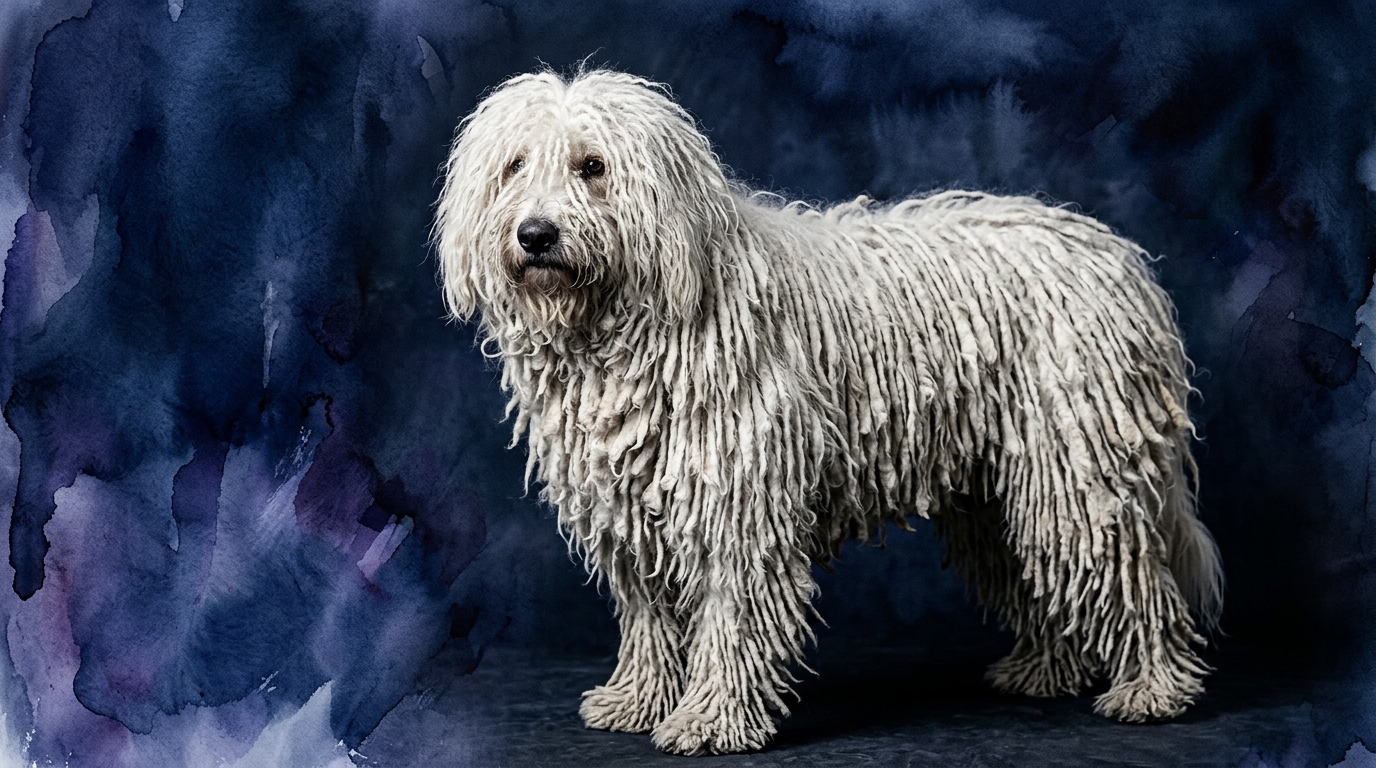
Side-by-Side IQ Profile: Labrador Retriever vs. Komondor
At The Cosmic Pet Pet IQ Lab, we evaluate canine intelligence across five key dimensions, offering a nuanced perspective beyond simple obedience. Understanding these facets helps us appreciate the unique cognitive architecture of each breed.
The Labrador Retriever, with a Coren rank of #7, showcases a formidable blend of collaborative and practical intelligence. Their Problem Solving is rated 4/5, indicating a strong aptitude for practical challenges, especially when a solution leads to a reward or pleases their human companions. They excel at tasks requiring sequential steps, object manipulation, and understanding cause-and-effect in scenarios like retrieving dropped items, navigating complex agility courses, or figuring out how to open a treat-dispensing puzzle. Their approach is often collaborative, seeking human guidance or approval as part of the solution, indicating a desire to work alongside their owner. Their Training Speed is an exceptional 5/5; this breed is remarkably quick to grasp new commands and routines, often requiring fewer repetitions than many other breeds. Their inherent enthusiasm for learning, combined with a strong desire to work alongside humans, contributes significantly to their rapid acquisition of new skills, making them highly receptive to various training methodologies, from basic obedience to advanced specialized tasks. Social Intelligence scores a perfect 5/5; Labradors possess remarkable social intelligence, adept at reading human cues, understanding emotional states, and adapting their behavior accordingly. They thrive on interaction and collaboration, forming deep bonds and demonstrating empathy, which underpins their success as service dogs, therapy animals, and beloved family members who seamlessly integrate into diverse social settings. Their Instinctive Drive is 4/5, primarily centered around retrieving, swimming, and an inherent desire to please. These drives are readily channeled into constructive activities and training, making them highly motivated by games of fetch, water activities, scent work, and tasks that involve carrying or finding objects. This strong drive makes them persistent and focused when engaged in a task that taps into these natural inclinations. Finally, their Memory is 4/5; Labradors exhibit a robust memory for commands, routines, and the locations of favored objects or people. They can recall complex sequences of behaviors, remember specific cues over long periods, and maintain a strong recollection of past experiences, which aids significantly in their long-term training, adaptability to established household norms, and the ability to perform intricate multi-step tasks reliably.
In contrast, the Komondor, with a Coren rank of #67, presents a very different cognitive profile, reflecting centuries of independent guarding work. Their Problem Solving is 3/5; Komondors approach problem-solving with a distinct independence, often preferring to assess situations and devise solutions autonomously, especially concerning their perceived duties of guarding. Their problem-solving is deeply rooted in their ancestral role, focusing on threat assessment, territorial defense, and strategic positioning to protect their flock or family, rather than engaging in human-directed puzzles or collaborative tasks. They excel at evaluating environmental cues and making decisions without waiting for instruction. Their Training Speed is 3/5; this breed exhibits a moderate pace for learning new behaviors, often preferring to analyze a command's utility and align it with their inherent purpose before complying. They are not as driven by human approval as Labradors, which can make training a more deliberate, patience-testing process requiring clear communication, firm consistency, and a profound understanding of their independent, self-willed nature. They learn, but on their own terms. Social Intelligence is 3/5; Komondors demonstrate a focused social intelligence, primarily directed towards their immediate family and the livestock they guard. While fiercely loyal and protective of their inner circle, their social interactions are typically reserved and less outwardly expressive with strangers or outside the context of their duties. They are observant of their human family but might not engage in the same level of interactive play or broad emotional reciprocity seen in more people-oriented breeds. Their Instinctive Drive is 3/5; their primary instinctive drive is guarding – protecting their flock or family with unwavering vigilance and a strong territorial instinct. This drive manifests as an innate ability to discern threats, leading to a self-reliant and watchful demeanor that requires little prompting. These instincts are deeply ingrained and less about performing human-directed tasks, making them intrinsically motivated by their protective role. Their Memory is 3/5; Komondors possess a solid memory for their territory, established routines, and the individuals they consider part of their flock or family. They remember threats and safe individuals, contributing significantly to their effective guarding capabilities and consistent patrolling patterns. However, their memory might be less focused on recalling a vast repertoire of abstract commands or intricate sequences compared to breeds specifically bred for diverse performance tasks.
Where the Labrador Retriever Wins Cognitively
Labradors demonstrate a distinct advantage in domains requiring active collaboration, rapid assimilation of new information, and sustained engagement with human partners. Their superior social intelligence allows them to quickly interpret human intentions and emotional states, making them exceptionally responsive partners in training, daily life, and complex service roles. The Labrador's strong problem-solving skills, particularly when a human-centric solution is desired, combined with their remarkable training speed, mean they excel at learning intricate tasks, adapting to varied environments with enthusiasm, and reliably performing multi-step commands. They readily engage in activities that require sustained focus and interaction with people, such as intricate obedience routines, agility, or scent work, where their memory for sequences and commands shines.
Where the Komondor Wins Cognitively
The Komondor's cognitive strengths lie in their profound independence, self-reliant decision-making, and an innate understanding of their environment, honed over centuries of livestock guarding. Their problem-solving, while not geared towards human-directed puzzles, is highly effective in assessing and neutralizing threats within their territory without human intervention. This breed possesses an unmatched ability to survey their surroundings, identify potential dangers, and act decisively to protect their charges with minimal external prompting. Their focused social intelligence ensures unwavering loyalty and protection for their family or flock, combined with a memory that retains critical information about safe individuals, perceived threats, and established territorial boundaries. This makes them exceptional at autonomous vigilance and strategic defense, a cognitive domain where few breeds can compare.
Training Ease: Labrador vs. Komondor
The Labrador Retriever is considerably easier to train due to a confluence of behavioral traits and cognitive predispositions. Their exceptionally high training speed means they pick up new commands and routines with minimal repetition, often eager to please their handler. This eagerness stems from their profound social intelligence, which makes them highly motivated by positive reinforcement and human interaction. They possess a strong desire to collaborate and integrate into family structures, making them naturally inclined to follow direction. Their strong memory for commands further cements their trainability, allowing them to build a vast repertoire of learned behaviors over time.
In contrast, the Komondor's independent problem-solving and moderate training speed mean they require a more patient and nuanced approach. They are less driven by human approval and will often evaluate a command's purpose, sometimes opting not to comply if it doesn't align with their intrinsic guarding instincts or seems unnecessary. Their self-reliant nature means they respond best to consistent, clear, and fair training that respects their independence, rather than expecting unquestioning obedience. Training a Komondor is more about building a respectful partnership based on mutual trust and understanding their inherent motivations, which are often tied to their protective role rather than performing for praise.
Matching Breeds to Lifestyles: Active vs. Relaxed Owners
The Labrador Retriever is an ideal match for active owners who enjoy engaging their dog in a variety of activities. Their high energy levels, combined with their instinctive drive for retrieving and swimming, make them excellent companions for long walks, hikes, runs, and water sports. Owners who appreciate a dog eager for training, canine sports, and constant companionship will find the Labrador’s collaborative nature and social intelligence deeply rewarding. They thrive in environments where they receive ample mental and physical stimulation, participating actively in family life and enjoying structured activities.
Conversely, the Komondor is better suited for owners who appreciate a more relaxed, yet vigilant, presence. While they require space to patrol and observe, their activity level is generally lower than a Labrador's, focusing more on watchful monitoring than energetic play. They thrive with owners who understand their independent guardian temperament, provide a secure environment, and are prepared for a dog that values its own counsel and offers protection rather than constant interactive engagement. They are not typically seeking high-energy games or constant human interaction, preferring to quietly observe and fulfill their protective duties.
The Verdict
Choose the Labrador Retriever if you seek a highly trainable, socially interactive companion eager to participate in family activities and excel in diverse tasks requiring collaboration.
Opt for the Komondor if you value an independent, self-reliant guardian with a strong protective instinct, suited to a lifestyle where their autonomous vigilance is appreciated.
🧠 Find Your Pet's IQ Score
Our Pet IQ Lab assessment covers 25+ tests across 5 cognitive dimensions — personalized to your breed.
Take the Full IQ Test →Frequently Asked Questions
Do Komondors learn tricks as readily as Labradors?
Komondors can learn tricks, but generally not with the same speed or enthusiasm as Labradors. Their independent nature means they often need more repetition and persuasion, and they may not see the inherent "purpose" in performing a trick for entertainment alone, preferring tasks related to their guarding instincts.
How does a Labrador's social intelligence benefit its owner?
A Labrador's high social intelligence allows them to form deep emotional bonds, readily understand human cues, and adapt their behavior to suit different social situations. This makes them exceptionally empathetic companions, easier to integrate into family life, and highly effective as assistance or therapy dogs.
Is the Komondor's lower Coren rank indicative of a lack of intelligence?
The Coren rank primarily measures "working and obedience intelligence," reflecting how quickly a dog learns human-directed commands. A lower rank for the Komondor doesn't mean a lack of intelligence overall, but rather highlights their independent nature and preference for autonomous problem-solving over strict obedience to human instruction, which is a strength in their guarding role.