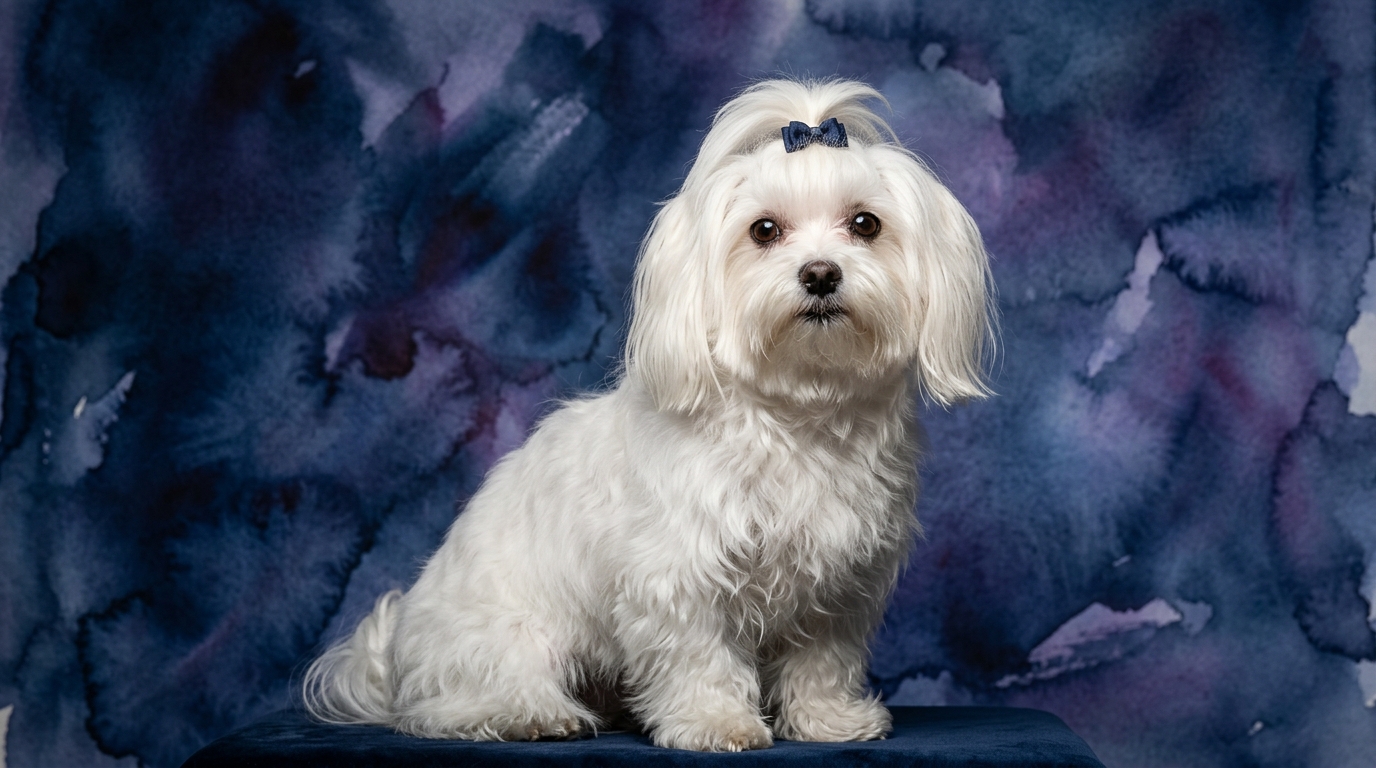

Side-by-Side IQ Profile: Maltese vs. Sussex Spaniel
The Cosmic Pet Pet IQ Lab employs a five-dimensional framework to assess canine intelligence, providing a granular view beyond a single rank. Both the Maltese and Sussex Spaniel sit closely in the Coren ranking, at #59 and #62 respectively, yet their individual cognitive profiles reveal distinct aptitudes.
For the Maltese (Coren Rank #59), its cognitive breakdown is as follows: Problem Solving (3/5), Training Speed (3/5), Social Intelligence (5/5), Instinctive Drive (2/5), and Memory (3/5). This profile suggests a breed that possesses a respectable capacity for navigating novel situations and figuring out solutions to moderate challenges, such as learning to manipulate simple latches or understanding basic cause-and-effect scenarios within their living environment. They acquire new commands and behaviors at a moderate pace, benefiting from consistent, reward-based training. Where the Maltese truly shines is its exceptional social intelligence, indicating a profound attunement to human emotions, body language, and social cues, fostering deep bonds and appropriate responses to human affection or distress. As a breed primarily developed for companionship, their instinctive drive for hunting, herding, or guarding behaviors is minimal. Finally, the Maltese maintains a solid memory for learned commands, routines, and experiences, recalling familiar faces and places readily and retaining behavioral sequences with consistent reinforcement.
In contrast, the Sussex Spaniel (Coren Rank #62) presents a slightly different cognitive architecture: Problem Solving (3/5), Training Speed (3/5), Social Intelligence (3/5), Instinctive Drive (3/5), and Memory (3/5). Like the Maltese, the Sussex demonstrates a moderate ability to tackle problems, on par with its companion counterpart, capable of analyzing straightforward situations and devising solutions relevant to both field work and domestic life. Their training speed is also moderate, requiring patience and consistency, though their desire to please and working background ensure they are receptive to instruction over time. The Sussex Spaniel possesses a sound level of social intelligence, allowing them to connect well with their human families and understand social dynamics, though their focus might be more balanced between human interaction and their environment. As a sporting breed, their moderate instinctive drive manifests as a natural inclination for scent work, flushing game, and retrieving, albeit with a deliberate style, requiring appropriate outlets. Lastly, the Sussex Spaniel, much like the Maltese, holds a good memory for commands, learned tasks, and significant experiences, crucial for a working breed that needs to recall specific cues and follow complex sequences.
Where the Maltese Wins Cognitively
The Maltese's standout cognitive strength lies in its exceptional social intelligence, scoring a perfect 5 out of 5, significantly higher than the Sussex Spaniel's 3/5. This manifests as an unparalleled ability to read and respond to human emotions and social cues. A Maltese often anticipates its owner's mood, offering comfort during distress or joining in joyful moments with uncanny timing. They excel at forming deep, intuitive bonds, understanding subtle shifts in tone or body language, making them extraordinarily empathetic companions. This heightened social awareness means they are often more responsive to subtle human feedback during interactions, and their world is largely centered around their human connections, driving much of their behavior and learning.
Where the Sussex Spaniel Wins Cognitively
The Sussex Spaniel's cognitive edge is found in its moderately higher instinctive drive, scoring 3 out of 5 compared to the Maltese's 2/5. This inherent drive is a remnant of its sporting dog heritage, giving it a natural inclination towards scent work, tracking, and retrieving. While not as high-strung as some other gun dog breeds, a Sussex Spaniel possesses a purposeful curiosity about its environment, driven by its nose and an urge to explore and "work." This means they are often more engaged by tasks that tap into these natural instincts, such as scent games or retrieving toys, and find satisfaction in activities that allow them to utilize these ingrained behaviors. Their cognitive engagement can be deeply tied to these primal motivations, making them particularly receptive to training that leverages these natural urges.
Which is Easier to Train and Why
Both breeds share an identical training speed rating of 3 out of 5, suggesting neither is inherently faster or slower at acquiring new commands. However, the approach to training and the specific behavioral differences influence perceived ease. The Maltese, with its superior social intelligence (5/5), often demonstrates a profound eagerness to please its human companion. This strong desire for connection and approval can translate into a cooperative attitude, making them highly motivated by praise and positive reinforcement, and often more forgiving of handler errors. They thrive on interactive, bond-building training sessions.
In contrast, the Sussex Spaniel, with its moderate instinctive drive (3/5), might require training that incorporates and channels its natural working tendencies. While equally capable of learning, their attention might occasionally drift towards an interesting scent or a perceived "task," necessitating a trainer who can effectively integrate their innate drives into the learning process. Therefore, while both are trainable, the Maltese's human-centric focus might make the process feel more intuitive for owners seeking a responsive, companion-oriented learner, whereas the Sussex might need more structured, purpose-driven engagement.
Which Suits Active Owners vs. Relaxed Owners
The choice between these breeds largely depends on an owner's lifestyle and energy levels. The Maltese, belonging to the Toy group with a low instinctive drive (2/5), is generally well-suited for more relaxed owners or those living in smaller spaces. Their exercise needs are moderate, typically satisfied with daily walks and indoor play, and their primary focus is companionship. They thrive on close human interaction and are content to be lap dogs for much of the day, making them ideal for individuals or families seeking a devoted, less demanding canine presence.
Conversely, the Sussex Spaniel, a Sporting breed with a moderate instinctive drive (3/5), aligns better with active owners who can provide consistent opportunities for mental and physical engagement. While not hyperactive, they require regular, purposeful exercise that allows them to utilize their natural sniffing and exploring instincts. Long walks, hikes, scent games, or even participation in dog sports like tracking or obedience are beneficial. Their robust build and love for the outdoors mean they are excellent companions for owners who enjoy spending time outside and can commit to channeling their working heritage.
The Verdict
Select the Maltese if you prioritize an intensely social, empathetic companion whose world revolves around human connection and who thrives in a less physically demanding, indoor-centric lifestyle.
Opt for the Sussex Spaniel if you are an active individual or family seeking a robust, characterful companion who enjoys outdoor adventures and whose moderate working drive can be consistently engaged through purposeful activities.
🧠 Find Your Pet's IQ Score
Our Pet IQ Lab assessment covers 25+ tests across 5 cognitive dimensions — personalized to your breed.
Take the Full IQ Test →Frequently Asked Questions
Does the Maltese's higher social intelligence make it easier to live with?
The Maltese's exceptional social intelligence (5/5) often translates into a dog that is highly attuned to its family's dynamics and emotions, making them very adaptable and responsive companions. This deep understanding of social cues can indeed make them feel more intuitive and easier to integrate into a household, as they excel at forming strong, empathetic bonds.
How does the Sussex Spaniel's instinctive drive impact its daily behavior?
The Sussex Spaniel's moderate instinctive drive (3/5) means they have a natural inclination for activities like sniffing, exploring, and retrieving. This manifests as a purposeful curiosity and a need for regular mental and physical engagement that taps into these instincts, preventing boredom and potential behavioral issues if not properly channeled.
Despite similar training speeds, are there differences in what motivates each breed?
Yes, while both learn at a similar pace, their primary motivators differ. The Maltese is often driven by the strong desire for human approval and affection due to its high social intelligence. The Sussex Spaniel, while also seeking approval, is often highly motivated by tasks that engage its natural instincts, such as scent work, retrieving, or exploring, making these excellent training tools.