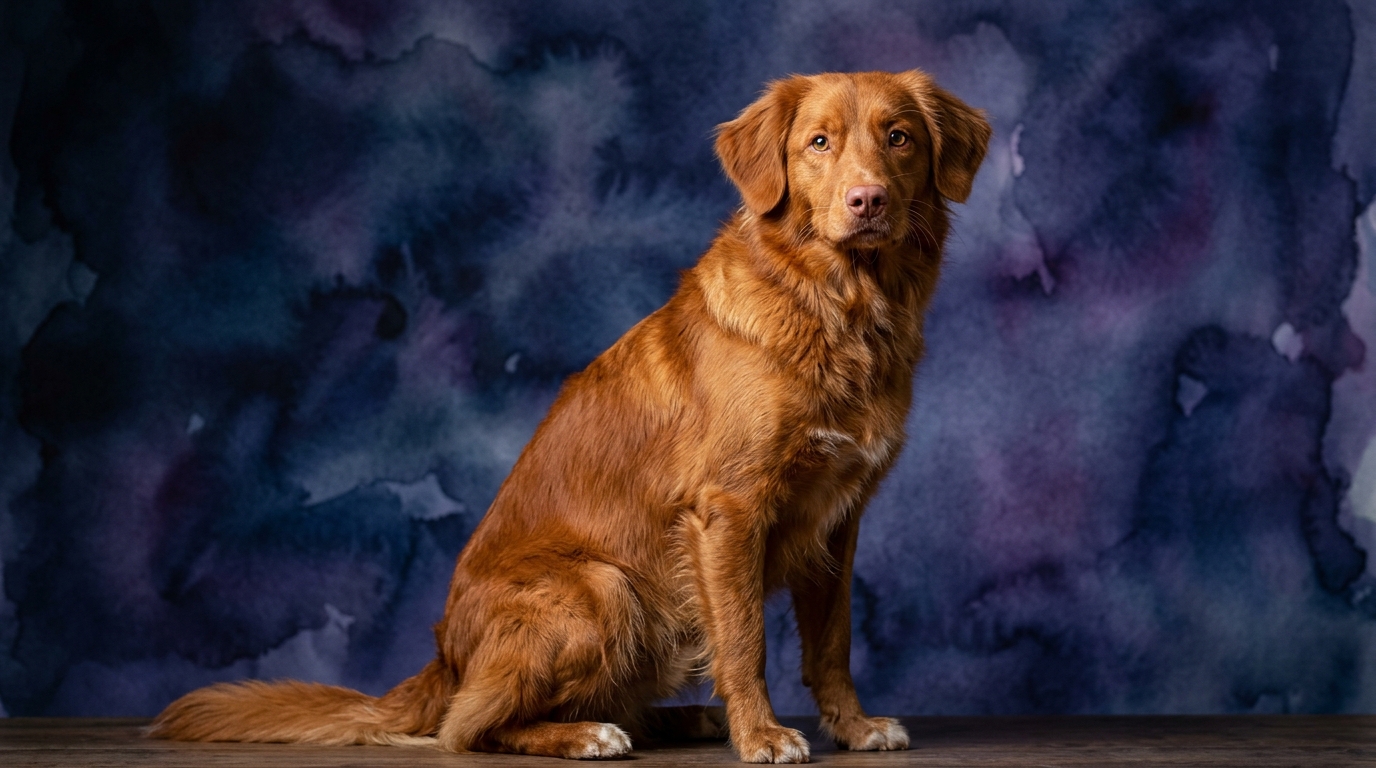

Side-by-Side IQ Profile: Unpacking the 3/5 Score
When two breeds register the same score across all cognitive metrics, it doesn't imply a lack of individual mental nuance; rather, it prompts us to examine how their inherent drives and temperaments shape the application of those cognitive abilities. Both the Nova Scotia Duck Tolling Retriever and the Wirehaired Pointing Griffon demonstrate a moderate level of cognitive function across the board, suggesting they are capable learners with a balanced blend of instinct and adaptability.
For the Nova Scotia Duck Tolling Retriever, a 3/5 in Problem Solving often translates into resourcefulness when navigating challenging terrains for retrieves or figuring out how to engage a reluctant bird. Their Training Speed at 3/5 indicates they pick up commands at a steady pace, though their independent streak, integral to their decoying work, means consistency is paramount. Social Intelligence at 3/5 allows them to form strong bonds with their families, reading owner cues effectively while often maintaining a reserved demeanor with strangers. Their Instinctive Drive, also 3/5, is strongly geared towards retrieving, often accompanied by their distinctive vocalizations. Finally, a 3/5 in Memory enables them to recall complex sequences of retrieves and retain learned behaviors over time.
The Wirehaired Pointing Griffon’s 3/5 in Problem Solving manifests in their methodical approach to scent work and their adaptability to varied hunting conditions, efficiently quartering a field. Their 3/5 Training Speed reflects an eagerness to please that makes them generally receptive to instruction, though their powerful scent drive can momentarily override other directives. A Social Intelligence score of 3/5 means they are deeply devoted to their human companions, often described as 'people dogs' who thrive on interaction and collaboration, particularly in the field. Their Instinctive Drive, also 3/5, is a balanced blend of pointing and retrieving, characteristic of a versatile gundog. Their 3/5 Memory is evident in their ability to remember scent patterns, bird locations, and handler signals across expansive areas.
Where the Nova Scotia Duck Tolling Retriever Wins Cognitively
While their numerical scores are identical, the Toller’s cognitive strengths shine in specific applications. Their 3/5 Problem Solving, for instance, is particularly evident in their specialized decoy work. This involves a unique cognitive sequence: enticing waterfowl by playing and disappearing along the shoreline, then returning to retrieve downed birds. This requires not just physical agility but a sequence of actions, timing, and an understanding of cause-and-effect that is central to their breed purpose. Their memory, also a 3/5, is often acutely tuned to marking the fall of multiple birds, allowing them to recall the precise location of each retrieve, even after a period of distraction or complex water currents.
The Toller's instinctive drive, while rated 3/5, includes a vocal component – the 'Toller scream' – which, in its original context, is a specific cognitive adaptation to attract waterfowl. This isn't just noise; it’s a targeted, innate behavior that requires an understanding of how their actions influence their environment. This blend of focused retrieving problem-solving, precise memory for marking, and instinctual vocal decoying gives the Toller a distinct cognitive edge within their niche.
Where the Wirehaired Pointing Griffon Wins Cognitively
The Wirehaired Pointing Griffon, too, leverages its 3/5 cognitive scores in ways that highlight its unique strengths. Their 3/5 Social Intelligence, while numerically matched with the Toller, often manifests as an exceptional desire for partnership and collaboration in the field. Griffons are renowned for their willingness to work closely with their handler, reading subtle body language and vocal cues to adjust their search patterns or hold a point. This collaborative spirit makes them particularly effective as versatile hunting companions, where teamwork is paramount.
Their 3/5 Problem Solving is consistently applied to their methodical approach to scent work, systematically quartering fields and deciphering complex scent trails to locate birds. This isn't just instinct; it's an active mental process of elimination and deduction in a dynamic environment. Furthermore, their instinctive drive, also 3/5, is a beautifully integrated system of pointing, retrieving, and water work, demanding a cognitive flexibility to transition between these roles seamlessly. This versatility, driven by their balanced instincts and collaborative intelligence, sets the Griffon apart in its specific domain.
Which is Easier to Train and Why?
Both breeds register a 3/5 in Training Speed, indicating they learn at a moderate pace and require consistent, positive reinforcement. However, their behavioral nuances can influence the perceived ease of training. The Nova Scotia Duck Tolling Retriever, despite its eagerness to please, can sometimes exhibit an independent streak; this trait, while beneficial for their self-directed decoying work, can translate into moments of stubbornness during general obedience training. Their sensitivity means harsh corrections are counterproductive, and their propensity for vocalization may require specific training to manage.
The Wirehaired Pointing Griffon, with its strong desire for companionship and collaborative spirit, often responds very well to training, motivated by praise and interaction. However, their powerful instinctive drive for scent work can present a challenge. If a compelling scent is encountered, a Griffon might become momentarily engrossed, potentially delaying a recall or other command. Training a solid 'leave it' and recall in distracting environments is crucial for the Griffon. Overall, while both demand patience, the Griffon’s inherent biddability and desire to work with its handler might make general obedience slightly more straightforward, provided their strong scent drive is actively managed through consistent, engaging training methods.
Active Owners vs. Relaxed Owners: A Cognitive Fit
Neither the Nova Scotia Duck Tolling Retriever nor the Wirehaired Pointing Griffon are suitable companions for relaxed or sedentary owners. Both are sporting breeds with significant energy levels and a deep cognitive need for purpose and activity. A lack of appropriate mental and physical outlets will invariably lead to boredom, frustration, and potentially destructive behaviors in either breed.
The Toller thrives on activities that engage its retrieving instincts, particularly water work, fetch games, and dog sports like agility or dock diving. Their cognitive makeup demands consistent mental challenges, and they can become restless if not given a 'job' to do. Similarly, the Griffon requires vigorous daily exercise, often enjoying long hikes, swimming, and opportunities for scent work or field trials. Their cognitive need for collaboration and exploration means they are happiest when actively participating in outdoor adventures with their human companions. Owners who enjoy an active, outdoor lifestyle and are prepared to engage their dog's mind with regular training and varied activities will find either breed a rewarding partner.
The Verdict
Choose a Nova Scotia Duck Tolling Retriever if you appreciate a dog with a resourceful, independent spirit for retrieving, thrives on water work, and you're prepared for their unique vocalizations.
Opt for a Wirehaired Pointing Griffon if you seek a highly collaborative hunting partner for diverse terrain, value a devoted companion, and can channel their strong pointing and retrieving drives.
🧠 Find Your Pet's IQ Score
Our Pet IQ Lab assessment covers 25+ tests across 5 cognitive dimensions — personalized to your breed.
Take the Full IQ Test →Frequently Asked Questions
Do Tollers or Griffons make better family pets?
Both breeds can integrate well into family life, given proper socialization and exercise. Tollers are often described as reserved with strangers but devoted to their family, while Griffons are generally more outgoing and affectionate with everyone, thriving on close companionship.
How much mental stimulation do these breeds need daily?
Both Tollers and Griffons require significant daily mental stimulation, beyond just physical exercise. This can include training sessions, puzzle toys, scent games, and opportunities to engage their natural retrieving or pointing instincts, preventing boredom and potential destructive behaviors.
Are Tollers or Griffons prone to stubbornness during training?
While both breeds possess a 3/5 training speed, implying moderate biddability, they can exhibit stubbornness. Tollers sometimes show an independent streak related to their decoy work, while Griffons might be momentarily distracted by compelling scents, requiring consistent, positive reinforcement to maintain focus.