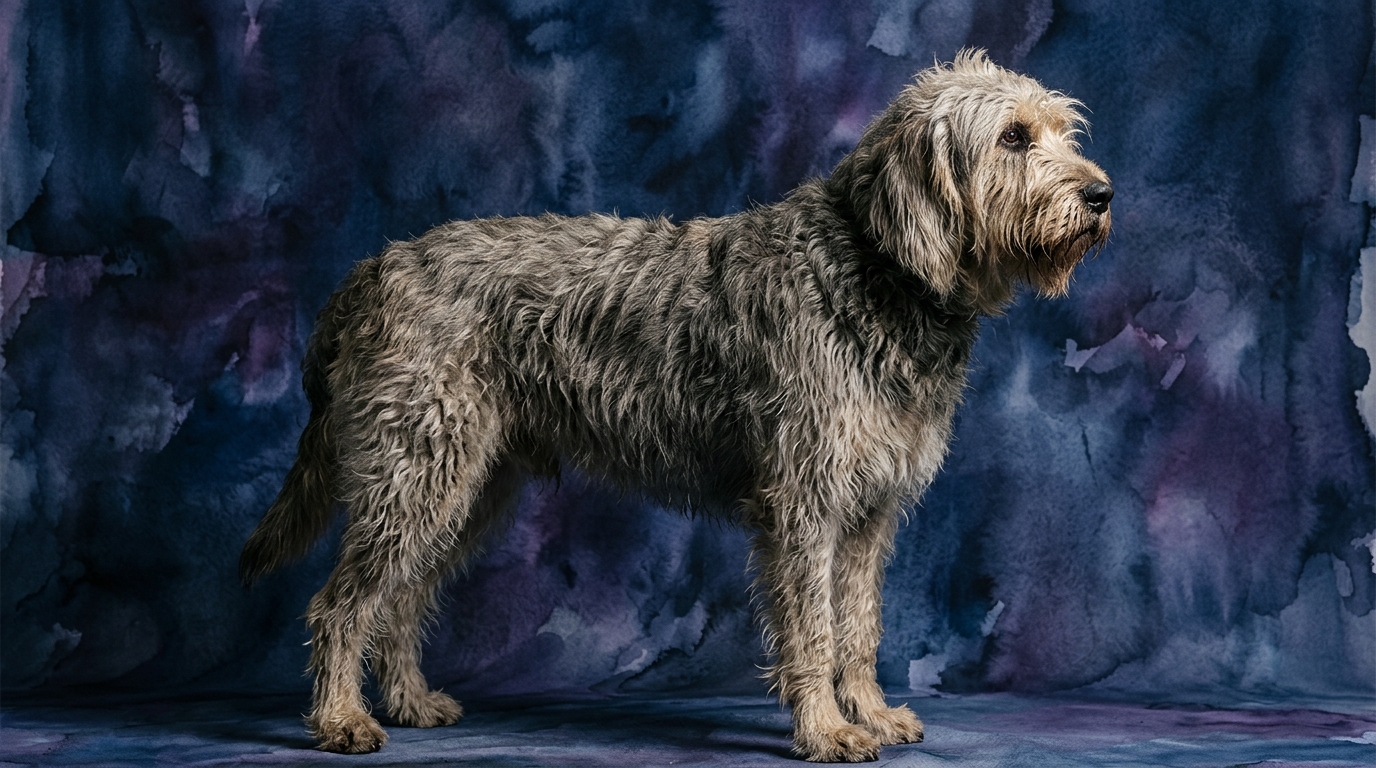

Side-by-Side IQ Profile: Unpacking Identical Scores
At The Cosmic Pet Pet IQ Lab, we assess canine intelligence across five key dimensions, assigning a score out of five for each. Interestingly, both the Otterhound and the Russian Toy register a 3/5 across the board. However, these identical scores don't mean identical minds; instead, they highlight how a similar level of cognitive ability can manifest in vastly different ways, shaped by centuries of selective breeding and distinct life purposes.
The Otterhound, a robust scenthound, displays a Problem Solving score of 3/5 primarily through its ability to navigate complex environmental challenges. This isn't about solving intricate puzzles on a coffee table, but rather about interpreting subtle scent changes, finding the most efficient path through dense undergrowth, or strategizing how to cross a stream during a long chase. Their cognitive determination is evident in their sustained focus on a goal, requiring deep engagement with their physical surroundings and an unwavering commitment to a task.
Their Training Speed, also at 3/5, indicates that Otterhounds are capable learners but demand patience and consistency. While they can acquire commands, their powerful instinctive drive often dictates their immediate attention, making distractions a significant factor. Successful training hinges on making lessons highly engaging and often aligning them with their natural inclinations, with reinforcement crucial for long-term retention.
In Social Intelligence (3/5), Otterhounds exhibit a cooperative and pack-oriented understanding. They form strong, often boisterous bonds with their human family, viewing them as an integral part of their group. This intelligence allows them to work collaboratively, understand group dynamics, and respond to cues from trusted leaders. Their social awareness is more geared towards harmonious group functioning rather than reading nuanced individual human emotional shifts.
The Otterhound's Instinctive Drive, rated 3/5, is powerfully centered around their nose. Their entire cognitive framework is heavily influenced by their innate desire to track and follow scents to their conclusion. This drive is pervasive, often overriding other considerations, and defines much of their behavior and problem-solving strategies, making them relentless in their pursuit of an interesting aroma. It is a fundamental aspect of their breed identity.
Finally, their Memory score of 3/5 reflects a solid capacity for recalling practical information. This includes remembering complex scent trails, navigating familiar routes and territories, and retaining training cues when consistently reinforced. Their memory serves a functional purpose, allowing them to effectively operate within their environment and recall information relevant to their primary drives and routines.
Turning to the Russian Toy, a delicate companion breed, their Problem Solving score of 3/5 is typically demonstrated in a domestic context. Their cleverness is often applied to their immediate surroundings: figuring out how to retrieve a favored toy from under furniture, manipulating objects or situations to gain attention or treats, or even devising strategies to access forbidden areas. Their solutions often involve observation, trial-and-error, and a degree of charm, showcasing an adaptability to their human-centric world.
Their Training Speed, also 3/5, indicates that Russian Toys can learn quite quickly, particularly when instruction is positive, engaging, and kept brief. Their smaller size and sometimes sensitive nature mean that harsh methods are counterproductive. They respond best to reward-based training, often excelling in activities like trick training or basic obedience when highly motivated and sessions are fun, though their attention span might necessitate shorter, more frequent bursts of learning.
The Russian Toy's Social Intelligence, also 3/5, is finely tuned to their human companions. This score highlights their exceptional capacity to read subtle human emotions, anticipate moods, and adjust their behavior accordingly. They often form profound, exclusive bonds, excelling at providing comfort and companionship, demonstrating a sophisticated understanding of interpersonal dynamics within their immediate family unit. They are highly responsive to their owner's tone and body language.
Their Instinctive Drive, rated 3/5, is primarily focused on companionship, alertness, and sometimes a playful, almost terrier-like chase instinct for small moving objects. This drive reflects an innate desire to be near their human, to alert them to perceived threats (often via barking), and to engage in interactive play. It is less about strenuous physical exertion and more about maintaining a close, watchful, and interactive relationship.
In terms of Memory, also 3/5, Russian Toys exhibit a good capacity for recalling routines, specific people, and past interactions. They can remember where certain toys are kept, associate specific cues with rewards, and often hold distinct memories of both positive and negative experiences. This memory contributes to their ability to adapt to household schedules and form lasting bonds, remembering who is a friend and who might be a stranger.
Where the Otterhound Excels Cognitively
While both breeds register a 3/5 in problem-solving, the Otterhound's cognitive strengths shine in scenarios demanding sustained, independent work in complex, expansive environments. Their problem-solving isn't about quick tricks for a treat but involves intricate decision-making during a long hunt: interpreting subtle scent changes, evaluating terrain for optimal passage, and maintaining unwavering focus despite physical fatigue or environmental distractions. This profound persistence, combined with a memory for practical routes and patterns, allows them to 'win' in tasks requiring deep environmental engagement and unwavering dedication to a physical objective, often over extended periods where immediate human feedback is absent. Their cooperative intelligence, while numerically identical, manifests as a unique ability to work in concert with others towards a shared physical goal, coordinating efforts in a more primal, pack-oriented fashion during activities like tracking or group exploration.
Where the Russian Toy Excels Cognitively
Conversely, the Russian Toy's cognitive prowess excels in navigating the nuances of human interaction and the complexities of domestic life. Their 3/5 in social intelligence, while numerically identical to the Otterhound's, translates to a superior ability to read and respond to subtle human cues, anticipating desires, and offering comfort and companionship with remarkable sensitivity. Their problem-solving often involves 'winning' at charming their way into laps or treats, using observation and cleverness to manipulate their immediate, human-centric environment. Their memory excels at recalling specific social interactions, routines, and the preferences of their human companions, allowing them to adapt seamlessly to household dynamics and form deep, personalized bonds. This makes them particularly adept at being attuned, responsive companions, understanding the emotional landscape of their home with a sensitivity the Otterhound, focused on the scent world, might overlook.
Training Dynamics: Which is Easier and Why?
Despite both breeds having a 3/5 training speed, the practical experience of training each can differ significantly due to their other cognitive dimensions and inherent behavioral traits. The Russian Toy often presents as 'easier' to train for many owners primarily because their strong social intelligence and lower instinctive drive, compared to a scenthound, make them highly motivated by human approval and connection. They are generally eager to please their specific person and are less likely to be overwhelmed by external environmental stimuli, making them more receptive to focused instruction in a home setting. Their problem-solving, geared towards domestic resourcefulness, can also be channeled into learning tricks or navigating puzzles for rewards, often responding well to positive reinforcement and food motivation.
In contrast, the Otterhound's powerful instinctive drive, especially their all-consuming scenting ability, can be a formidable challenge in training. Even with a 3/5 training speed, their nose often dictates their attention more than human commands. Training an Otterhound requires immense patience, consistency, and a profound understanding that their primary cognitive focus will always lean towards their natural hunting instincts. This makes off-leash reliability or precise obedience more difficult to achieve without significant, specialized effort, as their attention can be easily diverted by an intriguing smell, requiring owners to work with, rather than against, their powerful natural inclinations.
Matching Lifestyles: Active Owners vs. Relaxed Owners
The choice between an Otterhound and a Russian Toy hinges significantly on an owner's lifestyle and their preferred level of activity and interaction. The Otterhound is undeniably suited for active owners who relish outdoor adventures, particularly those involving long walks, hiking, or even water sports. Their robust physical build, combined with their 3/5 instinctive drive for tracking and exploration, means they require substantial daily exercise and mental stimulation that deeply engages their nose. Owners who appreciate a dog that can accompany them on strenuous, extended activities and are prepared for a dog that consistently follows its nose, often with a boisterous personality, will find a rewarding companion.
Conversely, the Russian Toy is an ideal match for more relaxed owners who prioritize companionship and indoor activities. While they enjoy playful bursts and short walks, their needs are predominantly for close human interaction and mental engagement within a domestic sphere. Their smaller size and strong social intelligence make them perfect lap dogs and attentive indoor companions. Owners who prefer quiet evenings, appreciate a sensitive, watchful presence, and can provide consistent, gentle interaction and attention will find the Russian Toy a perfect fit, thriving in an environment where their primary 'work' is to be a beloved and deeply integrated family member.
The Verdict
Choose the Otterhound if you are an active, patient outdoor enthusiast seeking a boisterous, independent companion for adventures, prepared to manage a powerful scent drive and provide ample physical and mental stimulation.
Opt for the Russian Toy if you desire a sensitive, highly attuned companion for a more relaxed, indoor-centric lifestyle, appreciating their cleverness and deep personal bond, and are ready to engage them with gentle play and attention.
🧠 Find Your Pet's IQ Score
Our Pet IQ Lab assessment covers 25+ tests across 5 cognitive dimensions — personalized to your breed.
Take the Full IQ Test →Frequently Asked Questions
Do Otterhounds and Russian Toys have similar needs for mental stimulation?
While both breeds scored 3/5 in problem-solving, their mental stimulation needs differ in *type*. Otterhounds thrive on scent work, tracking games, and exploring novel outdoor environments. Russian Toys, conversely, are best stimulated with indoor puzzles, trick training, and interactive play that engages their social intelligence and domestic cleverness.
Can a Russian Toy be an active dog, or are they strictly for relaxed owners?
Russian Toys are generally suited for more relaxed owners, but they are not entirely sedentary. They enjoy short, brisk walks, interactive play, and can even excel in dog sports like agility or obedience if trained positively. However, their physical endurance is not comparable to a large working breed like the Otterhound, and their primary need is for companionship and mental engagement rather than strenuous physical activity.
How do their social intelligence scores of 3/5 translate to living with other pets?
An Otterhound's cooperative social intelligence means they can integrate well into a multi-dog household, viewing other dogs as part of their pack, especially if raised together. A Russian Toy's social intelligence, being more focused on human bonds, means they can also live with other pets but might prefer being the center of human attention, and their small size requires careful supervision to ensure safe interactions with larger animals.