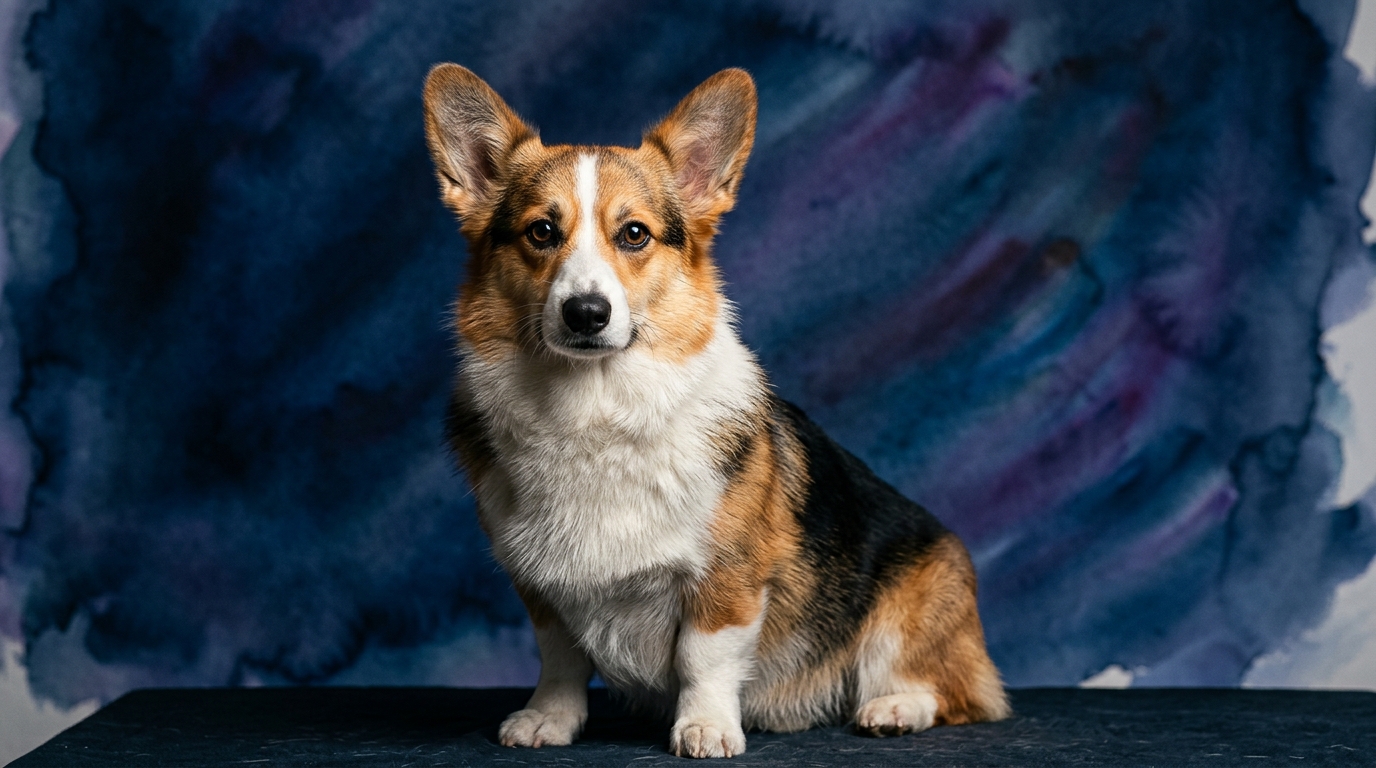

Side-by-Side IQ Profile: Corgi vs. Chinook
The Cosmic Pet Pet IQ Lab employs a five-dimensional framework to assess canine intelligence: Problem Solving, Training Speed, Social Intelligence, Instinctive Drive, and Memory. Let's examine how the Pembroke Welsh Corgi and the Chinook measure up in each area.
The Pembroke Welsh Corgi, a Herding breed, demonstrates a robust cognitive profile. Their Problem Solving is rated 4/5, indicating an adeptness at figuring out environmental puzzles, like opening latches or devising ways to get treats, often displaying creative persistence. Their Training Speed is an impressive 5/5, meaning they learn new commands and routines with remarkable rapidity, eager to please and quick to form associations between actions and outcomes. Social Intelligence stands at 4/5, showing they understand human cues well, can adapt behavior based on social feedback, and often exhibit a nuanced awareness of household dynamics. An Instinctive Drive of 5/5 highlights their strong herding instincts, manifesting in a desire to gather, control movement, and organize, even if it's just family members or other pets. Finally, their Memory is 4/5, retaining learned commands, routines, and experiences over long periods, making re-training or reinforcing old behaviors straightforward.
The Chinook, a Working breed, presents a more balanced and moderate cognitive set. Their Problem Solving is rated 3/5, meaning they are capable of solving straightforward tasks but may require more guidance or repetition for complex multi-step challenges, leaning on learned patterns. Training Speed is 3/5, indicating they learn at a steady pace, requiring consistent and patient instruction, building understanding through repetition rather than rapid conceptual leaps. Social Intelligence is 3/5; they form strong bonds with their immediate family but may be more reserved with strangers or in novel social situations, processing cues more deliberately. An Instinctive Drive of 3/5 signifies a moderate drive for companionship and pulling/endurance activities, but they lack the intense, focused instinct of a specialized working breed. Their Memory is also 3/5, retaining information reasonably well, particularly for established routines and familiar people, but might need refreshers for less frequently practiced skills.
Where the Pembroke Welsh Corgi Wins Cognitively
The Pembroke Welsh Corgi's cognitive edge is most apparent in its rapid acquisition of new skills and its adaptive problem-solving. A Corgi can quickly connect a new verbal cue to a specific action, often understanding the underlying concept rather than just memorizing a sequence; for instance, they might generalize "fetch" from a ball to any dropped item much faster. Their 4/5 problem-solving means they are less likely to become frustrated by novel obstacles, instead experimenting with different approaches to achieve a desired outcome, perhaps figuring out how to open a cabinet door that was previously secure. Furthermore, their 4/5 social intelligence allows for a more nuanced interaction with their human counterparts, often anticipating needs or reacting to subtle shifts in human mood, fostering a highly responsive partnership. This combination makes them particularly engaging for owners who enjoy dynamic interaction and complex training.
Where the Chinook Wins Cognitively
While not boasting the Corgi's rapid learning curve, the Chinook's cognitive strengths lie in its consistency, loyalty, and steady application of learned behaviors. Their 3/5 instinctive drive, focused on companionship and cooperative work, translates into a dog less prone to independent, disruptive impulses often seen in breeds with higher, more specialized drives. This means a Chinook is less likely to "herd" children or chase squirrels with single-minded intensity. Their moderate social intelligence (3/5), while not as effusive as a Corgi's, fosters a deep, stable bond with their family, making them dependable and unwavering companions. The Chinook's cognitive profile emphasizes reliability and an enduring, predictable temperament once training is established, rather than quick-witted improvisation. This makes them exceptionally trustworthy in consistent roles, such as a hiking partner or a family dog that adheres to established household rules without constant re-evaluation.
Which is Easier to Train and Why
The Pembroke Welsh Corgi generally presents as an easier dog to train, primarily due to its exceptional training speed (5/5) and high social intelligence (4/5). They are eager to please and quickly form associations between commands and actions, often needing only a few repetitions to grasp a new concept. This means owners can progress through obedience levels or learn tricks at a faster pace. However, their potent instinctive drive (5/5) means that while they learn quickly, owners must be diligent in channeling their herding tendencies. Without consistent mental and physical engagement, a Corgi might apply its problem-solving skills to undesirable behaviors, such as nipping at heels or attempting to control household movement.
In contrast, the Chinook, with its 3/5 training speed, requires a more patient and consistent approach. They absorb information steadily, building understanding through methodical repetition and positive reinforcement. Their moderate instinctive drive (3/5) means they are less likely to initiate highly independent actions, making them generally compliant once a command is understood. However, they may not offer the same spontaneous eagerness for fast-paced training as a Corgi. Training a Chinook often involves fostering a strong, trust-based relationship, where the dog learns to rely on its owner's clear and unwavering guidance. Owners should anticipate more sessions and a slower progression through training stages, but the resulting behaviors are often deeply ingrained and reliable.
Suitability for Active vs. Relaxed Owners
For active owners who thrive on engaging a dog in dynamic mental and physical challenges, the Pembroke Welsh Corgi is an ideal match. Their 4/5 problem-solving and 5/5 instinctive drive mean they excel in activities like agility, competitive obedience, or herding trials, constantly seeking opportunities to use their quick wits and strong work ethic. Owners who are prepared to provide consistent, stimulating training, intricate puzzle toys, and regular exercise will find a highly responsive and endlessly entertaining companion. This breed requires an owner dedicated to channeling their considerable mental energy into productive outlets, preventing boredom-induced mischief.
The Chinook, with its more balanced and moderate cognitive profile across all dimensions (3/5), is well-suited for owners seeking a steady, dependable companion for regular, yet not necessarily intense, activity. While they enjoy outdoor adventures such as hiking, backpacking, or long walks, their lower instinctive drive and moderate training speed mean they are generally content with a more predictable routine and less demanding mental stimulation than a Corgi. They appreciate consistent companionship, a stable home environment, and opportunities for shared outdoor exploration without the constant need for complex problem-solving or high-energy tasks. This breed offers a calmer, more predictable presence, fitting seamlessly into a relaxed lifestyle that still includes daily exercise.
The Verdict
Choose the Pembroke Welsh Corgi if you seek a quick-witted, highly trainable companion eager for mental challenges and consistent engagement, and you are prepared to channel their strong herding instincts.
Choose the Chinook if you prefer a steadfast, reliable companion that learns at a steady pace and thrives on consistent routines and outdoor adventures without requiring intense, constant mental stimulation.
🧠 Find Your Pet's IQ Score
Our Pet IQ Lab assessment covers 25+ tests across 5 cognitive dimensions — personalized to your breed.
Take the Full IQ Test →Frequently Asked Questions
Do Corgis bark more due to their intelligence?
Corgis' strong instinctive drive and social intelligence can make them vocal, often using barks to communicate or "herd." This isn't solely due to their general IQ but rather how their specific cognitive traits interact with their environment and role, making them communicative dogs.
Is the Chinook difficult to train because it's not Coren-ranked?
The Chinook's lack of a Coren rank doesn't imply difficulty, but rather indicates its relative rarity and specialized working origins, meaning fewer studies exist. Its 3/5 training speed means it learns steadily with patience, making it trainable for dedicated owners who use consistent methods.
Can a Chinook learn complex tasks?
Yes, a Chinook can learn complex tasks, though it may take more repetition and time than a breed with a higher training speed. Their problem-solving ability (3/5) means they can understand multi-step commands with consistent instruction and patient reinforcement.