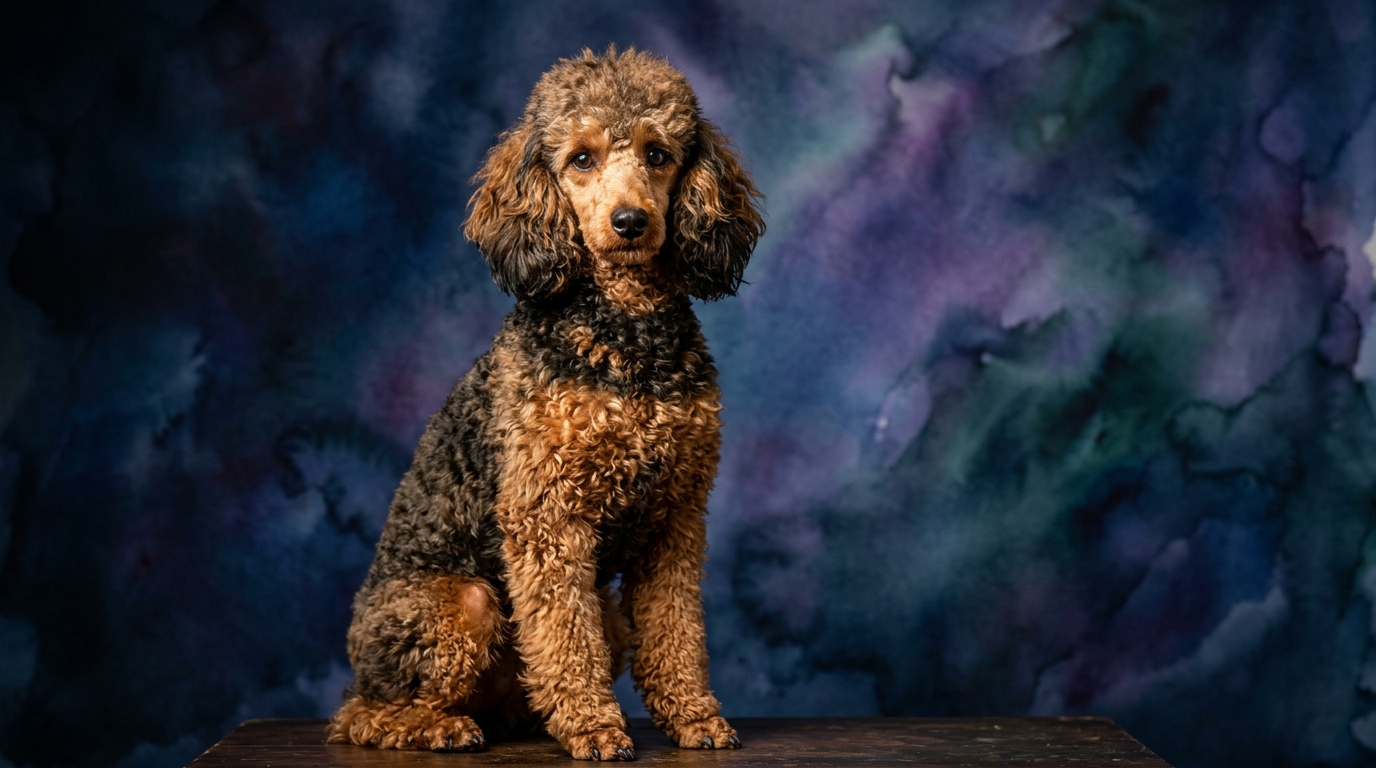
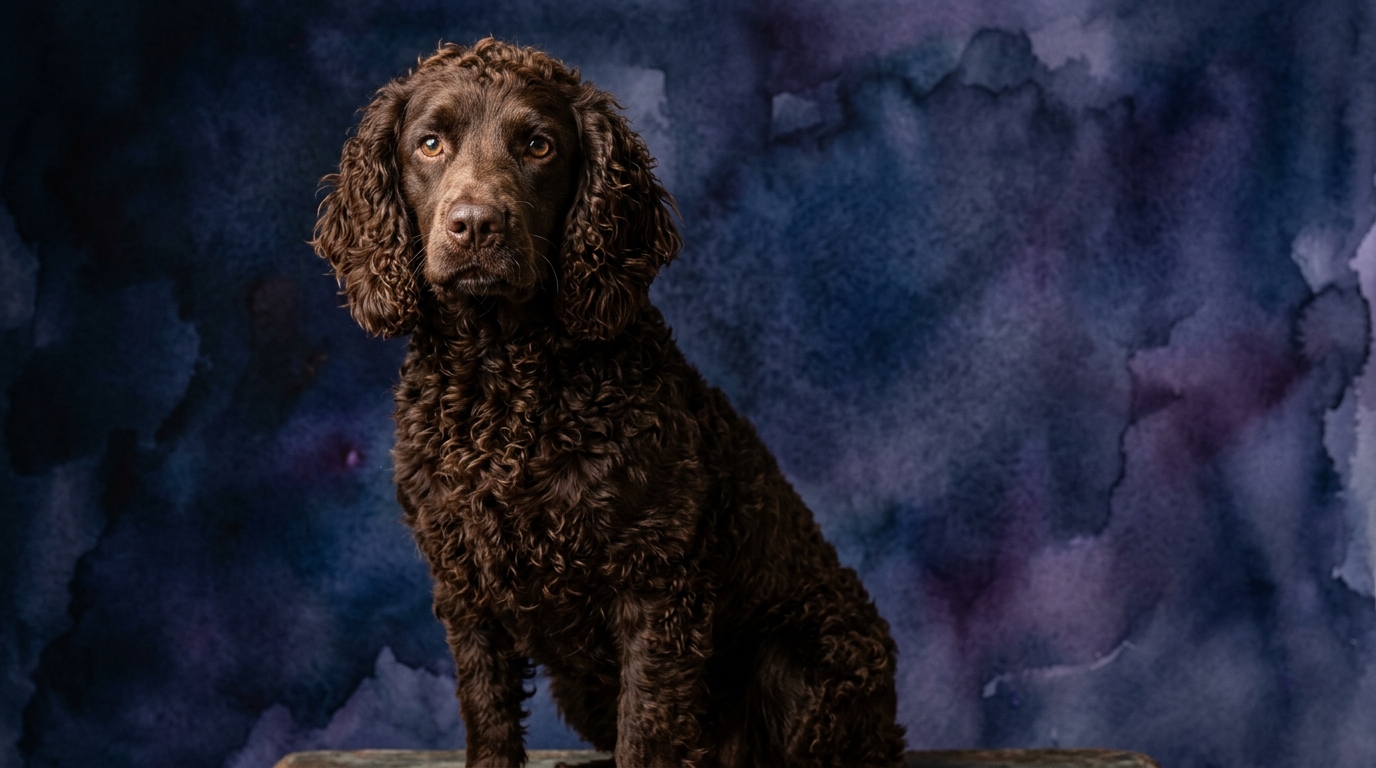
Side-by-Side Cognitive Profiles
The Cosmic Pet Pet IQ Lab employs five key dimensions to evaluate canine intelligence, offering a nuanced view beyond simple rankings. For the Standard Poodle, these dimensions reveal a remarkably consistent aptitude across the board, reflecting its status as a consistently high-ranking breed in cognitive studies. The American Water Spaniel, while possessing a different set of strengths, exhibits a profile more aligned with its specialized working background.
The Standard Poodle excels with a Problem Solving score of 5/5, demonstrating an exceptional capacity to figure out complex tasks, such as unlocking gates or navigating intricate puzzles, and understanding multi-step commands like 'go find your red ball in the basket and bring it here.' They don't just follow rote rules; they often grasp the underlying logic of a situation, allowing them to adapt strategies when faced with minor variations. Their Training Speed is also a perfect 5/5, meaning they acquire new commands and routines with astonishing rapidity, often needing very few repetitions before a behavior is solidified. They pick up on subtle verbal and visual cues quickly, and generalize learned behaviors efficiently across different environments. In Social Intelligence, the Poodle again scores 5/5, exhibiting a profound understanding of human emotions, intentions, and even social hierarchies within a household. They are adept at reading body language and often seem to anticipate their owner's moods or desires, making them exceptionally intuitive companions. Their Instinctive Drive is 4/5; while often associated with elegance, their historical role as water retrievers means they possess a robust, inherent drive for specific tasks, typically channeled into activities involving fetching, water work, and active engagement with their environment. Finally, their Memory is 5/5, boasting an outstanding recall for commands, complex routines, and even specific people or places over long periods, retaining intricate sequences of actions and associations with remarkable tenacity.
The American Water Spaniel presents a profile centered on practical application. Their Problem Solving is 3/5, with capabilities often tied to their working heritage, such as efficiently locating downed game or navigating dense cover. Their approach is typically more direct and less abstract than a Poodle's, focusing on tangible outcomes and tried-and-true methods rather than inventing novel solutions. Training Speed for the AWS is 3/5, meaning they learn at a solid, average pace, requiring consistent repetition and clear, positive communication to internalize new commands and behaviors, typically needing more sessions than a Poodle. In Social Intelligence, they score 3/5, possessing a functional understanding of their human companions, forming strong, loyal bonds and readily recognizing familiar faces and routines. While attentive to their handler's general mood, they may not interpret subtle emotional nuances or proactively adapt their behavior to complex social dynamics with the same depth as a Poodle. Their Instinctive Drive is 3/5, strong and notably focused on retrieving and water work, characteristic of a dedicated sporting breed. This inherent motivation is purposeful and directed towards their historical function, providing a powerful impetus for activities like fetching, swimming, and field trials. Lastly, their Memory is 4/5, demonstrating good retention of learned commands, familiar routes, and hunting patterns, reliably remembering where game was last seen or specific cues for retrieving, showcasing a dependable recall for practical applications.
Where the Standard Poodle Excels Cognitively
The Standard Poodle's cognitive strengths lie in its remarkable versatility and depth of understanding. Their superior Problem Solving (5/5) means they excel at abstract reasoning and generalization, not just memorizing tasks but grasping underlying principles. For instance, if taught to open one type of child-proof latch, a Poodle is far more likely to independently figure out a similar but different latch without explicit retraining, demonstrating true cognitive flexibility. This translates into an exceptional capacity for complex sequential tasks, allowing them to master intricate agility courses with numerous obstacles or advanced obedience routines involving multiple steps and changes in pace, requiring both foresight and memory. Their high Social Intelligence (5/5) provides an emotional acuity that sets them apart; Poodles often pick up on subtle human emotional cues, making them particularly attuned companions who can anticipate a handler's needs or moods, adjusting their behavior accordingly – a nuanced cognitive skill that fosters deep companionship. This combination of swift learning and insightful understanding makes them highly adaptable to novel situations and environments, thriving on intellectual stimulation and less likely to be flustered by unexpected changes or new learning challenges.
Where the American Water Spaniel Shows Unique Strengths
While the Standard Poodle's cognitive profile is broadly exceptional, the American Water Spaniel boasts specialized cognitive strengths forged by its working history. One key area is purpose-driven persistence. While their general Problem Solving ranks lower, the AWS excels in sustained, focused effort on tasks directly aligned with their innate sporting instincts. Their ability to track and retrieve downed game in challenging, varied environments, overcoming obstacles with unwavering determination, showcases a specialized cognitive tenacity that is invaluable in the field. This is not about abstract problem-solving, but an ingrained cognitive resilience to achieve a specific, tangible goal. Furthermore, their intelligence is deeply integrated with their senses, particularly scent and spatial awareness, for their original purpose. They demonstrate exceptional cognitive mapping skills in varied terrain, remembering where they've searched and where potential game might be, a unique form of practical memory and problem-solving. Their Instinctive Drive (3/5), while numerically lower, is channeled with remarkable efficiency into their working roles. They exhibit a distinct cognitive advantage in understanding and executing the 'why' behind their retrieving tasks, not just the 'how,' but in a practical, rather than abstract, sense, understanding the ultimate goal of the hunt. This focused instinctive application also means that, while Poodles learn faster, an AWS can demonstrate a formidable capacity for repetitive tasks *if those tasks align with their drive*, showing a cognitive endurance in performing the same retrieving action many times over, driven by their ingrained purpose.
Ease of Training and Behavioral Differences
When it comes to ease of training, the Standard Poodle (5/5 Training Speed, 5/5 Problem Solving, 5/5 Memory) holds a distinct advantage. They grasp new concepts with minimal repetitions, often anticipating the desired behavior before it's explicitly taught. For example, teaching a Poodle to 'fetch' a specific item by name might take only a few sessions, as they quickly associate the word with the object and the action. Their high social intelligence also means they are eager to please and highly attuned to their handler's feedback, making communication during training exceptionally effective. Poodles thrive on variety and complex commands, making advanced obedience, intricate tricks, and dog sports like agility a natural fit. Their cognitive flexibility allows them to generalize commands learned in one context to another, significantly reducing the need for extensive re-training in new environments or with different distractions.
Training an American Water Spaniel (3/5 Training Speed, 3/5 Problem Solving, 4/5 Memory) requires more patience and consistency. While they are willing partners, they typically need more repetitions to solidify a command, processing and storing information at a different pace. Teaching the same 'fetch by name' task might take significantly more sessions, as the AWS may rely more on sequential learning rather than immediate conceptual understanding. Their instinctive drive (3/5) is strong but needs careful channeling; without a clear purpose or alignment with their hunting instincts, they might appear less motivated or focused on abstract obedience tasks. For instance, while they excel at retrieving a dummy from water, teaching them to 'stay' for extended periods without a clear reward or context might prove more challenging than with a Poodle. Their memory (4/5) is good, meaning once a behavior is learned, it tends to stick, but the initial learning phase demands more sustained effort and clear, consistent instruction.
Matching Breeds to Owner Lifestyles
The cognitive profiles of these two breeds suggest they are best suited for different types of owner lifestyles. The Standard Poodle is an ideal companion for owners who are active in a mentally stimulating way. While they certainly appreciate physical exercise, their primary need is for consistent intellectual engagement. An owner who enjoys teaching new tricks, participating in dog sports like agility, obedience, rally, or even scent work, or providing complex puzzle toys will find the Poodle a willing and enthusiastic partner. They thrive on having a 'job' that challenges their intellect and will become bored and potentially destructive if their cognitive needs are not met. A relaxed owner who expects a Poodle to entertain itself without structured mental input and diverse learning opportunities will likely find themselves with a frustrated and creatively mischievous companion, potentially exhibiting undesirable behaviors born from unchanneled mental energy.
The American Water Spaniel, conversely, suits owners who are physically active and enjoy outdoor pursuits, particularly those involving water or field work. Their instinctive drive and moderate energy levels mean they excel with owners who can provide regular, vigorous exercise, such as long hikes, swimming, or retrieving games. They are not necessarily looking for intricate mental puzzles in the same way a Poodle is, but rather practical, purposeful activities that engage their senses and body. While they appreciate companionship and family inclusion, a relaxed owner who cannot provide consistent physical outlets and opportunities for their natural sporting instincts might find the AWS restless and prone to seeking their own 'work,' which could manifest as digging, excessive vocalization, or destructive chewing. They are less about intellectual gymnastics and more about robust, purposeful engagement with their environment and handler during activities that align with their heritage.
The Verdict
If you seek a canine companion for advanced obedience, complex trick training, dog sports requiring intricate problem-solving, or a deeply intuitive emotional connection, the Poodle's exceptional cognitive breadth and adaptability make them an unparalleled choice.
Opt for the American Water Spaniel if your lifestyle revolves around consistent outdoor activity, particularly water-based or retrieving sports, and you value a partner with robust, purpose-driven instincts and a steady, loyal disposition.
🧠 Find Your Pet's IQ Score
Our Pet IQ Lab assessment covers 25+ tests across 5 cognitive dimensions — personalized to your breed.
Take the Full IQ Test →Frequently Asked Questions
Do Standard Poodles need more mental stimulation than American Water Spaniels?
Yes, Standard Poodles generally require a higher degree of diverse mental stimulation due to their superior problem-solving and social intelligence, thriving on learning complex tasks and engaging in varied cognitive challenges. American Water Spaniels benefit more from consistent physical activity and purposeful work that aligns with their sporting instincts.
Can an American Water Spaniel excel in obedience or agility?
An American Water Spaniel can certainly excel in obedience and agility, particularly with a patient, consistent trainer who makes the activities engaging and purposeful, leveraging their memory and willingness to work. While their training speed is not as rapid as a Poodle's, their dedication and drive, once understood, can lead to impressive results.
How does social intelligence differ between these two breeds?
The Poodle's social intelligence (5/5) signifies a profound ability to interpret subtle human emotions and social cues, often anticipating needs or moods. The American Water Spaniel's social intelligence (3/5) indicates a functional understanding, forming strong bonds and recognizing familiar individuals, but perhaps without the same depth of emotional nuance or proactive social adaptation.