
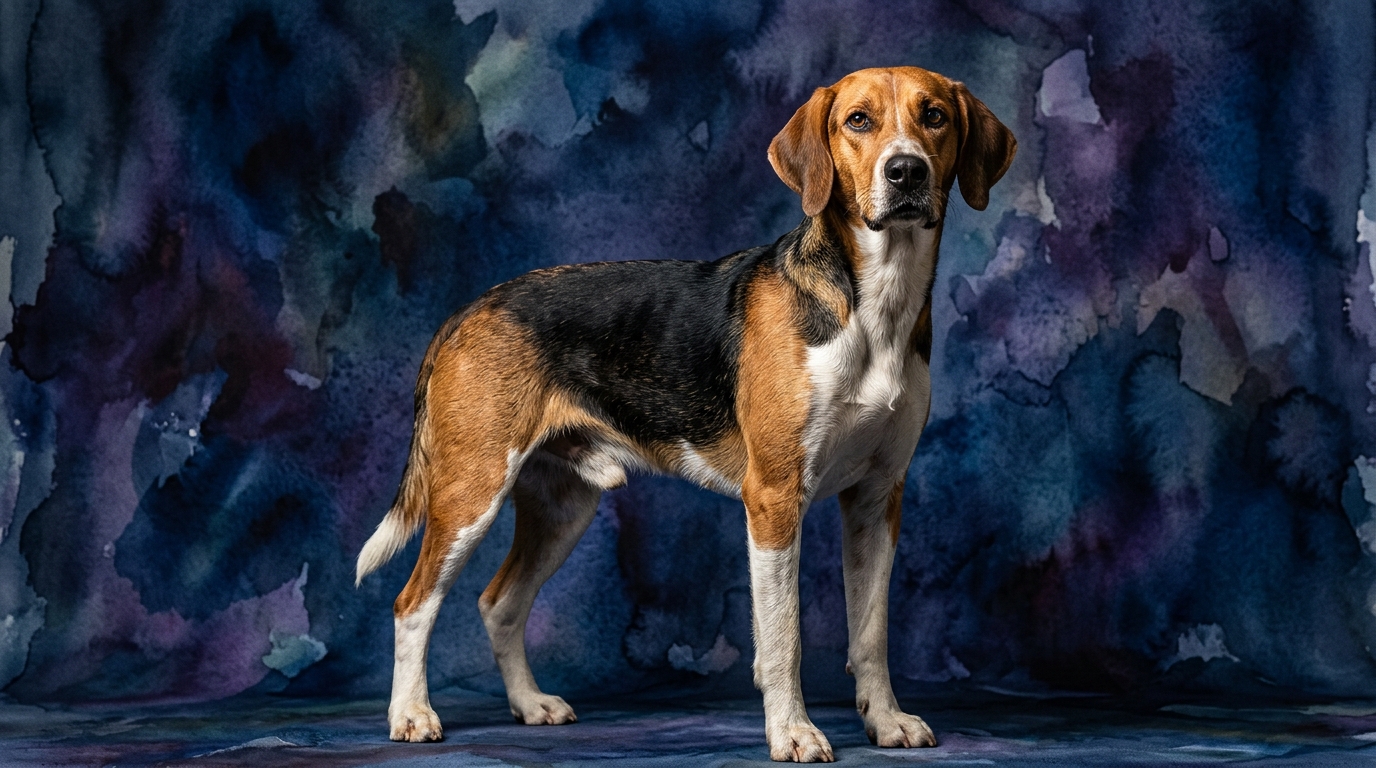
Side-by-Side Cognitive Profiles: Pug vs. English Foxhound
The Cosmic Pet Pet IQ Lab provides a nuanced view of canine intelligence, moving beyond simplistic notions to five distinct dimensions. The Pug, a beloved companion breed, holds a Coren rank of #57, indicating its position among dogs with more selective working intelligence. In contrast, the English Foxhound, a breed primarily developed for scent work, is not Coren-ranked, suggesting a different set of cognitive priorities and aptitudes.
Delving into the Pug's profile, we see a Problem Solving score of 2/5, meaning they might not be the quickest to figure out complex puzzles independently, often preferring to look to their human for guidance. Their Training Speed also sits at 2/5, suggesting that patience and repetition are key; they learn, but at their own comfortable pace. However, their Social Intelligence is a remarkable 5/5, indicating an exceptional ability to read human cues and connect emotionally. Instinctive Drive is low at 2/5, reflecting their role as companions rather than workers, and their Memory is an average 3/5, sufficient for daily routines and commands.
The English Foxhound presents a different picture. Its Problem Solving is rated at 3/5, indicating a greater capacity for independent thought and finding solutions, particularly in practical, outdoor scenarios. Training Speed is also 3/5, meaning they can learn commands efficiently with consistent methods, though perhaps not with the lightning speed of some high-drive working breeds. Their Social Intelligence is 3/5, functional and friendly, but not necessarily as acutely attuned to human emotions as the Pug. Crucially, their Instinctive Drive is 3/5, reflecting a significant, inherent motivation for scent work and exploration. Like the Pug, their Memory is an average 3/5, allowing them to recall learned behaviors and important trails.
Where the Pug Shines Cognitively
The Pug's undisputed cognitive strength lies in its Social Intelligence, rated at an impressive 5/5. This isn't merely about being friendly; it's a profound ability to interpret human emotions, body language, and subtle vocal cues with exceptional accuracy. A Pug can often anticipate its owner's mood or needs before they're explicitly stated, offering comfort or companionship precisely when it's desired. Their cognitive framework is geared towards understanding and navigating complex social dynamics within a household, making them incredibly intuitive and empathetic companions. This high social IQ allows them to adapt seamlessly to family life, often becoming the emotional anchor of the home, understanding routines and individual preferences without extensive formal training.
Where the English Foxhound Excels Cognitively
The English Foxhound demonstrates superior cognitive capabilities in areas that align with its historical purpose. Its Problem Solving score of 3/5, compared to the Pug’s 2/5, highlights a greater capacity for independent thought and resourcefulness, particularly when faced with practical challenges related to its environment or a specific goal. This often manifests in their ability to navigate complex terrain or figure out how to access a scent. Furthermore, their Training Speed of 3/5 indicates a more direct learning curve for structured commands, especially when motivation aligns with their natural drives. The moderate Instinctive Drive (3/5) provides a powerful internal engine, making them persistent and focused when engaged in activities that tap into their innate desire to track or explore, a cognitive advantage for tasks requiring sustained effort.
Training Dynamics: Which Breed is Easier?
When considering ease of training, the English Foxhound generally presents a more straightforward path than the Pug, primarily due to their respective Training Speed scores (Foxhound 3/5, Pug 2/5). The Pug's lower training speed means they require more repetition and a highly patient, positive reinforcement approach. While they are eager for social interaction, their motivation isn't always to master a task quickly; they often prefer comfort and affection over performing tricks. Their low instinctive drive means fewer innate distractions, but also less internal push to engage in structured learning, requiring owners to make training consistently fun and rewarding.
The English Foxhound, with its average training speed, can learn commands efficiently. However, their moderate instinctive drive (3/5), particularly their strong scenting instincts, can be a double-edged sword. While it provides a powerful motivator for certain types of training, it also means they can be easily distracted by compelling smells in the environment. Successful training for a Foxhound often involves channeling this drive, making sessions engaging and structured, and working to maintain their focus amidst environmental stimuli. They respond well to clear leadership and consistent methods, and while perhaps not as overtly 'eager to please' as some breeds, their capacity for learning is solid.
Lifestyle Match: Active vs. Relaxed Owners
The cognitive profiles of the Pug and English Foxhound dictate very different lifestyle matches for their owners. The Pug, with its low instinctive drive (2/5) and a primary focus on social intelligence and companionship, is an ideal fit for relaxed owners. They thrive in environments where daily activity involves leisurely strolls, abundant lap time, and consistent human presence. Their mental and physical needs are met through gentle interaction and comfort, making them perfectly suited for apartment living or less active households that value emotional connection over outdoor adventures. They are content with a calm pace and do not demand extensive physical or mental challenges.
Conversely, the English Foxhound, with its moderate instinctive drive (3/5) and higher problem-solving capacity, is better suited for active owners. These dogs possess a genuine need for consistent, vigorous physical exercise and mental stimulation that taps into their natural inclination for exploration and scent work. Owners who enjoy long hikes, running, or dog sports that engage a dog's nose will find a rewarding companion in a Foxhound. Without sufficient outlets for their energy and drive, they can become bored and potentially destructive, making them a poor choice for sedentary lifestyles. They require owners who understand and can cater to their working breed heritage.
The Verdict
Choose the Pug if your lifestyle prioritizes a highly empathetic, low-energy companion who excels at reading human emotions and thrives on close social bonds, with less emphasis on formal obedience or strenuous activity.
Choose the English Foxhound if you lead an active life, enjoy structured training, and can provide ample opportunities for physical exercise and mental stimulation that taps into a dog's natural drive for exploration and problem-solving.
🧠 Find Your Pet's IQ Score
Our Pet IQ Lab assessment covers 25+ tests across 5 cognitive dimensions — personalized to your breed.
Take the Full IQ Test →Frequently Asked Questions
Does the Pug's lower Coren rank mean it's 'less capable' overall than the English Foxhound?
Not necessarily 'less capable,' but rather possessing a different cognitive profile. The Pug's Coren rank of #57 reflects its lower scores in working intelligence, while its superior social intelligence is a distinct strength. The English Foxhound, though unranked, shows a more balanced profile across practical problem-solving and training, hinting at a task-oriented intelligence.
Can an English Foxhound truly be a good family pet, given its instinctive drive?
Yes, an English Foxhound can be a loyal family pet, especially with active owners who understand its needs. Their moderate social intelligence means they are generally friendly, but their instinctive drive requires consistent exercise and mental engagement to prevent boredom and manage their natural urge to follow scents. Early socialization and firm, positive training are crucial for successful integration into a home environment.
What specific training approaches work best for a Pug's cognitive profile?
For Pugs, leverage their high social intelligence and desire for companionship. Use gentle, positive reinforcement methods, focusing on consistency and making training feel like a shared, enjoyable interaction rather than a demanding task. Keep sessions short and fun, as their training speed is lower, and prioritize commands that enhance their role as a beloved family member.