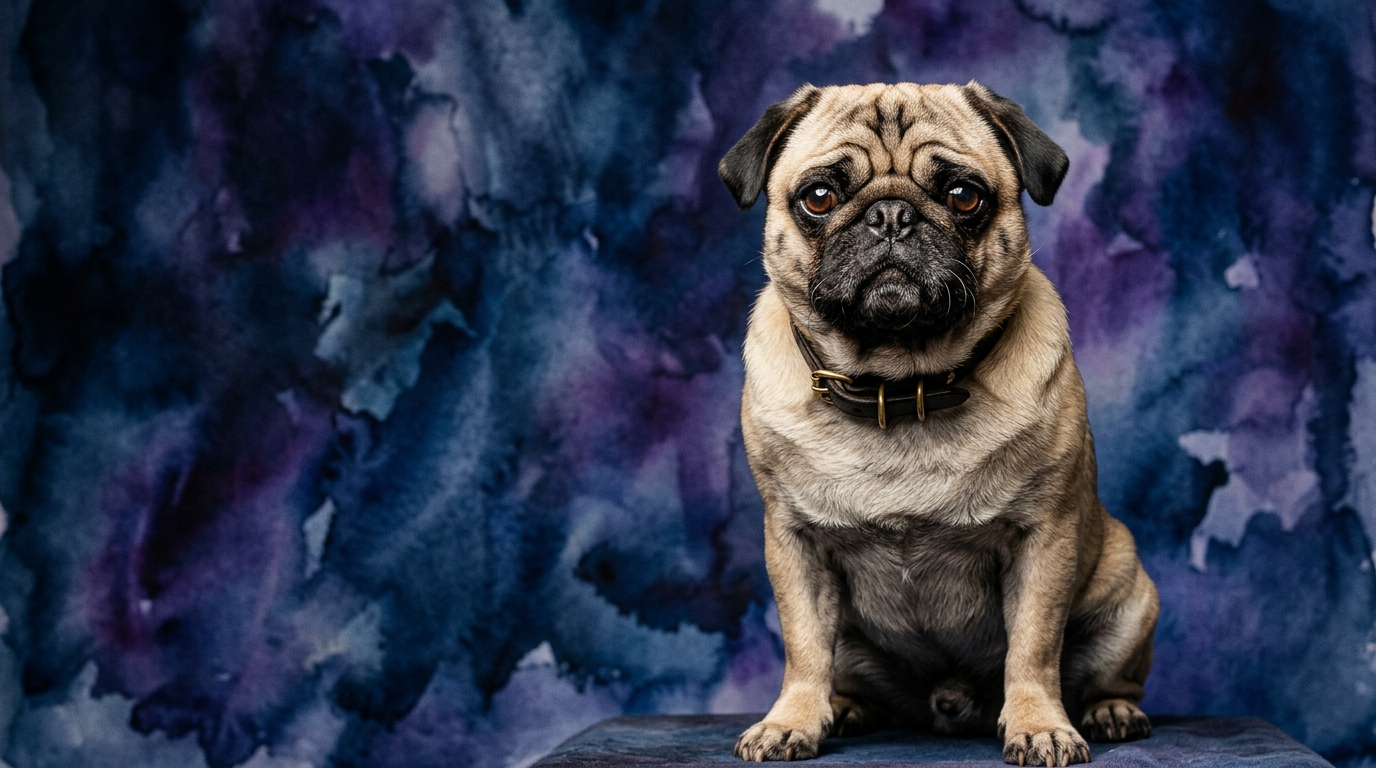
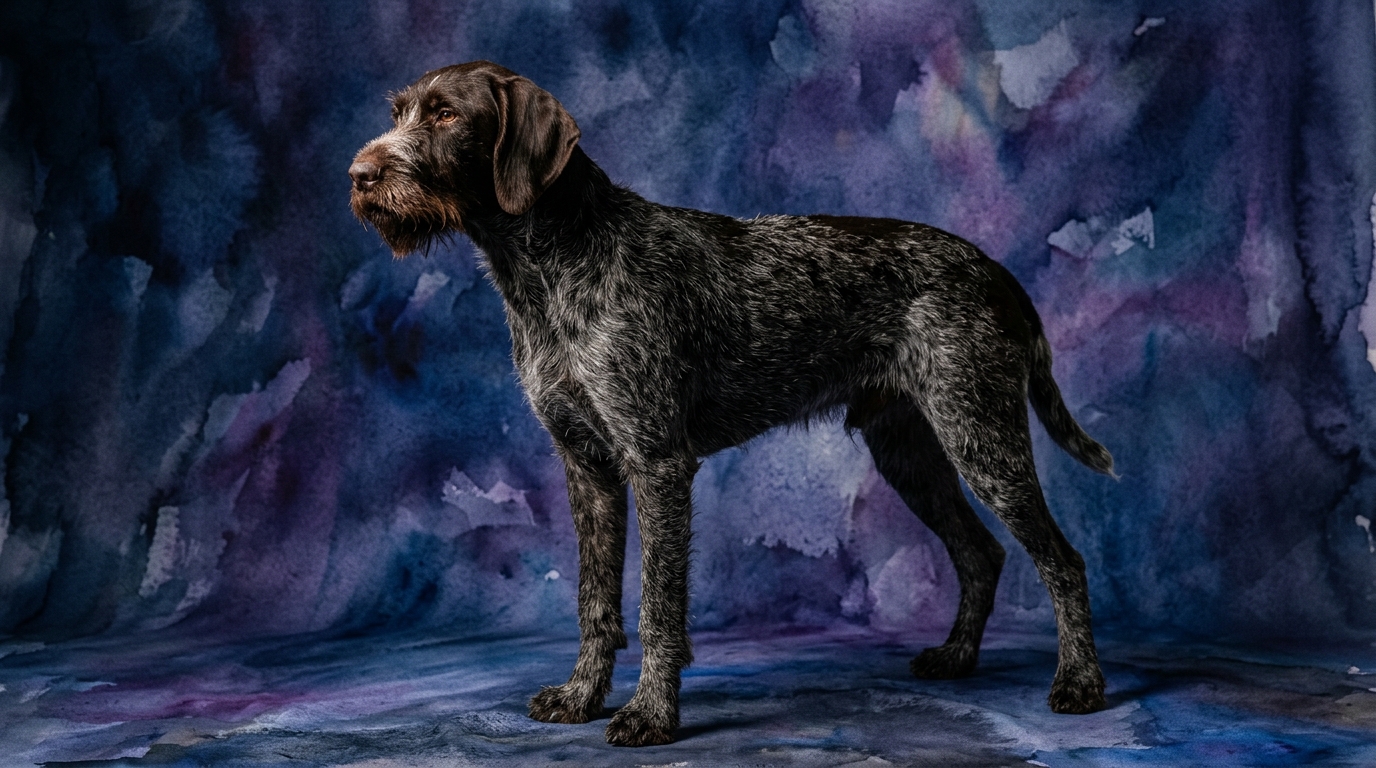
Side-by-Side IQ Profile: Pug vs. German Wirehaired Pointer
The Cosmic Pet IQ Lab's framework evaluates five key dimensions of canine intelligence, offering a nuanced view of how breeds process information and interact with their world. For the Pug, a Toy group member ranked #57 on Coren's scale, its cognitive strengths lean heavily into social dynamics, while the German Wirehaired Pointer (GWP), a Sporting group breed ranked #28, showcases a more task-oriented and adaptive intellect.
**Pug Intelligence Breakdown:**
**Problem Solving (2/5):** Pugs typically approach novel situations or complex tasks with less independent strategizing. They are less inclined to manipulate objects or environments to achieve a goal without direct human guidance. Their strength isn't in figuring out intricate puzzles but rather in understanding social cues.
**Training Speed (2/5):** While Pugs are eager to please their beloved humans, their pace of acquiring new commands can be slower. Repetition and patience are often key, as they may not grasp abstract concepts or multi-step tasks as quickly as breeds developed for complex working roles.
**Social Intelligence (5/5):** This is where the Pug truly shines. They possess an exceptional ability to read human emotions, intentions, and body language, making them profoundly empathetic companions. They excel at forming deep bonds and understanding subtle social cues, often anticipating their owner's moods and desires.
**Instinctive Drive (2/5):** Pugs exhibit a relatively low instinctive drive. Their primary motivation isn't typically rooted in ancestral tasks like hunting or herding, but rather in seeking comfort, companionship, and close proximity to their human family. They generally lack the intense focus on 'work' that defines many other breeds.
**Memory (3/5):** Pugs have an average memory capacity. They reliably recall familiar routines, people, and places, particularly those associated with positive social interactions or comfort. While they might not remember every complex command sequence, they certainly don't forget their favorite nap spot or the person who provides the best belly rubs.
**German Wirehaired Pointer Intelligence Breakdown:**
**Problem Solving (4/5):** German Wirehaired Pointers demonstrate a strong capacity for independent thought and problem-solving. They are adept at navigating challenging environments, figuring out how to retrieve objects, or overcoming obstacles, reflecting their heritage as versatile hunting dogs. This often manifests as resourcefulness in the field or during training.
**Training Speed (4/5):** GWPs are quick learners, capable of rapidly absorbing and executing new commands and sequences. Their eagerness to work and inherent drive make them highly receptive to training, often picking up complex tasks with fewer repetitions than many other breeds.
**Social Intelligence (3/5):** While GWPs are affectionate and loyal to their families, their social intelligence is more balanced, not as singularly focused as the Pug's. They are competent at reading human cues but might prioritize a task or a scent over subtle social niceties in certain contexts. They bond well but are less 'tuned in' to every emotional nuance.
**Instinctive Drive (3/5):** GWPs possess a moderate to strong instinctive drive, rooted in their hunting background. This manifests as a desire to explore, track scents, and engage in purposeful activities. While not as extreme as some herding or guarding breeds, it's a significant motivator for their behavior and training.
**Memory (4/5):** GWPs have a robust memory, crucial for remembering complex scent trails, field patterns, and intricate command sequences over time. This strong recall supports their ability to perform multi-stage tasks and retain extensive training knowledge, making them reliable partners in various activities.
Where the Pug Wins Cognitively
The Pug's undisputed cognitive strength lies in its exceptional Social Intelligence (5/5). They are masters of relational cognition, possessing an innate ability to connect with humans on a profound emotional level. This isn't merely about affection; it's a sophisticated capacity to interpret subtle shifts in tone, facial expressions, and body language, allowing them to offer comfort or companionship precisely when needed. A Pug's glance can convey an understanding that feels deeply intuitive, a skill honed over centuries of living in close partnership with people.
This high social intelligence translates into a remarkable ability to adapt to diverse household dynamics and individual human personalities. They excel at being present, absorbing the emotional climate of a home, and responding in ways that foster connection and well-being. While their problem-solving or training speed scores might be lower, their ability to navigate the complex world of human emotion and social interaction is unparalleled, making them uniquely attuned and empathetic companions. Their average memory (3/5) is sufficient to recall preferred human interactions and routines, reinforcing their social bonds.
Where the German Wirehaired Pointer Wins Cognitively
The German Wirehaired Pointer's cognitive profile is geared towards purposeful action and independent thought, a direct reflection of its sporting lineage. They excel in Problem Solving (4/5), demonstrating a resourceful and adaptive mind when faced with challenges. Whether it's navigating dense cover during a hunt or figuring out how to retrieve a toy from an awkward spot, GWPs apply intelligent strategies to achieve their goals. This isn't just about following commands; it's about making smart decisions in dynamic environments.
Their superior Training Speed (4/5) and strong Memory (4/5) further solidify their cognitive advantage in task-oriented learning. GWPs quickly grasp new concepts and retain them, allowing for the development of extensive and intricate command repertoires. This combination means they can learn complex sequences of behaviors and recall them reliably, making them highly capable in fields like obedience, scent work, and field trials. Their Instinctive Drive (3/5) provides the underlying motivation to engage with these tasks, turning their cognitive abilities into practical performance.
Which is Easier to Train and Why
From a purely technical standpoint of command acquisition and execution, the German Wirehaired Pointer generally proves easier to train. Their 4/5 Training Speed means they absorb new information rapidly, and their 4/5 Problem Solving allows them to understand the 'why' behind a task, not just the 'what.' Their moderate Instinctive Drive (3/5) means they are inherently motivated by activities that engage their senses and provide a purpose, making them eager participants in structured training sessions. They thrive on having a job and responding to direction, demonstrating a focused determination that accelerates learning.
The Pug, with its 2/5 Training Speed and 2/5 Problem Solving, presents a different training experience. While they possess an overwhelming desire to please their owners due to their 5/5 Social Intelligence, their capacity for quickly grasping complex commands or lengthy sequences is more limited. Training a Pug often requires more patience, shorter sessions, and a greater reliance on positive reinforcement that emphasizes connection rather than task completion. Their lower Instinctive Drive (2/5) means they are less motivated by the inherent challenge of a task and more by the social reward of pleasing their person. Success with a Pug often hinges on making training feel like a fun, interactive game that strengthens the bond, rather than a demanding exercise in obedience.
Which Suits Active Owners vs. Relaxed Owners
For owners seeking an active, engaged canine partner, the German Wirehaired Pointer is typically the more fitting choice. Their robust Instinctive Drive (3/5), coupled with their problem-solving prowess and quick learning, means they genuinely thrive when given regular mental and physical challenges. These dogs excel in activities like long hikes, running, hunting, agility, or advanced obedience training. An active owner can fulfill a GWP's intrinsic need for purposeful activity, preventing boredom and channeling their energy constructively. Their cognitive strengths are best showcased when they are actively learning and working alongside their human.
Conversely, the Pug is an exemplary match for relaxed owners or those seeking a devoted, low-key companion. Their high Social Intelligence (5/5) means their primary 'activity' is bonding and interacting with their human family. While they enjoy short walks and play, their lower Instinctive Drive (2/5) means they don't require intense physical exertion or complex mental tasks to be content. They are perfectly happy to spend their days napping on the couch, following their owner from room to room, and offering quiet companionship. Their cognitive strengths are best appreciated in an environment that values emotional connection and comfort over demanding performance.
The Verdict
Choose a Pug if you prioritize an empathetic, highly social companion who excels at emotional connection and thrives in a relaxed home environment.
Opt for a German Wirehaired Pointer if you seek a resourceful, quick-learning partner eager for purposeful activity, excelling in dynamic outdoor and training pursuits.
🧠 Find Your Pet's IQ Score
Our Pet IQ Lab assessment covers 25+ tests across 5 cognitive dimensions — personalized to your breed.
Take the Full IQ Test →Frequently Asked Questions
Is a Pug's 5/5 Social Intelligence a form of 'smarts'?
Absolutely. Social intelligence is a distinct and valuable form of cognitive ability, enabling Pugs to interpret human emotions and cues with exceptional accuracy. This allows them to forge deep bonds and navigate complex social dynamics within a household, which is a sophisticated skill.
Does a German Wirehaired Pointer's 4/5 Problem Solving mean it's 'too smart' or difficult to handle?
Not at all. A GWP's strong problem-solving ability means they are resourceful and can learn quickly, but it also means they need appropriate mental stimulation. Without constructive outlets, this intelligence could lead to boredom, so it's about channeling their cognitive strengths positively through training and activities.
Can a Pug be trained for complex tasks despite its lower scores in Problem Solving and Training Speed?
Pugs can certainly learn a variety of commands and tricks, especially with patient, positive reinforcement tailored to their social nature. While they may not achieve the speed or complexity of a GWP, their desire to please their owner, fueled by their high social intelligence, makes them willing participants in appropriate training endeavors.