
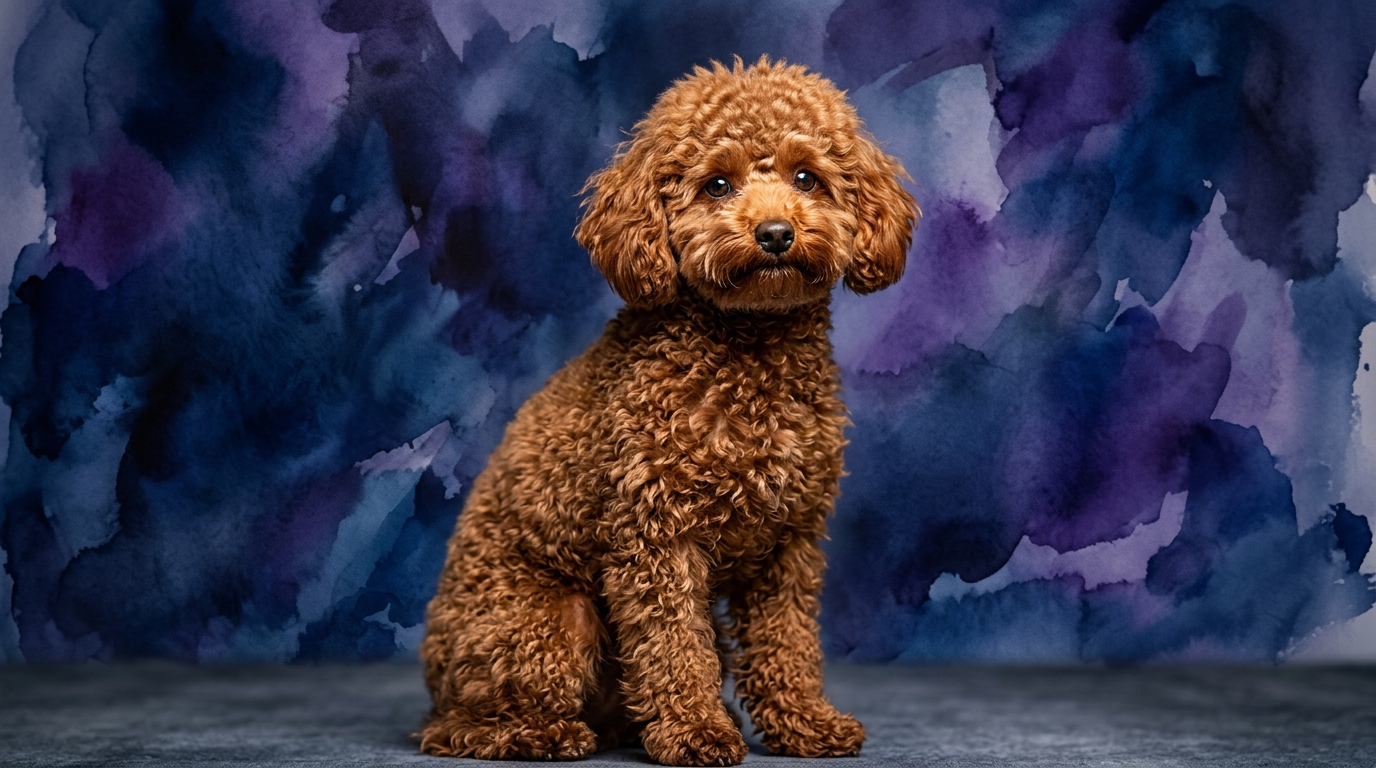
Side-by-Side IQ Profile: Rhodesian Ridgeback vs. Toy Poodle
The Cosmic Pet Pet IQ Lab employs a five-dimensional framework to assess canine intelligence, offering a nuanced view beyond simplistic labels. For the Rhodesian Ridgeback, a breed with a Coren rank of #52, its profile presents a balanced blend of practical aptitude: Problem Solving is rated 3/5, indicating an ability to navigate practical challenges and devise solutions for tangible obstacles. Its Training Speed is also 3/5, suggesting a steady learning pace that requires consistent, engaging methods, reflecting its independent nature. Social Intelligence stands at 3/5, meaning it capably interprets human cues and intentions, fostering a responsive partnership. Instinctive Drive, at 3/5, highlights a moderate, but focused, innate motivation often tied to its heritage of tracking and vigilance. Finally, Memory, at 3/5, shows a reliable capacity to retain learned commands and established routines over time.
In stark contrast, the Toy Poodle, holding an impressive Coren rank of #2, showcases a profile geared towards rapid acquisition and complex cognitive processing. Its Problem Solving ability is an outstanding 5/5, demonstrating an exceptional capacity to decipher intricate puzzles and adapt to novel situations with ingenuity. Training Speed is equally remarkable at 5/5, allowing for swift mastery of new commands and elaborate sequences, often appearing to grasp concepts almost immediately. Social Intelligence matches the Ridgeback at 3/5, indicating a solid understanding of human communication, though often expressed with more overt enthusiasm for interaction. Instinctive Drive is also 3/5, typically manifesting as a keen interest in interactive play or scent games rather than traditional hunting. Memory, mirroring its problem-solving and training speed, is a superior 5/5, ensuring commands, routines, and experiences are deeply ingrained and easily recalled.
Where the Rhodesian Ridgeback Wins Cognitively
While the Toy Poodle often outscores it in raw cognitive speed, the Rhodesian Ridgeback possesses a distinctive cognitive strength rooted in its history as a lion hunter and protector. Its 3/5 score in Problem Solving, though not a 5/5, signifies a grounded, practical intelligence that excels in real-world, often independent, scenarios. This breed demonstrates a measured assessment of situations, relying on its keen senses and an inherent self-reliance to make decisions, rather than constantly seeking human input. For instance, a Ridgeback might independently navigate a complex outdoor environment, assessing potential threats or pathways with a calm, deliberate logic, a critical trait for its original purpose. This isn't about learning tricks quickly, but about applying cognitive abilities to practical, often self-preservation-oriented tasks where sustained focus and physical stamina meet mental resolve. Its moderate instinctive drive, combined with its robust physical presence, means it can apply its cognitive resources to tasks requiring endurance and focused attention over extended periods, making it uniquely suited for roles demanding both brain and brawn.
Where the Toy Poodle Wins Cognitively
The Toy Poodle's cognitive superiority shines brightly in areas demanding rapid assimilation of information, intricate pattern recognition, and flexible application of learned behaviors. With 5/5 scores in Problem Solving, Training Speed, and Memory, the Toy Poodle is a canine prodigy in the realm of classical and operant conditioning. This breed can quickly grasp multi-step commands, infer solutions to novel puzzles, and remember a vast repertoire of cues with exceptional accuracy. Their cognitive agility makes them adept at complex dog sports like agility, obedience, and freestyle, where they must process sequences of commands, navigate obstacles, and make split-second decisions. Unlike the Ridgeback's practical, independent problem-solving, the Poodle often thrives on collaborative cognitive tasks with humans, demonstrating an eagerness to engage in mental challenges and a remarkable capacity to generalize learned concepts to new situations. This mental dexterity allows them to learn new skills with minimal repetition, retaining them for extended periods, making them truly stand out in a classroom setting.
Which is Easier to Train and Why?
When considering ease of training, the Toy Poodle unequivocally takes the lead, primarily due to its outstanding 5/5 scores in Training Speed and Memory. This breed exhibits an innate eagerness to please and a remarkable ability to quickly associate commands with actions and rewards. A Toy Poodle will often grasp a new verbal cue or hand signal in just a few repetitions, retaining that knowledge with impressive longevity. Their high problem-solving capacity also means they can often figure out what is expected of them, even with subtle cues. In contrast, the Rhodesian Ridgeback, with a 3/5 Training Speed and Memory, requires a more patient, consistent, and creative approach. Ridgebacks possess an independent spirit and a tendency to evaluate the "why" behind a command, rather than simply complying. While they are certainly trainable, their learning curve is steadier, and trainers must work to keep them engaged, often appealing to their practical intelligence and avoiding repetitive, rote exercises that might bore them. A Ridgeback might offer a look that says, "What's in it for me?" while a Poodle is often asking, "What do you want me to do next?"
Which Suits Active Owners vs. Relaxed Owners?
The distinct cognitive and physical profiles of these breeds lend themselves to very different owner lifestyles. The Rhodesian Ridgeback, with its robust build, moderate instinctive drive, and practical problem-solving, is better suited for active owners who appreciate a canine partner with independent thought and physical stamina. They thrive with owners who can provide consistent mental stimulation through varied training, scent work, or long, exploratory walks where their senses are engaged. A Ridgeback needs a job, whether it's guarding, hiking, or participating in dog sports that leverage their endurance and deliberate decision-making. Relaxed owners might find their independent streak and need for consistent engagement challenging, potentially leading to boredom-induced behaviors.
Conversely, the Toy Poodle, despite its small stature, is not a sedentary "lap dog" in terms of mental needs. Its exceptional cognitive abilities mean it requires significant mental engagement, making it ideal for active owners who enjoy teaching complex tricks, participating in dog sports like agility or rally obedience, or even engaging in advanced puzzle toys. While their physical exercise needs are more moderate than a Ridgeback's, their minds demand constant stimulation. A relaxed owner who cannot provide this mental outlet might inadvertently create an under-stimulated Poodle, which could manifest as excessive barking or anxious behaviors. However, their smaller size and adaptability mean that even active owners in smaller living spaces can provide adequate engagement through mental games and shorter, frequent walks, making them versatile for various "active" definitions.
The Verdict
Choose a Rhodesian Ridgeback if you seek a self-reliant, physically capable companion with practical intelligence for outdoor adventures and a steady, deliberate approach to learning.
Opt for a Toy Poodle if you desire a highly trainable, mentally agile partner who thrives on intricate cognitive challenges, rapid learning, and a constant stream of interactive engagement.
🧠 Find Your Pet's IQ Score
Our Pet IQ Lab assessment covers 25+ tests across 5 cognitive dimensions — personalized to your breed.
Take the Full IQ Test →Frequently Asked Questions
Does a Rhodesian Ridgeback's lower Coren rank mean it's not smart?
Absolutely not; Coren rank primarily measures obedience training ease. A Ridgeback's 3/5 scores across most IQ dimensions signify a balanced, practical intelligence, excelling in independent problem-solving and real-world application rather than rapid obedience.
Can a Toy Poodle's high intelligence lead to behavioral issues?
Yes, if not properly stimulated. A Toy Poodle's exceptional cognitive abilities require consistent mental challenges; without adequate engagement, they can become bored, leading to behaviors like excessive barking, anxiety, or destructive tendencies as they seek their own "work."
Are there any cognitive overlaps between these two breeds?
Both breeds share a Social Intelligence score of 3/5 and an Instinctive Drive of 3/5, indicating they are both capable of understanding human cues and possess moderate innate motivations. However, how these manifest in behavior and learning speed differs significantly.