
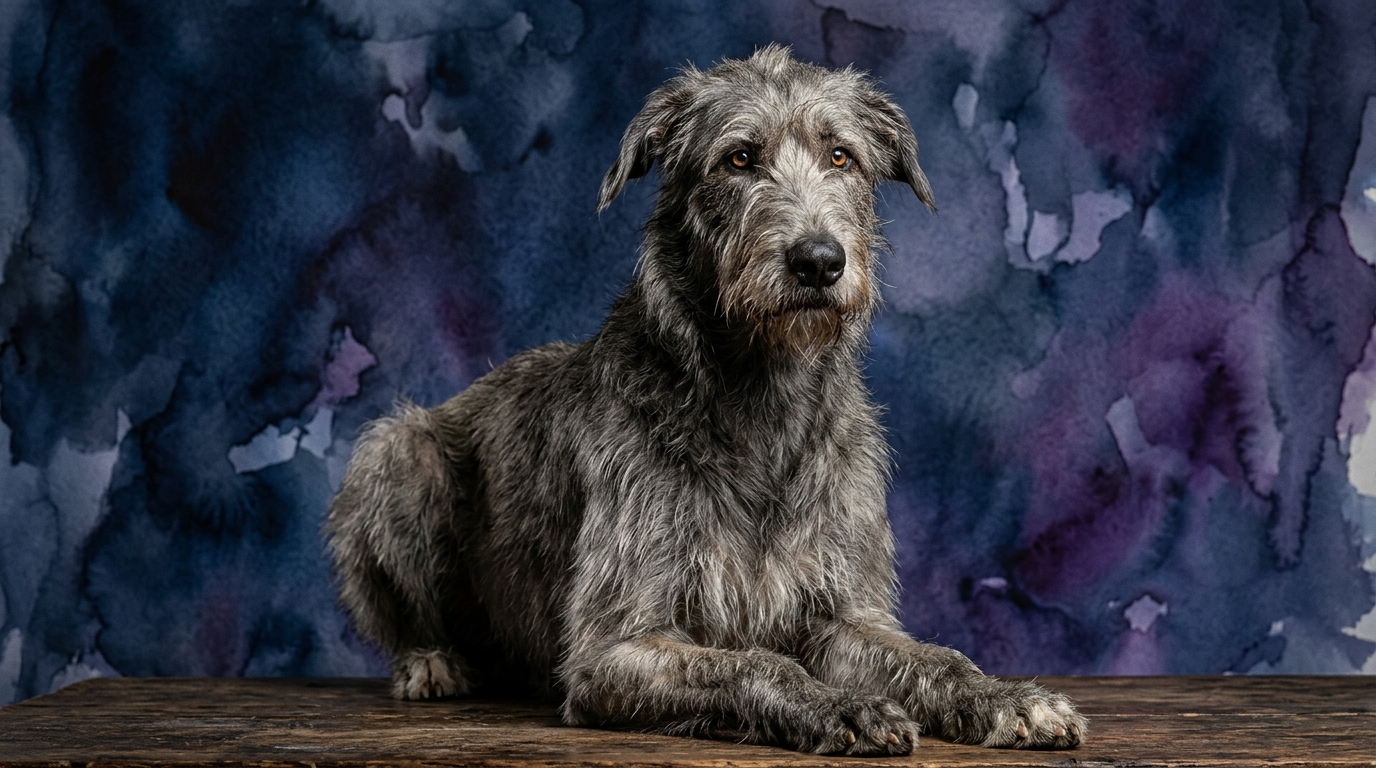
Side-by-Side Cognitive Profiles: Saint Bernard vs. Irish Wolfhound
The Cosmic Pet Pet IQ Lab categorizes canine intelligence across five key dimensions, offering a nuanced view of how breeds process information and interact with their environment. For the Saint Bernard, a Working dog, and the Irish Wolfhound, a Hound, these profiles illuminate their inherent strengths and learning styles.
**Saint Bernard (Working, Coren rank #65):** This breed’s cognitive makeup reflects its historical role in alpine rescue and companionship. Their Problem Solving score of 3/5 indicates a moderate ability to figure out novel situations or puzzles, capable but not always quick to innovate without guidance. Training Speed, at 2/5, suggests they require patience and repetition; new commands or routines aren't absorbed instantly. Social Intelligence shines at 4/5, highlighting their exceptional capacity for empathy, understanding human cues, and forming deep bonds. Instinctive Drive is a remarkable 5/5, reflecting their powerful innate urges, particularly for protection, rescue, and companionship. Their Memory stands at 3/5, meaning they retain learned information and experiences at an average pace, neither exceptional nor forgetful.
**Irish Wolfhound (Hound, Not Coren-ranked):** As a sighthound, the Irish Wolfhound's profile is shaped by centuries of independent hunting. Their Problem Solving is also 3/5, indicating a similar moderate capacity for navigating challenges, often relying on observation rather than intricate deduction. Training Speed is rated 3/5, placing them slightly ahead of the Saint Bernard; while not lightning-fast, they can learn new tasks with consistent, engaging methods. Social Intelligence is 3/5, suggesting they are affectionate and responsive to their family but perhaps less universally attuned to subtle human emotions than the Saint Bernard. Instinctive Drive, at 3/5, points to a strong, but not overwhelming, drive for their natural sighthound behaviors like chasing or observing. Their Memory is 3/5, reflecting a comparable ability to recall past events and training.
Where the Saint Bernard's Mind Excels
The Saint Bernard’s cognitive strengths are deeply rooted in their history as companions and rescuers, particularly evident in their superior Social Intelligence (4/5) and Instinctive Drive (5/5). Their elevated social intelligence means they possess a remarkable ability to read and respond to human emotions and intentions. They often demonstrate an uncanny knack for knowing when comfort is needed, offering a gentle nudge or a reassuring presence without explicit command. This isn't just learned behavior; it's an intrinsic capacity for empathy that fosters profound human-animal bonds.
Furthermore, their top-tier Instinctive Drive (5/5) manifests as a powerful, almost unwavering, impulse to protect, nurture, and assist. This drive isn't merely about guarding territory; it extends to an inherent desire to be an active, beneficial part of their family unit. For instance, a Saint Bernard might instinctively intervene if they perceive a family member in distress, or consistently 'herd' younger children gently within their perceived safe zone. This deep-seated motivation means they are often self-directed in their compassionate actions, making them uniquely attuned companions in scenarios requiring a steady, reassuring presence.
Cognitive Advantages of the Irish Wolfhound
While both breeds share a 3/5 score in Problem Solving and Memory, the Irish Wolfhound edges out the Saint Bernard in Training Speed, scoring 3/5 compared to the Saint Bernard's 2/5. This subtle difference indicates that, with the right approach, an Irish Wolfhound may grasp new commands and routines slightly more efficiently. Their sighthound heritage imbues them with a certain independence, but also a keen observational intelligence. Once their interest is piqued and the purpose of a task is clear, they can process and internalize instructions at a moderate pace, often requiring fewer repetitions than their Alpine counterpart.
Their Problem Solving at 3/5, combined with their moderate instinctive drive, often translates into a practical, rather than overtly complex, approach to challenges. An Irish Wolfhound might assess a barrier and find a direct route around it, or patiently wait for an opportunity, rather than attempting multiple, varied solutions. This measured problem-solving, coupled with their slightly quicker training uptake, allows them to adapt to structured routines and learn specific tasks without the extensive repetition a Saint Bernard might require, provided the training is engaging and consistent.
Training Dynamics: Patience for the Saint, Engagement for the Wolfhound
When considering ease of training, the data from The Cosmic Pet Pet IQ Lab paints a clear picture: the Irish Wolfhound (3/5 Training Speed) presents a slightly more straightforward training journey than the Saint Bernard (2/5 Training Speed). The Saint Bernard's lower score suggests a need for exceptional patience and consistency. They are not quick to pick up new commands and may require extensive repetition across many sessions to solidify a behavior. Their placid nature, while endearing, can sometimes translate into a slower processing of novel requests, making training feel like a marathon rather than a sprint. Owners must be prepared to use gentle, positive reinforcement, breaking tasks into minute steps, and celebrating small victories to avoid overwhelming this gentle giant.
In contrast, the Irish Wolfhound's 3/5 training speed indicates a more moderate learning curve. While they are sighthounds, known for their independent streak and tendency to follow their noses or eyes rather than immediate commands, they can learn effectively when motivated. Training an Irish Wolfhound often benefits from engaging, varied methods that capture their attention and make learning feel like a game. They might respond better to shorter, more frequent sessions and positive reinforcement tailored to their individual preferences, such as chasing a lure or receiving a favorite treat. Their independence doesn't mean stubbornness in the same way; it means an owner needs to make the training worth their while, rather than expecting blind obedience. Consequently, an Irish Wolfhound, while still requiring commitment, might show progress in a new skill within a shorter timeframe than a Saint Bernard.
Matching Canine Cognition to Lifestyle: Active vs. Relaxed Owners
Understanding these cognitive profiles is key to matching either a Saint Bernard or an Irish Wolfhound to the right home environment and owner lifestyle. For owners seeking a more relaxed pace of life, the Saint Bernard often fits seamlessly. Their high Social Intelligence and profound Instinctive Drive for companionship mean they thrive in homes where they can be a constant, comforting presence. They are generally content with moderate exercise and appreciate a predictable routine. Their slower training speed means an owner must be patient and consistent, but the reward is a deeply bonded companion who offers unwavering emotional support. They are ideal for individuals or families who appreciate a placid, empathetic canine presence and are willing to invest long-term in foundational training without expecting rapid mastery.
Conversely, the Irish Wolfhound, with its slightly quicker training speed and moderate instinctive drive, might appeal more to owners who enjoy a balance of structured activity and independent companionship. While they are not hyperactive, their sighthound heritage means they benefit from opportunities to stretch their long legs and engage their senses, whether through supervised off-leash runs in a secure area or mentally stimulating training sessions. Owners who appreciate a dog with a degree of self-possession, capable of learning new skills at a reasonable pace, and who can provide consistent, engaging training methods will find the Irish Wolfhound a rewarding companion. They suit owners who are comfortable with a dog that retains some independent thought, rather than one solely focused on pleasing, and who can channel their moderate instinctive drives into appropriate activities.
The Verdict
Choose the Saint Bernard if you seek a deeply empathetic, protective companion with an innate desire to connect, and you have the patience for a more deliberate training journey.
Opt for the Irish Wolfhound if you appreciate a noble, independent companion who can learn new skills at a moderate pace and benefits from engaging, structured activities.
🧠 Find Your Pet's IQ Score
Our Pet IQ Lab assessment covers 25+ tests across 5 cognitive dimensions — personalized to your breed.
Take the Full IQ Test →Frequently Asked Questions
Is the Saint Bernard difficult to train?
The Saint Bernard has a Training Speed of 2/5, indicating they are not quick learners. They require significant patience, consistency, and positive reinforcement, with tasks broken into small, manageable steps to facilitate understanding and retention.
Do Irish Wolfhounds respond well to commands?
Irish Wolfhounds score 3/5 in Training Speed, suggesting they can learn effectively with engaging and consistent methods. While they possess an independent sighthound nature, they respond well when training is made stimulating and rewarding, allowing them to grasp commands at a moderate pace.
Which breed is more affectionate?
The Saint Bernard's Social Intelligence is 4/5, higher than the Irish Wolfhound's 3/5, suggesting the Saint Bernard is typically more overtly empathetic and attuned to human emotions, often displaying affection through close proximity and gentle reassurance. Both breeds are affectionate, but the Saint Bernard's connection is often more demonstrative and intuitive.