
Side-by-Side Cognitive Profiles
The Sussex Spaniel (Coren Rank #62) presents a balanced, moderate cognitive profile across the board. Its problem-solving ability, rated at 3/5, suggests a dog that can navigate new situations and puzzles but may require consistent guidance and repetition to master complex tasks. Training speed also sits at 3/5, indicating a steady learning pace where new commands are absorbed reliably over time with patient, clear instruction. Social intelligence, at 3/5, points to a dog that forms strong bonds and understands social cues within its family unit without necessarily seeking to dominate interactions or displaying overly independent social strategies. Its instinctive drive, also 3/5, reflects a moderate desire to engage in traditional spaniel work like flushing game, a drive that is present but generally manageable in a home environment. Finally, memory at 3/5 means the Sussex Spaniel retains learned information and experiences consistently, though not always with the immediate recall of some higher-scoring breeds.
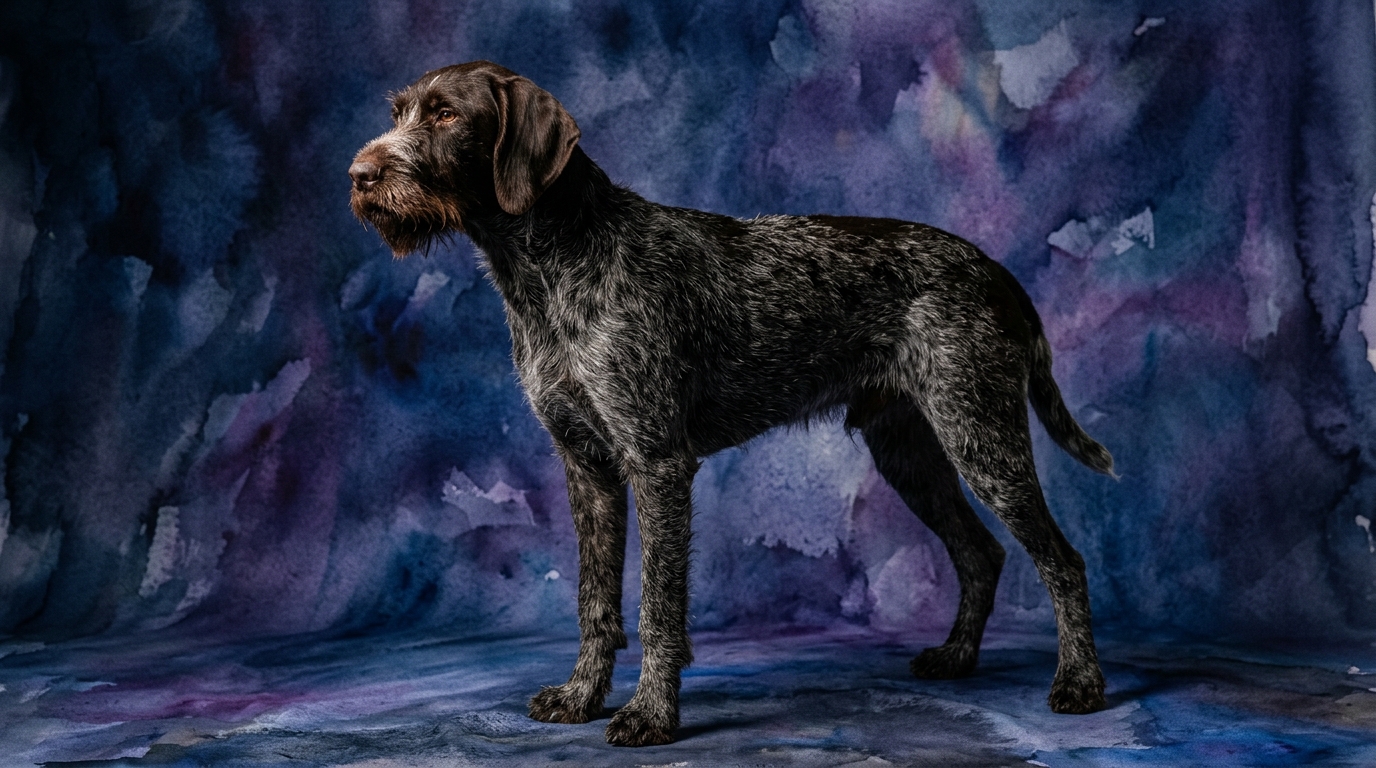
In contrast, the German Wirehaired Pointer (Coren Rank #28) showcases a more accelerated cognitive architecture, placing it significantly higher in Coren's ranking. Its problem-solving capacity, a robust 4/5, allows it to quickly assess new environments and challenges, often devising solutions with impressive efficiency and less reliance on human intervention. This breed's training speed, also 4/5, translates into a rapid acquisition of new skills and commands, making it a highly responsive student. Social intelligence mirrors the Sussex at 3/5, indicating a cooperative and engaged companion that understands social dynamics well, seeking partnership rather than absolute independence. The instinctive drive, rated 3/5, is also shared, reflecting its strong heritage as a versatile hunting dog, though its expression can be more intense due to its higher overall cognitive drive. Memory, at 4/5, means the German Wirehaired Pointer not only learns quickly but also retains vast amounts of information, from commands to complex routines, with enduring accuracy.
Where the Sussex Spaniel's Cognition Shines
While the German Wirehaired Pointer often exhibits a quicker processing speed, the Sussex Spaniel's cognitive strengths lie in its balanced, consistent approach to learning and interaction. Its 3/5 rating across all five IQ dimensions—problem solving, training speed, social intelligence, instinctive drive, and memory—cultivates a remarkably even-tempered and predictable companion. This consistent cognitive output means the Sussex is less prone to the intense, sometimes overwhelming mental demands that can accompany breeds with higher, more specialized intellectual capacities. Owners often find this steady cognitive rhythm translates into a calmer, more adaptable presence in the home, where unexpected challenges are met with thoughtful consideration rather than immediate, high-energy problem-solving.
The Sussex Spaniel's moderate instinctive drive (3/5) is another area where its cognitive profile offers distinct advantages for certain lifestyles. While it possesses the inherent desire to work, this drive is typically expressed in a more measured way compared to breeds with a 4/5 or 5/5 drive. This means its hunting instincts, while present, are generally easier to manage and redirect in a non-hunting household, requiring less intensive daily mental and physical exertion to satisfy. Its balanced social intelligence (3/5) also ensures it integrates smoothly into family life, offering affectionate companionship without the need for constant mental stimulation from its human counterparts, making it a reliable and emotionally stable presence.
Where the German Wirehaired Pointer's Cognition Excels
The German Wirehaired Pointer's cognitive architecture is designed for efficiency and adaptability, positioning it as a highly capable and versatile working dog. Its superior problem-solving ability, rated at 4/5, allows it to rapidly analyze and overcome obstacles, making it adept at complex tasks like intricate scent work, agility courses, or navigating challenging terrains during a hunt. This quick analytical mind means the GWP often figures out solutions independently, requiring less trial-and-error guidance from its handler, which is a significant advantage in dynamic environments.
Furthermore, the German Wirehaired Pointer's elevated training speed (4/5) and memory (4/5) are hallmarks of its cognitive prowess. This combination ensures that new commands, routines, and behavioral expectations are not only grasped quickly but also retained with remarkable long-term accuracy. Owners frequently report that a GWP can learn a new trick or task in fewer repetitions than many other breeds, and once learned, it sticks. This robust memory and rapid learning curve contribute to its reputation as a highly trainable and responsive partner, whether in a competitive sport, a working field, or a structured home environment. Its ability to absorb and apply information so readily makes it an exciting and rewarding dog for those who enjoy engaging in advanced training or dog sports.
Trainability: Patient Guidance vs. Rapid Acquisition
When considering trainability, the core differences in their cognitive profiles become evident. The German Wirehaired Pointer, with its 4/5 training speed and 4/5 memory, is engineered for rapid skill acquisition and retention. This means a GWP will typically pick up new commands, elaborate sequences, or complex behavioral cues with fewer repetitions and recall them more consistently over time. Its higher Coren rank of #28 reflects this capacity for understanding and executing instructions efficiently, often showing an eagerness to learn and perform. For owners seeking a dog that excels in obedience, advanced dog sports, or intricate field work, the GWP's cognitive makeup provides a distinct advantage, allowing for quicker progression through training stages.
Conversely, the Sussex Spaniel, with its 3/5 training speed and 3/5 memory, requires a more patient and consistent approach to training. While perfectly capable of learning a wide array of commands and behaviors, the Sussex will generally need more repetitions and a slower pace to fully internalize new information. Its Coren rank of #62 places it in a category where learning is reliable but not instantaneous. Real behavioral differences include the Sussex potentially taking longer to generalize a command from one environment to another, or needing more frequent refreshers to maintain proficiency. Owners of a Sussex Spaniel will find success through positive reinforcement, clear communication, and a willingness to invest consistent time into training sessions, celebrating steady progress rather than expecting immediate mastery.
Lifestyle Suitability: Active Engagement vs. Harmonious Companionship
The German Wirehaired Pointer's cognitive profile, characterized by its 4/5 problem-solving and memory, alongside a 3/5 instinctive drive that can express intensely, makes it an ideal match for active owners who can provide substantial mental and physical engagement. These dogs thrive on purpose and challenge, excelling in activities like hunting, agility, tracking, or competitive obedience. An owner who enjoys long, vigorous hikes, daily training sessions, and providing novel mental puzzles will find the GWP to be an incredibly rewarding and engaged companion. Without adequate outlets for their sharp minds and robust bodies, GWPs can become bored, potentially manifesting in undesirable behaviors as they seek to create their own "work."
The Sussex Spaniel, with its balanced 3/5 scores across the board, is better suited for owners who appreciate a more harmonious blend of activity and relaxed companionship. While still a sporting dog that enjoys walks and outdoor exploration, its cognitive demands are generally less intense than the GWP's. A Sussex can adapt well to a comfortable home life, enjoying moderate daily exercise like leash walks or garden play, followed by quiet time with its family. Its steady temperament and moderate drive mean it's less likely to become restless if a day's activity is slightly less rigorous, making it a good fit for individuals or families seeking a devoted, manageable companion who is content with consistent, rather than constant, stimulation.
The Verdict
Choose the Sussex Spaniel if you seek a steadfast, even-tempered companion whose steady cognitive pace and moderate drives make for a predictable and adaptable family member, thriving on consistent, gentle guidance and a comfortable home life.
Opt for the German Wirehaired Pointer if you are an active individual or family prepared to engage a quick-witted, highly trainable dog in regular, challenging activities, valuing its rapid learning, problem-solving prowess, and unwavering drive for purpose.
🧠 Find Your Pet's IQ Score
Our Pet IQ Lab assessment covers 25+ tests across 5 cognitive dimensions — personalized to your breed.
Take the Full IQ Test →Frequently Asked Questions
Is the Sussex Spaniel difficult to train due to its lower Coren rank?
No, the Sussex Spaniel is not difficult to train, but it does require more patience and consistency than some higher-ranking breeds. Its 3/5 training speed means it learns reliably with clear, positive reinforcement, just at a steadier pace, making it a rewarding experience for dedicated owners.
Does the German Wirehaired Pointer need constant mental stimulation?
The German Wirehaired Pointer, with its 4/5 problem-solving and memory, certainly benefits from consistent mental engagement. While not needing "constant" stimulation, daily training, puzzle toys, or participation in dog sports are crucial to satisfy its intelligent and purposeful nature, preventing boredom.
How do their social intelligence scores (3/5 for both) compare in real-world interactions?
Both breeds, sharing a 3/5 social intelligence score, are generally cooperative and form strong bonds with their families. The Sussex Spaniel tends to be more reserved and gentle in social settings, while the German Wirehaired Pointer, though equally bonded, might express its social engagement with more robust enthusiasm and a desire for interactive play.