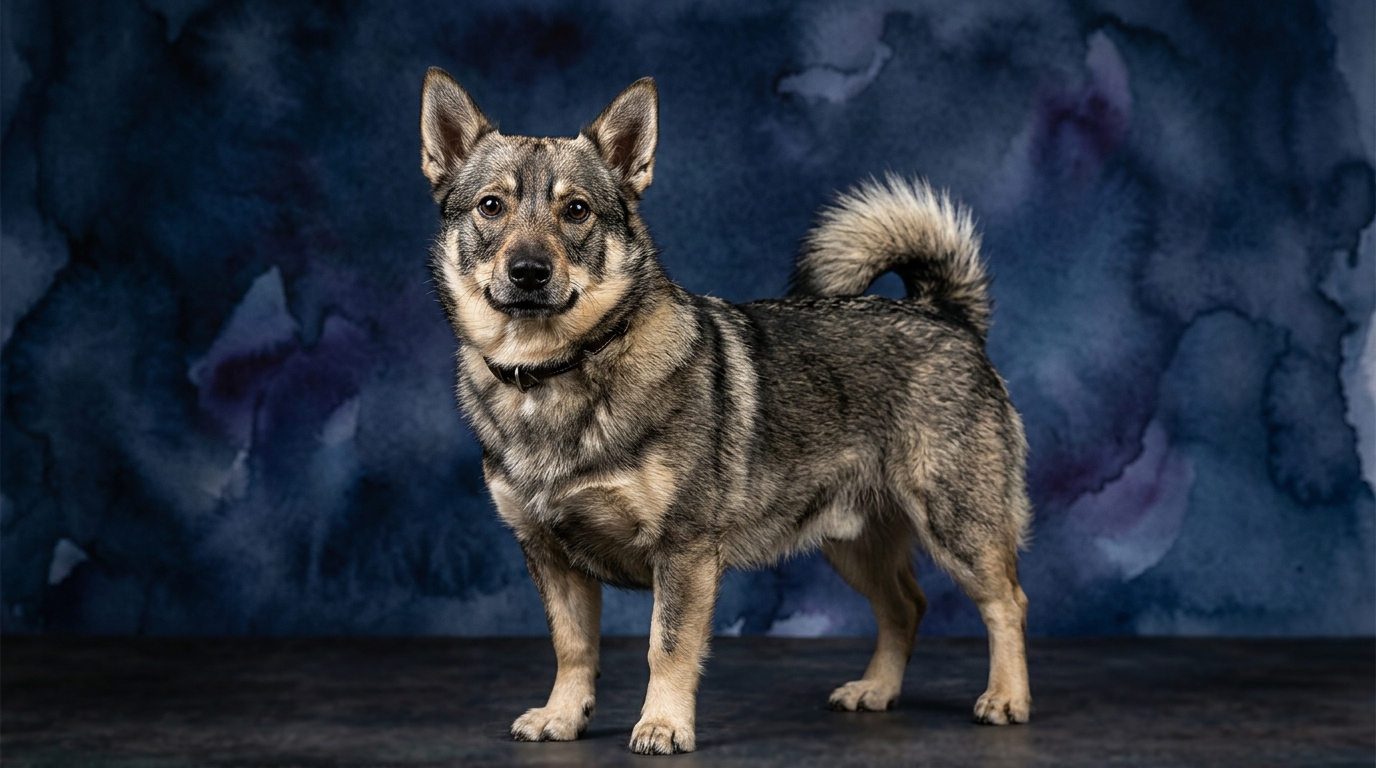

Side-by-Side Cognitive Profiles
The Cosmic Pet Pet IQ Lab assesses canine intelligence across five key dimensions, providing a nuanced view beyond simplistic 'smart or not' labels. For both the Swedish Vallhund and the Basset Hound, each dimension registers a 3/5, indicating a moderate, functional level of cognitive ability, but manifested through distinct breed lenses.
The **Swedish Vallhund**, a dog from the Herding group, exhibits a Problem Solving score of 3/5, typically applied to practical tasks like maneuvering livestock or navigating varied terrains. Their Training Speed, also 3/5, suggests they learn new commands at a moderate pace, often motivated by partnership and purpose. Social Intelligence at 3/5 means they read human cues reasonably well, fostering cooperative bonds. Their Instinctive Drive, 3/5, is centered around herding behaviors like nipping at heels and controlling movement. Finally, a Memory score of 3/5 indicates they retain routines and learned behaviors with moderate consistency.
The **Basset Hound**, belonging to the Hound group, also scores 3/5 across the board. Their Problem Solving, 3/5, is largely rooted in their olfactory world, expertly deciphering complex scent trails to locate a target, a task requiring significant mental processing and persistence. A Training Speed of 3/5 signifies they learn at a moderate rate, though their deep-seated independence often requires more consistent and creative motivational strategies. Their Social Intelligence, 3/5, allows them to connect with their human companions, often in pursuit of comfort or food. The Instinctive Drive, 3/5, is powerfully geared towards scenting and tracking, driving them to follow intriguing odors. Their Memory, 3/5, is particularly adept at recalling scent patterns and the locations of past discoveries, alongside general routines. It's important to note the Basset Hound holds a Coren rank of #71 for working and obedience intelligence, while the Swedish Vallhund is not Coren-ranked, reflecting different historical focuses in intelligence assessment.
Where the Swedish Vallhund Excels Cognitively
Despite sharing identical 3/5 scores with the Basset Hound, the Swedish Vallhund's cognitive strengths shine in areas demanding active partnership and adaptable problem-solving. Their herding background has honed their ability to observe and react quickly to environmental changes, translating into a practical intelligence valuable in structured activities. This breed demonstrates a keenness for engaging with their handler, often anticipating commands or seeking direction, which is a subtle yet significant cognitive advantage in co-operative tasks.
Their Problem Solving at 3/5 is less about abstract thought and more about dynamic, real-time decision-making in a working context. For instance, a Vallhund might quickly figure out how to use obstacles to guide a 'flock' (be it ducks or toys) or navigate a complex agility course efficiently. Their moderate Social Intelligence often manifests as a strong desire to please and work alongside their people, making them responsive to human instruction and more inclined to seek interaction as a form of problem-solving when faced with a novel situation. This cooperative drive, stemming from centuries of working closely with humans, gives them an edge in tasks requiring sustained human-canine teamwork.
Where the Basset Hound Excels Cognitively
The Basset Hound's cognitive prowess, while also scoring 3/5, lies in its specialized sensory intelligence and unparalleled focus. Their entire being is geared towards processing olfactory information, a complex cognitive task that involves differentiation, pattern recognition, and sustained attention. This isn't just a physical act of sniffing; it's a mental deep dive into a world of invisible data, allowing them to follow a trail for miles, ignoring distractions that would deter other breeds.
Their 3/5 Problem Solving manifests as incredible persistence in tracking, where they must logically deduce the path of a scent, often over varied and challenging terrain. This requires a unique form of sequential memory and an unwavering commitment to a singular goal. While their Training Speed is moderate, their Social Intelligence allows them to form strong, affectionate bonds, often using subtle cues to communicate their needs or desires, particularly around comfort and food. The Basset's moderate Memory is exceptionally tuned to remembering specific scent profiles and the intricacies of a hunting path, showcasing a different but equally valid form of cognitive strength compared to the Vallhund's generalist memory.
Training Ease: Cooperation vs. Independence
When it comes to training, the core behavioral differences rooted in their breed purposes become evident, despite both having a 3/5 Training Speed. The Swedish Vallhund, as a herding dog, possesses an inherent biddability and a desire to work with a handler. Their instinct is to respond to direction and participate in tasks, which generally makes them more receptive to obedience training. While they still require consistency and positive reinforcement, their moderate Social Intelligence and Instinctive Drive to herd often translate into a willingness to learn and please, making the training process feel more like a partnership.
The Basset Hound, on the other hand, was bred for independent scent work, following a trail often out of sight of a hunter. This has fostered a deep-seated independence and a selective hearing when a compelling scent is present. Their 3/5 Training Speed means they are capable of learning, but their strong Instinctive Drive for scenting can easily override commands if something more interesting catches their nose. Training a Basset requires immense patience, creativity, and understanding of their motivation, often leveraging food rewards and making training feel like a game rather than a chore. While they are affectionate, their primary motivation isn't always to please their human in the same cooperative way as a herder.
Suitability for Active vs. Relaxed Owners
The Swedish Vallhund is an excellent fit for active owners who enjoy engaging their dogs in various activities. Their moderate Instinctive Drive and Problem Solving skills thrive when given a 'job' to do, whether it's herding, agility, or competitive obedience. Owners who appreciate a dog that is always ready for an adventure, enjoys learning new tricks, and can keep pace on hikes will find a Vallhund to be a rewarding companion. Their cognitive needs are met through consistent mental stimulation and physical exercise, preventing boredom and potential mischief.
Conversely, the Basset Hound is generally better suited for more relaxed owners who appreciate a calm, laid-back companion, but who also understand the breed's need for scent-driven exploration. While Bassets enjoy leisurely strolls and can be surprisingly persistent on a scent trail, they are not typically high-energy dogs seeking constant physical exertion. Their cognitive needs are often satisfied through sniff-focused walks, scent games, and puzzle toys, allowing them to engage their powerful olfactory senses. Owners who are patient with a dog's independent streak and can provide a secure, fenced yard for safe sniffing will find the Basset's placid nature a comforting presence.
The Verdict: When to Choose Each Breed
The Verdict
Choose the Swedish Vallhund if you seek an active, cooperative canine partner eager for engagement in various activities, from structured training to outdoor adventures.
Opt for the Basset Hound if you appreciate a calm, affectionate companion with a profound independent streak, and you're prepared to indulge their world-class scenting capabilities.
🧠 Find Your Pet's IQ Score
Our Pet IQ Lab assessment covers 25+ tests across 5 cognitive dimensions — personalized to your breed.
Take the Full IQ Test →Frequently Asked Questions
Do Swedish Vallhunds and Basset Hounds have similar intelligence levels?
Based on The Cosmic Pet Pet IQ Lab, both breeds score 3/5 across all five cognitive dimensions. While their raw scores are identical, how they apply these abilities differs significantly due to their distinct breed purposes and instincts.
Which breed is easier to house train?
Both breeds are moderately trainable (3/5 Training Speed), but the Swedish Vallhund's cooperative nature often makes house training a more straightforward process. Basset Hounds, with their independent and scent-driven focus, may require more patience and consistency.
Are these breeds good with children?
Both breeds typically exhibit good social intelligence (3/5) and can be wonderful family pets. The Vallhund's energetic and playful nature might appeal to active children, while the Basset's calm demeanor makes them a patient companion for relaxed interactions, provided proper supervision and socialization.