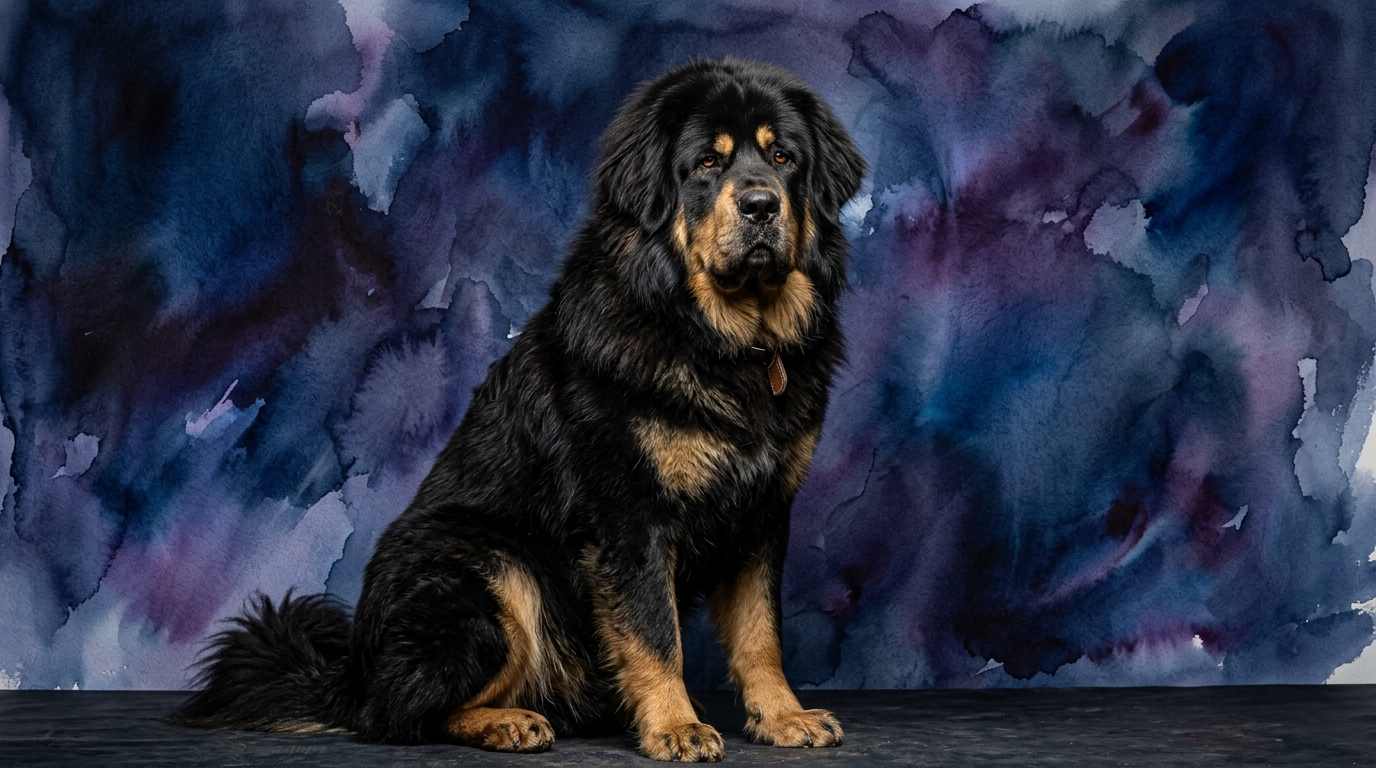

Side-by-side IQ profile
At The Cosmic Pet Pet IQ Lab, both the Tibetan Mastiff and the English Toy Spaniel register identical scores across our five key cognitive dimensions: Problem Solving (3/5), Training Speed (3/5), Social Intelligence (3/5), Instinctive Drive (3/5), and Memory (3/5). While these scores appear uniform, the practical application and behavioral expression of these capabilities diverge significantly, shaped by millennia of distinct breeding purposes and environmental adaptations. Understanding these differences requires moving beyond the numbers to examine the context of their cognitive operations.
For the Tibetan Mastiff, a 3/5 in Problem Solving often translates to independent decision-making in vast, challenging environments, such as assessing potential threats or navigating complex terrain to patrol its territory. Its 3/5 Training Speed reflects a discerning nature; these dogs learn quickly when a task aligns with their protective instincts or makes logical sense to them, but they are not inherently eager to perform arbitrary commands. Social Intelligence at 3/5 for a Tibetan Mastiff means a profound understanding of its immediate family unit, coupled with a wary, observational approach to outsiders, discerning intentions with a stoic precision. Its Instinctive Drive, also 3/5, is deeply rooted in guarding and territoriality, manifesting as an unwavering commitment to protection. Finally, a 3/5 Memory allows it to retain detailed mental maps of its domain, recall past encounters with precision, and remember routines critical to its sentinel duties.
The English Toy Spaniel’s 3/5 in Problem Solving, by contrast, typically manifests in navigating intricate indoor social dynamics or figuring out how to access desired comforts, like a favorite lap or a hidden treat. Its 3/5 Training Speed indicates an ability to grasp commands readily, particularly when motivated by positive reinforcement and a desire to please its human companions, though their attention can sometimes wander. A 3/5 in Social Intelligence for this breed signifies a keen attunement to human emotions and subtle cues, making them adept at providing comfort and adapting their behavior to the mood of their household. Their Instinctive Drive, also 3/5, is powerfully geared towards companionship and interaction, seeking close physical proximity and engagement with their people. Their 3/5 Memory is excellent for recalling specific family members, daily routines, and a repertoire of learned behaviors or tricks, ensuring seamless integration into a domestic setting.
Where Tibetan Mastiff wins cognitively
When evaluating cognitive strengths through the lens of their historical roles, the Tibetan Mastiff's intellect shines in scenarios demanding independent judgment and robust physical presence. Its problem-solving capabilities, rated 3/5, are uniquely suited to complex, high-stakes situations where a guardian must assess and react without direct human command. This isn't about solving puzzles for treats, but about strategically positioning itself, identifying nuanced threats, and making autonomous decisions to safeguard its charges over vast territories.
The Tibetan Mastiff’s 3/5 Instinctive Drive for guarding and its corresponding social intelligence excel in discerning genuine danger from harmless novelty. It processes environmental stimuli with a deep-seated caution, remembering past intrusions or perceived threats with impressive accuracy (3/5 Memory). This cognitive framework allows it to maintain vigilance over extended periods, making it exceptionally adept at long-term, self-directed security operations where consistent human oversight isn't always feasible. Its mental fortitude for independent watchfulness and its ability to process complex territorial information without succumbing to over-excitement or distraction are profound cognitive advantages in its domain.
Where English Toy Spaniel wins cognitively
The English Toy Spaniel, while physically small, possesses a cognitive profile perfectly optimized for nuanced human companionship and intricate social navigation. Its 3/5 Social Intelligence is arguably its most profound cognitive asset, allowing it to read subtle shifts in human mood, voice tone, and body language with remarkable precision. This breed excels at understanding the intricate web of household dynamics, often preempting emotional needs or offering comfort without explicit prompting. Their problem-solving abilities (3/5) are frequently directed at optimizing their social environment, whether by charming a new visitor or strategically positioning themselves for maximum affection.
The English Toy Spaniel's 3/5 Training Speed, combined with its strong companion-oriented Instinctive Drive, allows it to quickly pick up on verbal cues and routine behaviors that strengthen its bond with humans. This isn't merely rote memorization; it's an intelligent adaptation to the human social structure, remembering preferred interactions, favorite games, and the particular quirks of its family members (3/5 Memory). Their cognitive strengths lie in their capacity for profound emotional connection and their ability to integrate seamlessly into and enrich human domestic life through their perceptive and adaptable nature, making them masters of the art of companionship.
Which is easier to train and why
Despite both breeds scoring 3/5 in Training Speed, the practical experience of training a Tibetan Mastiff versus an English Toy Spaniel differs substantially due to their inherent motivations and historical roles. The Tibetan Mastiff, an ancient guardian, approaches training with a strong sense of independence and purpose. Its cognitive framework is geared towards assessing whether a command serves a logical function within its world, particularly concerning its protective duties. They are not inherently eager to please in the way many companion breeds are; instead, they learn quickly when the task is clear, fair, and aligns with their intrinsic drives or is presented by a leader they respect and trust. This means training requires immense patience, consistency, and a deep understanding of their independent nature, often involving problem-solving techniques that appeal to their self-reliance rather than simple obedience drills.
Conversely, the English Toy Spaniel’s 3/5 Training Speed is propelled by a powerful Instinctive Drive for companionship and interaction. These dogs generally possess an inherent desire to please their human counterparts, making them highly responsive to positive reinforcement, praise, and treats. Their cognitive processes are attuned to social feedback, and they thrive on the interactive aspects of training. While they can sometimes be distracted by their surroundings or their own playful impulses, their eagerness to engage and their sensitivity to human cues make them generally more straightforward to train for a wide range of domestic behaviors and tricks. The "why" behind their easier trainability isn't a higher cognitive score, but rather a disposition that aligns more readily with typical human training methodologies focused on compliance and social reward.
Which suits active owners vs relaxed owners
When considering suitability for active versus relaxed owners, the distinction between these two breeds becomes particularly stark, driven by their cognitive predispositions and physical requirements. The Tibetan Mastiff, despite not being a high-endurance athlete, demands an "active" owner in a different sense: one who is actively engaged in managing a powerful, independent, and territorial mind. Their 3/5 Instinctive Drive for guarding necessitates an owner who can provide consistent, firm, and knowledgeable guidance, establishing clear boundaries and ensuring proper socialization to channel their protective instincts appropriately. This breed requires extensive space, a secure environment, and mental stimulation that challenges their problem-solving abilities related to their original purpose. An owner must be proactive in their training and management, understanding that this breed's cognitive strengths are best harnessed through respect and consistent leadership, not just casual interaction.
The English Toy Spaniel, on the other hand, is an ideal fit for more relaxed owners seeking a devoted companion. Their cognitive profile, with a strong 3/5 Social Intelligence and Instinctive Drive for companionship, means they thrive on close human interaction and a comfortable, predictable home environment. While they appreciate gentle play and short walks, their primary mental and physical needs revolve around being near their people. Their problem-solving skills are often applied to domestic comfort and social engagement, making them content with indoor activities, cuddle sessions, and puzzle toys. An owner for an English Toy Spaniel needs to be "active" in providing affection, consistent routines, and gentle mental engagement, but not necessarily in demanding physical exertion or rigorous training for complex tasks. They flourish in an environment where their perceptive nature and desire for connection are cherished.
The Verdict
Choose the Tibetan Mastiff if you are an experienced, committed owner seeking a majestic guardian with a profound sense of purpose, capable of independent thought and unwavering loyalty in a well-managed, spacious environment. This breed thrives with consistent, respectful leadership and an understanding of its deep-seated protective instincts.
Opt for the English Toy Spaniel if you desire a sensitive, affectionate, and perceptive companion who excels at domestic life, offering profound emotional connection and thriving on gentle interaction within a relaxed home setting. This breed will flourish with owners who appreciate its keen social intelligence and desire for close human bonds.
🧠 Find Your Pet's IQ Score
Our Pet IQ Lab assessment covers 25+ tests across 5 cognitive dimensions — personalized to your breed.
Take the Full IQ Test →Frequently Asked Questions
Do similar IQ scores mean these breeds are equally "smart"?
No, identical IQ scores of 3/5 across dimensions for both breeds mean they possess similar *levels* of cognitive ability, but they apply these abilities in vastly different ways, shaped by their distinct historical roles and physical attributes. Their intelligence manifests uniquely through their problem-solving approaches, social interactions, and instinctive drives.
How does the Tibetan Mastiff's independence affect its cognitive performance?
The Tibetan Mastiff's independence means its 3/5 problem-solving and training speed are often directed towards self-reliant decision-making in guarding contexts, rather than eager compliance. Its cognitive strength lies in autonomous assessment and action, requiring an owner who respects this self-directed intelligence.
What makes the English Toy Spaniel's social intelligence stand out?
The English Toy Spaniel's 3/5 social intelligence allows it to excel at reading subtle human cues and emotions, making it exceptionally empathetic and adaptable to domestic social dynamics. This cognitive strength fosters deep emotional bonds and makes them highly attuned companions, often anticipating their owners' needs.