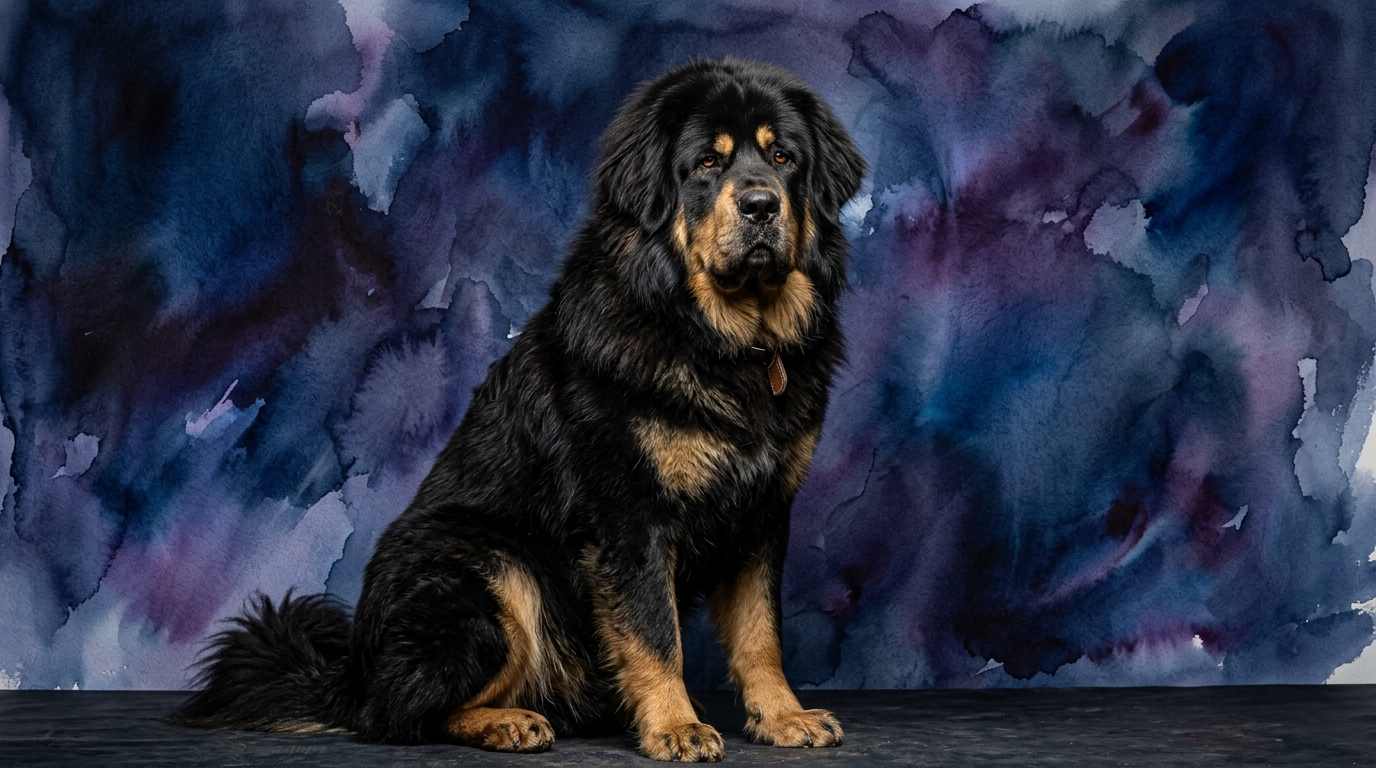
Tibetan Mastiff at a glance
| IQ Rank / Score | 15/25 |
|---|---|
| Trainability | ★★☆☆☆ (2/5) |
| Social Intelligence | ★★★☆☆ (3/5) |
| Lifespan | 10-12 years |
| Shedding | Moderate to high |
| Exercise Needs | High (60+ min/day + training) |
| Origin | Tibet |
The Independent Guardian: Tibetan Mastiff's Primary Intelligence Angle
At the core of the Tibetan Mastiff's cognitive profile is what we term 'Autonomous Guardian Intelligence.' This isn't about excelling in obedience trials or quickly learning complex tricks, but rather a profound capacity for independent judgment and self-directed action in the service of protection. For millennia, these dogs operated largely without direct human command, tasked with safeguarding livestock and monasteries against formidable predators and human intruders across vast, isolated terrains. Their survival and effectiveness depended on their ability to assess threats, strategize responses, and act decisively, often under challenging conditions, rather than awaiting specific instructions.
This primary angle means a Tibetan Mastiff's intelligence manifests in its astute environmental awareness, its uncanny ability to discern friend from foe, and its deliberate, often calculating approach to perceived dangers. They are not reactive in the impulsive sense but possess a deep-seated understanding of their territory and charges, making decisions based on subtle cues and past experiences. This cognitive independence, while admirable, often translates into a dog that thinks for itself, requiring an owner who respects and understands this unique mental framework.
IQ Scores: Decoding the Tibetan Mastiff Mind
Our Pet IQ Lab analysis reveals a distinct cognitive blueprint for the Tibetan Mastiff, reflecting their specialized role. Their problem-solving ability, scoring a 4, refers less to puzzle-box challenges and more to situational navigation – strategizing how to patrol, flank a perceived threat, or secure a boundary. This intelligence is practical and purpose-driven, not abstract.
Training speed, rated at 2, often surprises those unfamiliar with the breed. This isn't an indication of low intelligence, but rather a strong independence. Tibetan Mastiffs learn quickly but choose when and whether to apply learned commands based on their own assessment of the situation's relevance. Repetitive, arbitrary drills hold little interest for them, making them appear 'stubborn' to traditional training methods.
Social intelligence scores a 3, reflecting a dual nature. They exhibit profound loyalty and discerning affection towards their immediate family, showing high social understanding within their trusted circle. However, they are naturally aloof, cautious, and often suspicious of strangers, a trait vital for their guardian role. Their social interactions are selective and deeply rooted in their protective instincts, not a broad desire for camaraderie.
Instinctive drive is a resounding 5. The Tibetan Mastiff's inherent urges for guarding, territoriality, and protection are incredibly powerful and form the bedrock of their cognitive architecture. These drives are deeply ingrained and dictate much of their behavior and decision-making, requiring experienced handling to channel effectively. Their nocturnal vigilance, a historical adaptation for guarding against predators active at night, is a prime example of this intense drive.
Memory, scoring a 4, is another critical asset. They possess an excellent long-term memory for people, places, routines, and particularly, perceived threats or past negative experiences. This allows them to build a comprehensive mental map of their territory and social circle, remembering individuals they've assessed as safe or dangerous over extended periods, contributing significantly to their vigilant guarding capabilities.
An Ancient Lineage: A Surprising Evolutionary Adaptation
A fascinating scientific insight into the Tibetan Mastiff's unique cognition is rooted in its ancient lineage and high-altitude adaptations. Genetic studies have revealed that Tibetan Mastiffs possess unique physiological characteristics, including distinct hemoglobin traits, enabling them to thrive in the low-oxygen environments of the Himalayan plateau. This biological specialization isn't just physical; it underpins centuries of independent guardianship, where their cognitive abilities were honed to survive and protect in incredibly harsh, isolated conditions. Their ancestors diverged very early from other dog breeds, allowing for unique evolutionary pressures to shape not only their physical resilience but also their autonomous, self-reliant intelligence.
This deep historical context illuminates why their intelligence is so specialized. It wasn't about being a shepherd's shadow, but a self-sufficient sentinel, capable of navigating treacherous terrain, enduring extreme weather, and making life-or-death decisions without human direction. This evolutionary path means their cognitive framework is profoundly different from breeds selected for cooperative hunting or close companionship, emphasizing independent judgment and innate vigilance over compliant obedience. Their very biology supports a mind built for unwavering, autonomous defense.
Recommended Cognitive Tests for the Tibetan Mastiff
To truly understand the Tibetan Mastiff's distinct intelligence, traditional 'trick' tests fall short. Our Pet IQ Lab recommends tests that evaluate their natural guardian instincts and independent problem-solving abilities.
Beyond the Stereotype: Debunking the 'Stubborn' Myth
The most common myth surrounding Tibetan Mastiff intelligence is that they are 'stubborn and untrainable.' This claim often arises when owners attempt to apply conventional obedience training methods, expecting an eagerness to please that simply isn't inherent in the breed. Why it exists: Their independent nature and strong will mean they evaluate commands rather than immediately complying, especially if they perceive the command as arbitrary or unnecessary. They are not 'dumb,' but rather discerning and self-assured. The truth is, Tibetan Mastiffs are highly intelligent; their cognition is simply geared towards independent judgment and guarding, not rote obedience. They learn quickly but on their own terms, requiring patient, consistent training based on mutual respect and understanding of their unique drives, rather than forceful demands. What appears as stubbornness is often their intelligence assessing the situation and deciding whether a command aligns with their ingrained purpose or makes logical sense to them.
Cognitive Comparisons: Tibetan Mastiff vs. Great Pyrenees
While both the Tibetan Mastiff and the Great Pyrenees are formidable livestock guardian dogs with independent temperaments, their cognitive profiles exhibit key differentiators. The Great Pyrenees often displays a more 'gentle giant' social intelligence, being somewhat more amenable to strangers if properly socialized, though still possessing strong protective instincts. The Tibetan Mastiff, however, maintains a more pronounced aloofness and suspicion towards outsiders, with its social intelligence being almost exclusively focused inward on its immediate family. Cognitively, the Tibetan Mastiff's problem-solving often leans towards decisive, sometimes confrontational defense, whereas the Pyrenees might prioritize intimidation and deterrence, with physical confrontation as a last resort. Both are independent thinkers, but the Tibetan Mastiff's independence is often coupled with a more intense, unyielding protective drive shaped by centuries of guarding against more aggressive high-altitude predators.
Frequently Asked Questions About Tibetan Mastiff Intelligence
Q: Are Tibetan Mastiffs good family dogs? A: Yes, they can be exceptionally loyal and protective family members, but their social intelligence is selective; they bond deeply with their inner circle but remain aloof with strangers, requiring careful socialization.
Q: Can a Tibetan Mastiff live in an apartment? A: No, their profound instinctive drive for patrolling and guarding, coupled with their giant size and nocturnal tendencies, makes them unsuited for apartment living; they thrive with ample space and a secure yard.
Q: How difficult are Tibetan Mastiffs to train? A: They are not 'difficult' if understood, but they are challenging for novice owners due to their independent problem-solving and strong will; training requires patience, consistency, and positive reinforcement, focusing on cooperation rather than absolute submission.
Q: Do Tibetan Mastiffs bark a lot? A: Their vocalizations are specific to their guardian role; they are not typically nuisance barkers but will use deep, resonant 'oomphs' or barks to deter perceived threats, often becoming more vocal at night due to their natural nocturnal guarding instincts.
3 At-Home Tests to Measure Your Tibetan Mastiff's IQ
These tests are adapted from peer-reviewed ethology research. No equipment is needed beyond items you have at home. Run each test 5–10 times for reliable results.
The Myth: "Tibetan Mastiffs are stubborn and untrainable."
✅ Tibetan Mastiffs are highly intelligent, but their cognition is geared towards independent judgment and guarding, not rote obedience; they learn quickly but on their own terms, requiring patient, consistent training based on mutual respect and understanding of their unique drives, rather than forceful demands.
Tibetan Mastiff vs. Similar Breeds
🧠 What's Your Dog's IQ Score?
Our full Pet IQ Lab assessment includes 12+ tests across 5 cognitive dimensions, calibrated for Tibetan Mastiffs specifically.
Take the Full IQ Test →Frequently Asked Questions
How smart is a Tibetan Mastiff?
Our Pet IQ Lab framework scores cognition across five dimensions (max 25). The Tibetan Mastiff totals 15/25 — above-average for a domestic dog. The full article breaks down each dimension with at-home tests.
Are Tibetan Mastiffs easy to train?
Tibetan Mastiffs are independent learners; short, highly-motivating sessions work best. They score 2/5 on Training Speed in our breed profile.
Are Tibetan Mastiffs good with children and other pets?
Tibetan Mastiffs can live well with families when socialized early. Their Social Intelligence scores 3/5, so supervise interactions with small children and introduce new pets gradually.
Do Tibetan Mastiffs need a lot of mental stimulation?
Absolutely. With Problem Solving 3/5 and Instinctive Drive 4/5, Tibetan Mastiffs need daily mental work — puzzle feeders, scent games, training sessions, or nose-work — to avoid boredom.
How much exercise does a Tibetan Mastiff need?
Tibetan Mastiffs need active engagement. Plan for 45-60 minutes of exercise and training per day, plus mental stimulation.
How good is a Tibetan Mastiff's memory?
Tibetan Mastiffs score 3/5 on memory. They remember high-value associations well; less-used cues fade without refresher sessions.
What is the typical lifespan of a Tibetan Mastiff?
Typical lifespan is 10-12 years for a giant dog like the Tibetan Mastiff.
The Tibetan Mastiff offers a profound lesson in specialized intelligence, a mind perfectly honed for autonomous guardianship rather than conventional obedience. Understanding their unique cognitive profile is key to building a harmonious relationship with these majestic, ancient protectors, respecting their independence while guiding their powerful instincts.