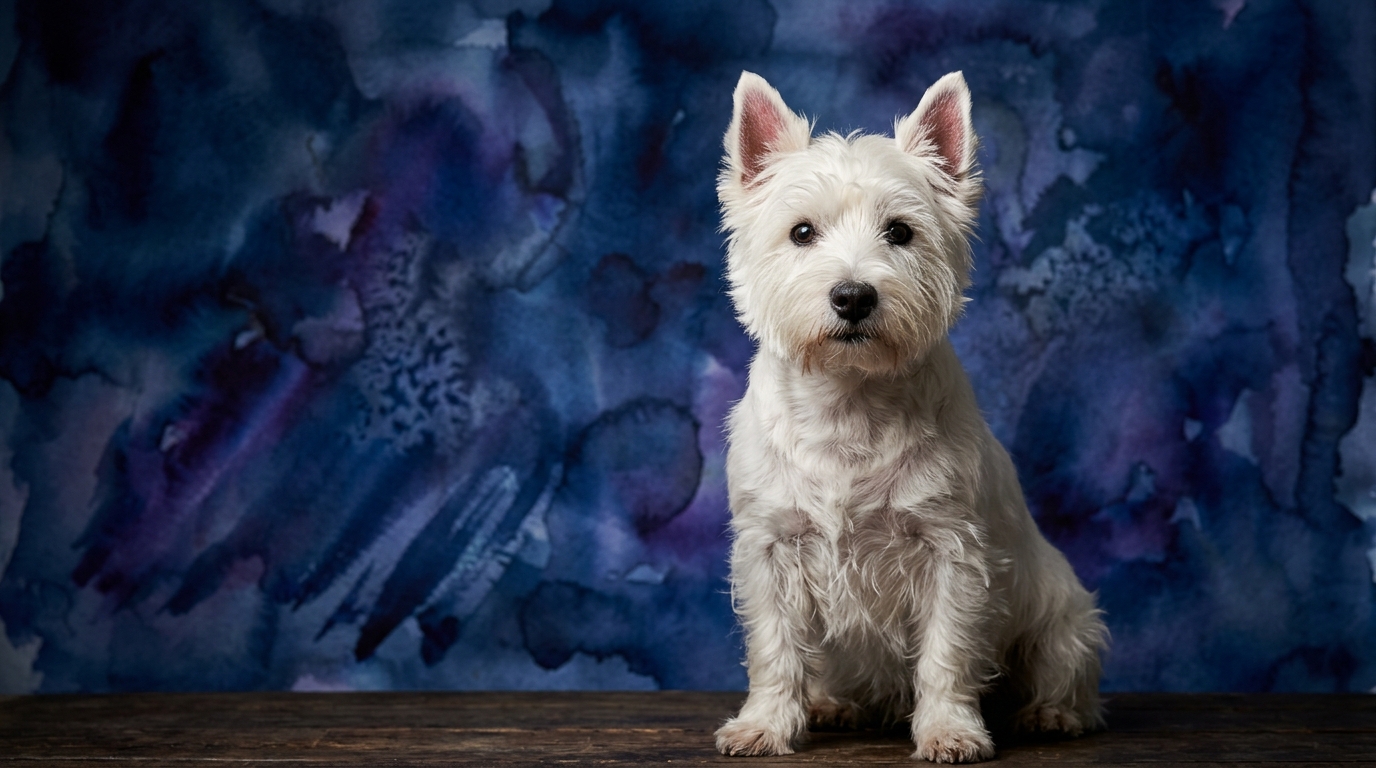

Side-by-Side IQ Profile: Westie vs. Irish Terrier
The West Highland White Terrier, a familiar face in many households, holds a respectable Coren rank of #47, placing it within the average working/obedience intelligence category. Our Cosmic Pet IQ Lab data reveals its cognitive profile: a Problem Solving score of 3/5, Training Speed at 3/5, Social Intelligence also at 3/5, and an Instinctive Drive of 3/5. Notably, the Westie distinguishes itself with a Memory score of 4/5, indicating a strong capacity for recall and retention of information.
In contrast, the Irish Terrier, while equally spirited, is not formally ranked on Stanley Coren's scale, often reflecting a less widespread participation in competitive obedience trials, which Coren's ranking heavily considers. Its IQ Lab profile shows remarkable consistency across most dimensions: Problem Solving at 3/5, Training Speed at 3/5, Social Intelligence at 3/5, and Instinctive Drive at 3/5. This breed exhibits a Memory score of 3/5, placing it on par with its other cognitive attributes.
Comparing these profiles, both breeds demonstrate a solid foundation in core cognitive areas, with similar scores in their ability to navigate novel situations, absorb new commands, interact with their environment, and express innate breed-specific behaviors. The key differentiator emerges in memory, where the Westie shows a distinct advantage, a factor that can subtly influence their overall learning and adaptability across their lifespan.
Where the West Highland White Terrier Wins Cognitively
The most pronounced cognitive advantage for the West Highland White Terrier lies in its superior Memory score of 4/5, surpassing the Irish Terrier's 3/5. This enhanced recall capacity means Westies are more adept at retaining learned commands, routines, and past experiences over extended periods. For an owner, this translates into fewer refreshers for established behaviors and a quicker re-engagement with tasks after a break, making the reinforcement process more efficient.
This robust memory also plays a crucial role in their problem-solving approach. While both breeds score 3/5 in Problem Solving, the Westie can draw upon a larger mental database of previous successes and failures. This allows them to apply past solutions to similar new challenges more readily, potentially leading to more refined and efficient strategies over time. Their ability to remember specific cues and consequences contributes to a more nuanced understanding of their environment.
Where the Irish Terrier Wins Cognitively
While the Irish Terrier doesn't present a numerically higher score in any single cognitive dimension compared to the Westie, its strength lies in the consistent and balanced nature of its profile. With 3/5 across Problem Solving, Training Speed, Social Intelligence, Instinctive Drive, and Memory, the Irish Terrier embodies a robust, unwavering approach to its intellectual and behavioral world. This breed isn't overly reliant on one specific cognitive strength, but rather operates with a well-integrated set of abilities.
This balanced profile suggests a dog that tackles challenges head-on with consistent focus, rather than seeking complex workarounds or relying heavily on subtle past cues. Their tenacious spirit, inherent to the terrier group, is supported by a stable cognitive framework that ensures persistent engagement with tasks. Owners can expect a dog that applies itself with consistent vigor, making them reliable in their responses once a behavior is established, even if it takes a bit more repetition to embed it initially.
Which is Easier to Train and Why
When considering ease of training, the West Highland White Terrier's superior Memory (4/5) gives it a notable edge, despite both breeds sharing a 3/5 Training Speed. While both can grasp new commands at a similar initial pace, the Westie's ability to retain that information more effectively means less backtracking and fewer repetitions are needed for long-term mastery. This makes building a complex repertoire of behaviors potentially more straightforward with a Westie.
The Irish Terrier, with its 3/5 Memory, might require more consistent and frequent reinforcement to solidify learned behaviors and ensure they stick over time. Both breeds, as true terriers, possess a 3/5 Instinctive Drive, which translates to a degree of independent thought and a natural inclination to follow their own nose. However, the Westie's stronger memory may allow for quicker generalization of learned rules across different contexts, potentially making them appear more adaptable and less prone to testing boundaries once a command is truly embedded.
Which Suits Active Owners vs. Relaxed Owners
The Irish Terrier, with its consistent 3/5 across most cognitive dimensions and a historical role as a spirited working dog, thrives with active owners who can match its robust energy and provide consistent mental and physical stimulation. Their balanced profile suggests they are not easily deterred and require proactive engagement to channel their instinctive drives. Activities like agility, earthdog trials, long hikes, or structured play sessions are ideal for keeping an Irish Terrier mentally sharp and physically content, preventing boredom and potential mischief.
The West Highland White Terrier, while still a terrier needing engagement, can be somewhat more adaptable to varied lifestyles due to its stronger memory and often a slightly more 'companionable' disposition. Their ability to remember routines and adapt to household dynamics might make them suitable for owners who appreciate a dog that can transition from an energetic outdoor session to a more relaxed indoor presence with greater ease. They still require daily walks and mental puzzles but might be slightly more forgiving of an occasional shift in schedule than their Irish Terrier counterparts.
The Verdict
For owners seeking a terrier with strong memory recall, making long-term training and adaptation to household routines potentially smoother, especially if varied daily schedules are common, the West Highland White Terrier is an excellent choice.
For those who value a consistently spirited, robust companion that approaches challenges with unwavering focus, thriving with owners who can provide consistent, engaging activities for their balanced cognitive drive, the Irish Terrier will be a rewarding partner.
🧠 Find Your Pet's IQ Score
Our Pet IQ Lab assessment covers 25+ tests across 5 cognitive dimensions — personalized to your breed.
Take the Full IQ Test →Frequently Asked Questions
Does the Westie's higher memory score mean it's "smarter" than the Irish Terrier?
Not necessarily in a general sense. While a 4/5 memory gives Westies an edge in recalling past experiences and commands, the Irish Terrier's consistent 3/5 across all dimensions indicates a balanced, robust cognitive profile, suggesting consistent application of its abilities rather than a singular intellectual peak.
How does the "Instinctive Drive" score of 3/5 for both breeds impact their daily lives?
A 3/5 instinctive drive means both breeds possess a moderate, but present, inclination towards behaviors typical of terriers, such as digging, chasing small prey, and independent problem-solving. Owners should be prepared to manage and constructively channel these natural instincts through consistent training, secure environments, and appropriate outlets like puzzle toys or supervised digging areas.
Given the similar "Training Speed" scores, are both equally easy to train?
While both breeds learn new commands at a similar initial pace (3/5), the Westie's superior memory (4/5) may lead to better retention of those commands over time and require less frequent refreshing. The Irish Terrier might require more consistent and frequent reinforcement to maintain learned behaviors, making the overall training journey slightly different in terms of ongoing commitment.