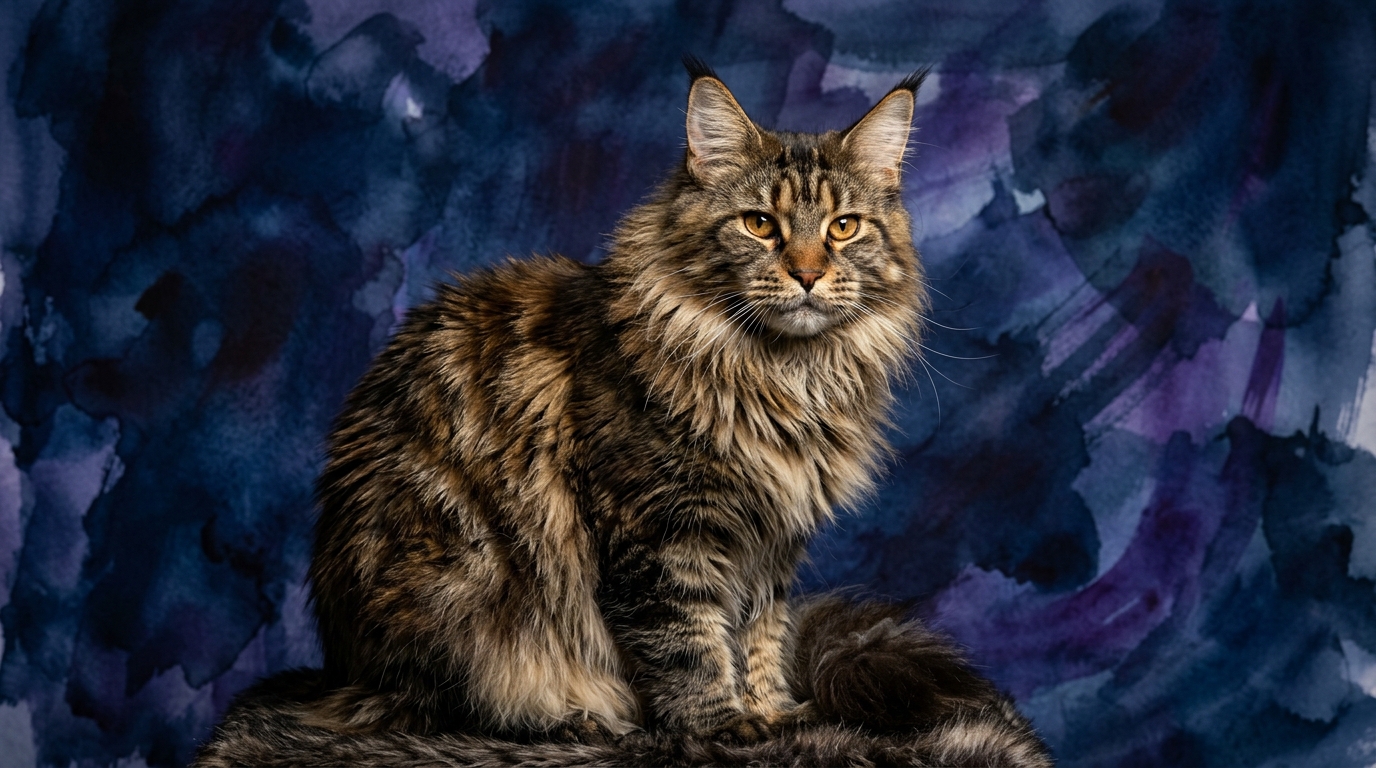
Maine Coon at a glance
| IQ Rank / Score | 21/25 |
|---|---|
| Trainability | ★★★★☆ (4/5) |
| Social Intelligence | ★★★★★ (5/5) |
| Lifespan | 12-16 years |
| Shedding | Moderate to high |
| Exercise Needs | Needs active play (45-60 min/day) |
| Origin | USA (Maine) |
Decoding the Maine Coon Mind: More Than Just a Majestic Mane
The Maine Coon presents a fascinating blend of brawn and brains, embodying a 'gentle giant' intelligence that sets them apart in the feline kingdom. Far from being merely large and docile, these cats apply their impressive cognitive abilities to navigating complex household environments and seamlessly integrating into family dynamics. Their behavioral repertoire often leans towards what many owners describe as 'dog-like,' showcasing a level of social engagement and trainability rarely seen in other domestic cat breeds.
Our Pet IQ Lab profile for the Maine Coon highlights specific strengths: Problem Solving at 4/5, Training Speed at 4/5, Social Intelligence at a remarkable 5/5, Instinctive Drive at 4/5, and Memory at 4/5. These scores illustrate a feline capable of intricate thought and adaptive learning, making them highly interactive and responsive companions.
Their heightened social intelligence means they are exceptionally attuned to human emotions and household routines, often seeking interaction and participating actively in family life. This profound social awareness, combined with their capacity for rapid learning, makes them particularly receptive to training and cooperative behaviors, which we'll explore further with our at-home tests.
The Evolutionary Edge: How Maine Coons Master Their World
The Maine Coon's unique physical traits are not just for show; they are profound adaptations that have also contributed to their remarkable cognitive profile, particularly in object manipulation and spatial reasoning. Maine Coons have tufted ears and large, polydactyl paws (extra toes) that act like natural snowshoes—adaptations to the harsh Maine winters that also gave them extraordinary manual dexterity for object manipulation. This physical capability translates directly into an enhanced ability to interact with their environment in sophisticated ways, often leading them to 'figure things out' with surprising proficiency.
This manual dexterity, combined with strong problem-solving skills, allows Maine Coons to approach challenges with a hands-on, exploratory mindset. They aren't just observing; they are actively engaging, using their paws in ways most other cat breeds do not. This active engagement strengthens neural pathways related to spatial reasoning and fine motor control, fostering a breed that thrives on mental stimulation and physical exploration.
Their robust instinctive drive, rated at 4/5, is often channeled into purposeful activities, from 'helping' with household chores to intricate play sessions. These instincts are not merely reflexive but are often applied with a calculated precision, showcasing a sophisticated level of practical intelligence rooted in their survivalist origins.
The Canine Paradox: Understanding Your Maine Coon's Social Savvy
The most striking aspect of Maine Coon intelligence for many owners is their remarkably 'dog-like' social intelligence and behavior. This isn't just an anecdotal observation; their 5/5 social intelligence rating indicates an exceptional capacity for forming deep bonds, understanding social cues, and engaging in cooperative play. While other cats might be independent, Maine Coons often display a desire to be involved, to follow their humans from room to room, and even to 'talk' with a variety of chirps and trills.
This high social intelligence fuels their training speed (4/5). Unlike many felines who may learn out of curiosity or habit, Maine Coons often learn as a form of social engagement and pleasing their human companions. This makes them surprisingly receptive to clicker training, leash walking, and even learning complex tricks, transforming typical feline independence into a unique partnership.
Their strong memory (4/5) reinforces these learned behaviors, ensuring that once a skill or a routine is established, it tends to stick. They remember sequences, locations, and even specific requests, further cementing their reputation as a highly adaptable and interactive companion species. This combination of social acumen and strong memory is a cornerstone of their gentle giant intelligence, allowing them to integrate into family life with unparalleled grace and understanding.
Busting the Myth: Big Cats, Nimble Minds
A common misconception suggests that large cats are slower and less agile mentally than smaller breeds. This myth often exists because larger animals, in general, are sometimes perceived as less nimble or intelligent due to their size and perceived lower energy levels compared to their smaller counterparts. The truth is, a Maine Coon's size is an asset to its unique cognitive profile, not a hindrance. Their physical adaptations, like those extraordinary paws, are directly linked to their dexterity and problem-solving abilities. Maine Coons demonstrate a nuanced approach to challenges, often using their strength and manual dexterity in tandem with their keen minds, proving that size does not equate to mental sluggishness. In fact, their larger brains, relative to some smaller breeds, often support complex cognitive functions, allowing for the deep social intelligence and problem-solving prowess observed in these magnificent felines.
Maine Coon vs. Other Feline Brains
While often compared due to their robust build and long coats, the Norwegian Forest Cat, while also possessing a formidable intelligence adapted for survival, generally exhibits a more independent problem-solving approach compared to the Maine Coon's more socially cooperative drive. Similarly, the Siberian cat, another intelligent and sturdy breed, tends to be more reserved and less overtly 'dog-like' in its constant pursuit of human interaction than the highly gregarious Maine Coon.
3 At-Home Tests to Measure Your Maine Coon's IQ
These tests are adapted from peer-reviewed ethology research. No equipment is needed beyond items you have at home. Run each test 5–10 times for reliable results.
The Myth: "Large cats are slower and less agile mentally than smaller breeds."
✅ The Maine Coon actively disproves this by demonstrating a highly agile and adaptable mind, frequently leveraging their strength and dexterity. Their unique physical attributes, like their specialized paws, directly contribute to their problem-solving and manipulation skills, showing that size can enhance rather than diminish cognitive capabilities. Their deliberate, thoughtful approach to problem-solving is a testament to their refined intelligence, not a lack of it.
Maine Coon vs. Similar Breeds
🧠 What's Your Cat's IQ Score?
Our full Pet IQ Lab assessment includes 12+ tests across 5 cognitive dimensions, calibrated for Maine Coons specifically.
Take the Full IQ Test →Frequently Asked Questions
How smart is a Maine Coon?
Our Pet IQ Lab framework scores cognition across five dimensions (max 25). The Maine Coon totals 21/25 — very high for a domestic cat. The full article breaks down each dimension with at-home tests.
Are Maine Coons easy to train?
Maine Coons are generally easy to train when you use consistent, reward-based sessions. They score 4/5 on Training Speed in our breed profile.
Are Maine Coons good with children and other pets?
Yes — their Social Intelligence rates 5/5 in our Pet IQ Lab framework. With early socialization and supervised play, most Maine Coons integrate well into families with respectful children and other pets.
Do Maine Coons need a lot of mental stimulation?
Absolutely. With Problem Solving 4/5 and Instinctive Drive 4/5, Maine Coons need daily mental work — puzzle feeders, scent games, training sessions, or interactive wand toys — to avoid boredom.
How much exercise does a Maine Coon need?
Maine Coons need active engagement. Plan for 45-60 minutes of play and climbing per day, plus mental stimulation.
How good is a Maine Coon's memory?
Maine Coons score 4/5 on memory. They remember routines, hiding spots, and learned cues for months, sometimes years.
What is the typical lifespan of a Maine Coon?
Most Maine Coons live 12-16 years with good veterinary care, quality diet, and indoor living.
The Maine Coon truly redefines what it means to be a domestic cat, showcasing a blend of size, gentle demeanor, and remarkable intelligence that consistently captivates. Through their unique adaptations and dog-like sociability, these gentle giants offer a profoundly rewarding and intellectually engaging companionship unlike any other feline.