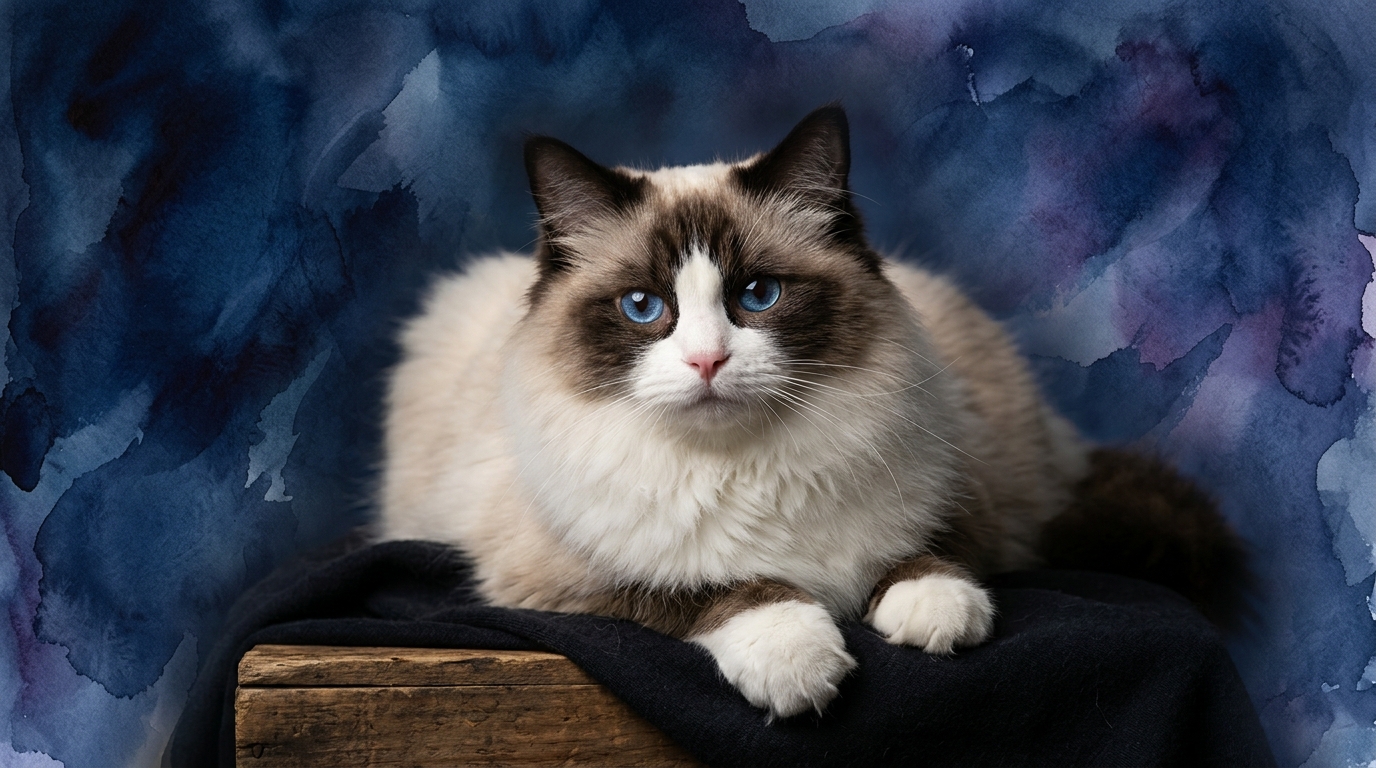
Ragdoll at a glance
| IQ Rank / Score | 16/25 |
|---|---|
| Trainability | ★★★☆☆ (3/5) |
| Social Intelligence | ★★★★★ (5/5) |
| Lifespan | 12-16 years |
| Shedding | Moderate to high |
| Exercise Needs | Moderate (20-40 min play/day) |
| Origin | USA (California) |
The Ragdoll's Unique Trust-Based Intelligence
One of the most iconic traits of the Ragdoll is their namesake behavior: going completely limp when held, often described as melting into your arms. This isn't a simple physical reflex; it's a profound display of learned trust and security, a highly sophisticated form of social signal that demonstrates their comfort and deep bond with their human companions. This willingness to surrender control is a hallmark of their exceptional social intelligence (rated 5/5), setting them apart in the feline world.
Dive deeper into what this 'limpness' signifies, and you'll find a cat actively communicating profound trust and security. It’s an intentional, learned behavior that highlights their comfort and bonding with their human companions, distinguishing them from many other breeds who might tolerate being held but rarely relax to this degree. This unique communication style underscores a complex understanding of their social environment and the safety their humans provide.
Their high social intelligence also manifests in their strong desire for interaction, often greeting owners at the door and participating in family activities with an eagerness typically associated with canines. This consistent seeking of companionship and inclusion in daily life indicates a cat keenly attuned to human behavior, routines, and emotional states, making them highly responsive to social learning cues from their trusted people.
Decoding the Ragdoll's Cognitive Profile
To truly appreciate the Ragdoll's mind, we can examine various facets of their intelligence: Problem Solving (3/5), Training Speed (3/5), Social Intelligence (5/5), Instinctive Drive (2/5), and Memory (3/5). These scores paint a picture of a cat whose mental strengths lie less in raw cunning or independent survival, and more in their capacity for affectionate interaction and understanding of their human household.
While not master escape artists or quick trick learners like some highly active, independent breeds, their moderate scores in problem-solving and training speed indicate a capable and cooperative learner. Ragdolls are adept at understanding household routines, responding to consistent commands, and even engaging with interactive puzzle toys. Their progress often thrives on positive reinforcement and patient, gentle training methods, which align perfectly with their amenable and social temperament.
Ragdolls are one of the largest domestic cat breeds, with males often reaching up to 9kg, and they have a distinct tendency to follow owners from room to room – a trait so consistent the breed is often described as 'puppy-like.' This continuous presence and monitoring of their human's location speaks volumes about their strong social drive and memory for routines, reinforcing their affectionate 'shadow cat' persona. It's a clear indicator of their engagement with their environment and their human family.
Their lower instinctive drive (2/5) means Ragdolls generally exhibit a reduced prey drive compared to breeds with strong hunting heritages. This characteristic aligns with their highly social, indoor-oriented temperament, making them less prone to destructive behaviors driven by boredom or instinctual urges when adequately stimulated through play and companionship. They are generally content with indoor life, prioritizing comfort and human connection over adventurous pursuits.
Unveiling the Myth: Relaxation Versus Engagement
Many observers see a Ragdoll's exceptionally relaxed and gentle demeanor and mistakenly interpret it as a sign of passivity or even a lack of cognitive engagement. This common misjudgment leads to the belief that Ragdolls are unintelligent because they appear too serene to be actively thinking or interacting with their environment. However, their calmness is a strength, not a weakness, enabling a different kind of mental processing.
A truly relaxed cat is often a more observant one, capable of taking in subtle cues from its environment and human companions without the distraction of high-energy impulses or overstimulation. Their serene presence allows for deep processing of social interactions, routine patterns, and environmental changes, demonstrating a thoughtful engagement rather than a disinterest. This quiet observation is a form of active intelligence, where they are constantly learning and adapting based on trust and understanding.
At-Home Discoveries: Testing Your Ragdoll's Mind
Unlocking your Ragdoll's cognitive strengths can be a rewarding experience for both of you. The Pet IQ Lab encourages you to engage in these fun, interactive at-home tests, not as formal intelligence measurements, but as fascinating windows into your cat's unique understanding of the world. These simple activities provide tangible proof of their impressive abilities in social learning, cross-species communication, and memory.
By observing your Ragdoll's reactions to these playful challenges, you'll gain a deeper appreciation for their capacity to learn from you, understand your gestures, and recognize their own name. These abilities underscore a sophisticated understanding of their environment and their human companions, moving beyond anecdotal observations to concrete demonstrations of feline smarts. Prepare to be delightfully surprised by what your Ragdoll can show you about their inner world.
Ragdolls in the Feline Family: A Comparative Glimpse
Comparing Ragdolls to other popular cat breeds helps to highlight their distinct attributes and unique approach to intelligence. Just as humans possess different types of smarts, so too do our feline friends, with each breed showcasing particular cognitive strengths shaped by their history, temperament, and selective breeding. Understanding these differences enriches our appreciation for the diverse landscape of feline intelligence.
While all cats share fundamental feline instincts, breeds like the Maine Coon, Birman, and Scottish Fold offer fascinating contrasts to the Ragdoll's social and trust-based intelligence. These comparisons underscore that there isn't a single measure of 'smartness,' but rather a spectrum of cognitive skills that make each cat special in its own way. It allows us to pinpoint what makes the Ragdoll's intelligence so uniquely endearing and effective within a domestic setting.
3 At-Home Tests to Measure Your Ragdoll's IQ
These tests are adapted from peer-reviewed ethology research. No equipment is needed beyond items you have at home. Run each test 5–10 times for reliable results.
The Myth: "Ragdolls are passive and unintelligent because they're too relaxed to engage."
✅ The Ragdoll's relaxed nature is not a sign of disengagement, but rather a profound display of trust and security, allowing for deep observation and processing of their environment. Their high social intelligence drives them to keenly observe and interact with their human family, often 'helping' with daily tasks and learning complex routines. This calm attentiveness is a unique form of engagement, demonstrating a sophisticated awareness rather than mere passivity.
Ragdoll vs. Similar Breeds
🧠 What's Your Cat's IQ Score?
Our full Pet IQ Lab assessment includes 12+ tests across 5 cognitive dimensions, calibrated for Ragdolls specifically.
Take the Full IQ Test →Frequently Asked Questions
How smart is a Ragdoll?
Our Pet IQ Lab framework scores cognition across five dimensions (max 25). The Ragdoll totals 16/25 — high for a domestic cat. The full article breaks down each dimension with at-home tests.
Are Ragdolls easy to train?
Ragdolls can learn most cues, but expect to repeat lessons and keep sessions short. They score 3/5 on Training Speed in our breed profile.
Are Ragdolls good with children and other pets?
Yes — their Social Intelligence rates 5/5 in our Pet IQ Lab framework. With early socialization and supervised play, most Ragdolls integrate well into families with respectful children and other pets.
Do Ragdolls need a lot of mental stimulation?
Ragdolls benefit from 10-15 minutes of focused enrichment a day: food puzzles, short training drills, or novel toys rotated weekly.
How much exercise does a Ragdoll need?
Ragdolls do well with 20-40 minutes of interactive play plus a few short training moments.
How good is a Ragdoll's memory?
Ragdolls score 3/5 on memory. They remember high-value associations well; less-used cues fade without refresher sessions.
What is the typical lifespan of a Ragdoll?
Most Ragdolls live 12-16 years with good veterinary care, quality diet, and indoor living.
The Ragdoll cat, far from being merely a beautiful and docile lap cat, possesses a rich and distinctive intelligence, deeply rooted in trust, social connection, and unique communication. Their 'limpness' and 'puppy-like' devotion are not signs of passivity but active expressions of a complex mind, challenging us to look beyond conventional notions of feline smarts.