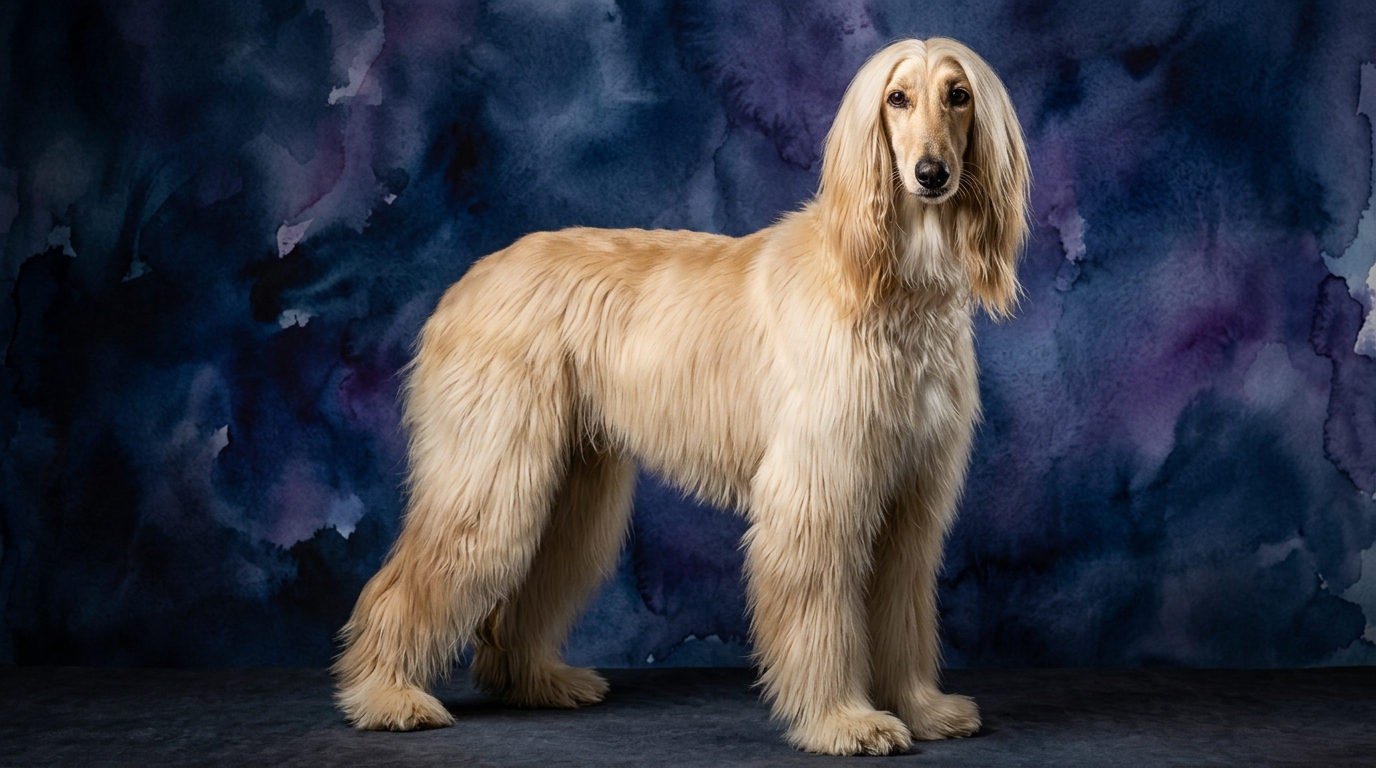
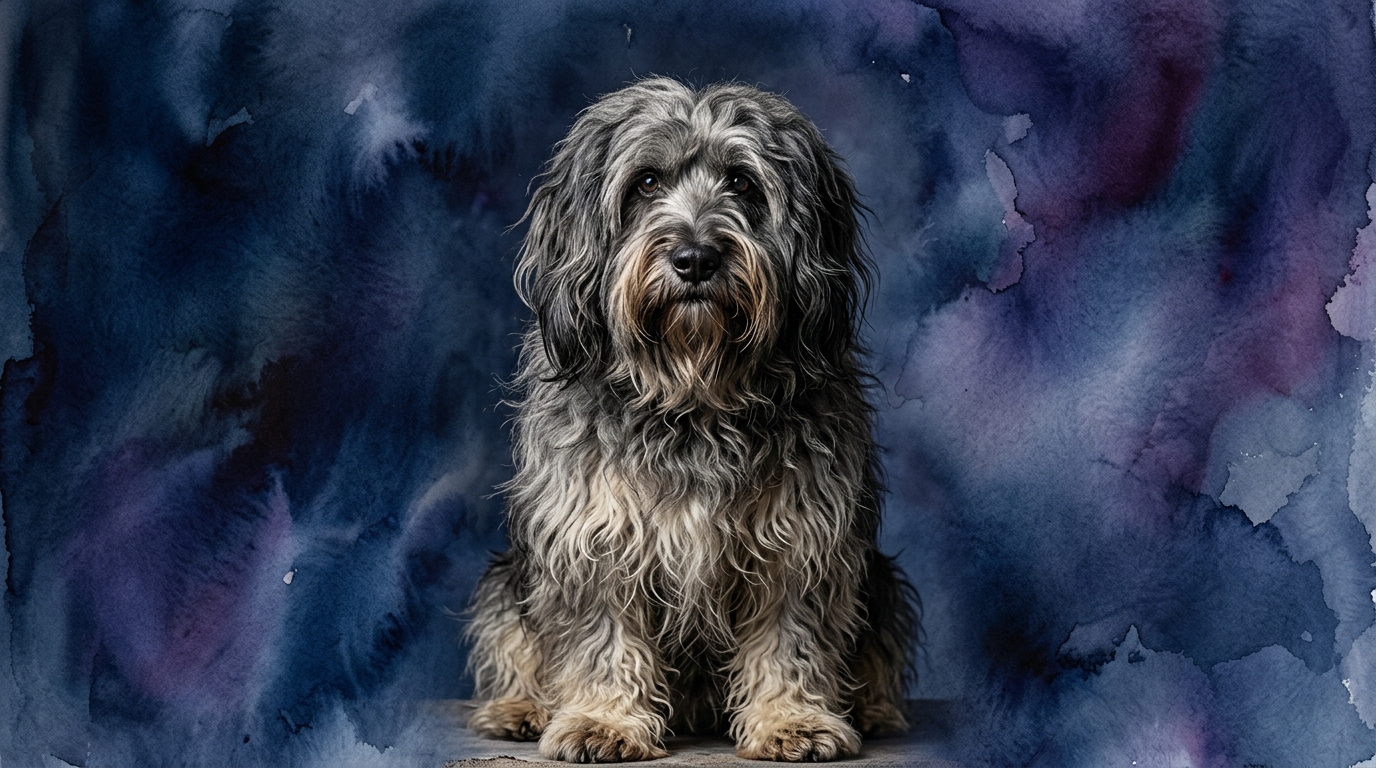
Side-by-Side IQ Profile: Afghan Hound vs. Polish Lowland Sheepdog
The Cosmic Pet Pet IQ Lab employs a multi-dimensional approach to evaluating canine intelligence, moving beyond simple obedience scores to understand the nuanced cognitive landscapes of different breeds. For the Afghan Hound and the Polish Lowland Sheepdog, these profiles paint vivid pictures of their distinct mental architectures.
The **Afghan Hound**, with a Coren rank of #79, presents a profile marked by strong independence and specialized abilities. Their Problem Solving is rated 4/5, indicating a significant capacity for independent thought and figuring out how to achieve desired outcomes, often for their own benefit. Training Speed is a low 1/5, reflecting their challenge in learning and complying with human commands, largely due to their independent spirit and lack of inherent desire to please. Social Intelligence stands at 2/5, suggesting a reserved nature and selective engagement in social interactions, often preferring their own company or that of a select few. Instinctive Drive is a powerful 5/5, highlighting their intense sighthound prey drive and deep-seated urge to chase and act on impulse. Memory is rated 3/5, indicating an average capacity to recall experiences and learned behaviors, though this doesn't always translate to compliance.
The **Polish Lowland Sheepdog**, not specifically Coren-ranked, shows a more balanced and cooperative cognitive profile, typical of many herding breeds. Their Problem Solving is 3/5, demonstrating a practical intelligence geared towards managing situations and adapting to tasks, often in a group context. Training Speed is a moderate 3/5, meaning they are generally willing and able to learn new commands and routines with consistent positive reinforcement. Social Intelligence is also 3/5, indicating a good capacity for reading human cues, engaging in family dynamics, and understanding social hierarchies within their 'flock.' Instinctive Drive is 3/5, reflecting their inherent herding tendencies and watchful nature, but without the overwhelming intensity seen in some specialized breeds. Memory is 3/5, showing an average ability to retain information, crucial for remembering routines, boundaries, and learned tasks.
Where the Afghan Hound Excels Cognitively
The Afghan Hound’s cognitive strengths lie in areas demanding independent decision-making and a potent, unyielding drive. Their 4/5 rating in Problem Solving is not about solving puzzles for human approval, but rather about their remarkable ability to independently navigate their environment to achieve self-serving objectives. This might manifest as artfully opening a gate, locating a hidden treat, or devising a strategy to pursue a squirrel across a yard, all without direct human instruction. Their sighthound heritage instilled a need for quick, autonomous judgment in the field, a trait that remains deeply ingrained.
Furthermore, their Instinctive Drive, an impressive 5/5, is a profound cognitive asset in its original context. This isn't merely a physical urge; it's a highly focused mental state that allows them to lock onto a target and execute a complex, instinct-driven pursuit with incredible precision and endurance. This deep-seated drive, while challenging in a domestic setting, represents a pinnacle of specialized, innate intelligence, allowing them to act with singular purpose and efficiency when their instincts are engaged. This mental tenacity, combined with their problem-solving prowess, makes them formidable in situations requiring self-reliance.
Where the Polish Lowland Sheepdog Wins Cognitively
The Polish Lowland Sheepdog's cognitive advantages are rooted in their cooperative nature and adaptability, traits honed by centuries of working alongside humans. Their 3/5 Training Speed significantly surpasses the Afghan Hound's 1/5, indicating a much greater amenability to structured learning. This breed possesses a more intrinsic desire to understand and respond to human directives, making the process of teaching basic commands and complex tasks considerably smoother and more rewarding for both dog and owner. Their background as a working herding dog means they are predisposed to engaging in a partnership, rather than operating in complete autonomy.
Their 3/5 Social Intelligence also represents a distinct cognitive win. Unlike the more reserved Afghan Hound, the Polish Lowland Sheepdog is generally more attuned to human emotions, social cues, and the dynamics of a family unit. They are capable of forming strong bonds and often take on a watchful, protective role, demonstrating an awareness of their 'flock' and its needs. This social acumen allows them to integrate more seamlessly into family life, offering companionship that is both engaged and responsive. While their Problem Solving at 3/5 is not as high as the Afghan's, it is a practical, context-aware intelligence, excellent for navigating household routines and even anticipating human needs within a cooperative framework.
Which is Easier to Train, and Why?
Without question, the Polish Lowland Sheepdog is the easier breed to train when compared to the Afghan Hound. This difference stems directly from their divergent IQ profiles, particularly in Training Speed and Social Intelligence. The Afghan Hound's 1/5 Training Speed is a direct reflection of their independent, sighthound mentality. They are not inherently driven to please their human companions and possess a strong will, often choosing to prioritize their own instincts or comfort over compliance. Their relatively lower social intelligence (2/5) means they are less motivated by human approval and can find repetitive training exercises boring or irrelevant, making consistency and engagement a continuous challenge for the handler. Training an Afghan often feels more like a negotiation, requiring immense patience, creativity, and a deep understanding of their unique motivations, often focusing on making the desired action intrinsically rewarding for the dog.
In contrast, the Polish Lowland Sheepdog's 3/5 Training Speed and 3/5 Social Intelligence make them significantly more receptive to instruction. Their herding background has instilled a natural inclination to work cooperatively with a handler, to follow directions, and to respond to cues. They generally thrive on mental stimulation and positive reinforcement, showing a willingness to learn and participate in structured activities. While they can possess a stubborn streak typical of many herding breeds, their desire to be an engaged member of the family and their capacity for understanding social hierarchy means they are more inclined to accept guidance. This makes them a more straightforward and rewarding partner in training endeavors, capable of excelling in various dog sports and obedience disciplines.
Suitability for Active vs. Relaxed Owners
When considering an Afghan Hound or a Polish Lowland Sheepdog, the owner's lifestyle is a critical factor, as both breeds demand significant engagement, albeit in different ways. Neither breed is truly suited for a 'relaxed' owner who prefers minimal interaction and exercise; both require dedicated attention to thrive. However, their specific needs cater to different types of 'active' ownership.
The Afghan Hound, with its powerful 5/5 Instinctive Drive and significant physical requirements, is best suited for owners who are prepared for a truly active lifestyle centered around providing outlets for their intense energy. This means owners who can offer regular, vigorous exercise in secure, expansive areas where they can run freely and safely. Their independent problem-solving (4/5) also means they need mental engagement that respects their autonomy, such as scent work or lure coursing, rather than repetitive obedience drills. An ideal owner for an Afghan Hound appreciates a dog with a strong, distinct personality, is patient with their independent nature, and understands that companionship with an Afghan is a unique, often challenging, but deeply rewarding experience. They are not for the faint of heart or those seeking a highly biddable companion; rather, they thrive with owners who celebrate their aristocratic aloofness and provide the space and understanding for their distinctive intelligence to flourish.
The Polish Lowland Sheepdog also requires an active owner, but their activity is often more structured and cooperative. Their moderate Instinctive Drive (3/5) means they need consistent daily exercise and mental stimulation that taps into their herding intelligence. Owners who enjoy teaching new tricks, participating in dog sports like agility, obedience, or herding trials, and engaging in regular, interactive play will find a willing partner in a PONS. Their higher Social Intelligence (3/5) means they thrive on being an integrated, active member of the family, often seeking to be involved in household activities and acting as a watchful companion. They are an excellent choice for owners who want a dog that is both physically capable and mentally engaged in a partnership, someone who can provide consistent training and enjoys a dog that is responsive and eager to participate in shared activities. While they need exercise, their needs are often more about consistent engagement and mental work rather than the sheer, unbridled running required by the Afghan Hound.
The Verdict
Choose an Afghan Hound if you appreciate an independent, elegant companion, are prepared for significant training challenges, and can provide ample, secure space for their powerful instinctive drives to be exercised, understanding that compliance is earned, not given.
Choose a Polish Lowland Sheepdog if you seek a more cooperative, engaged, and trainable companion who thrives on mental stimulation and enjoys being an active, integrated member of the family, and are prepared for regular grooming and consistent training.
🧠 Find Your Pet's IQ Score
Our Pet IQ Lab assessment covers 25+ tests across 5 cognitive dimensions — personalized to your breed.
Take the Full IQ Test →Frequently Asked Questions
Is the Afghan Hound truly 'unintelligent' due to its low Coren rank?
No, the Coren rank primarily measures obedience and working intelligence, which heavily weighs on training speed and compliance. An Afghan Hound's high problem-solving and instinctive drive demonstrate a distinct, independent form of intelligence, albeit one less focused on human-directed tasks and more on autonomous decision-making.
How does a Polish Lowland Sheepdog's herding instinct manifest in a home environment?
Their herding instinct often translates into a desire to 'gather' family members, especially children, or to keep an eye on everyone. They can be watchful and protective, sometimes attempting to 'herd' people or other pets by nudging or circling, requiring consistent guidance to manage this natural behavior effectively.
What are the biggest challenges in training an Afghan Hound?
The primary challenge lies in their low training speed and high independence; they are not inherently driven to please and can quickly become bored or distracted. Training requires immense patience, creative motivation, short engaging sessions, and a deep understanding of their sighthound mentality, often focusing on recall and impulse control in a highly stimulating environment.