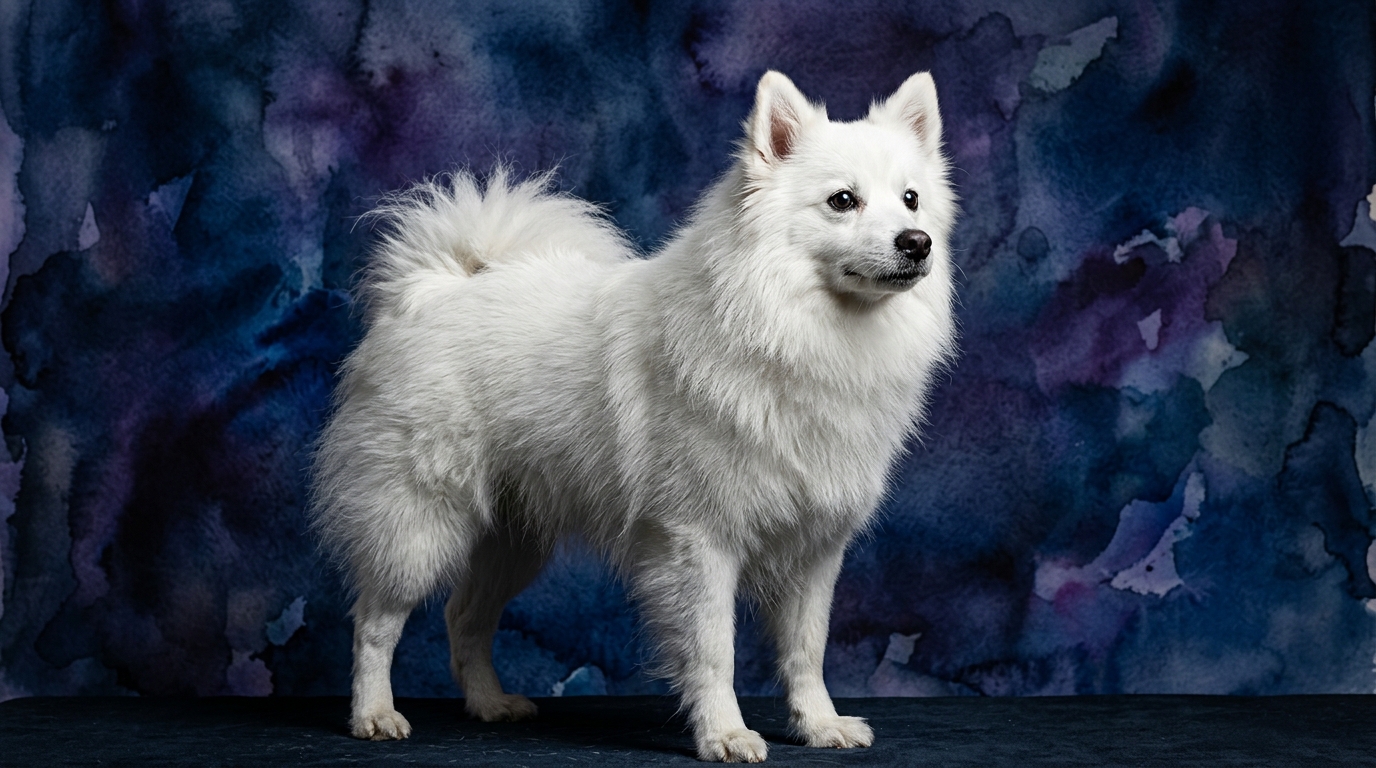

Side-by-Side Cognitive Profile: Unpacking the 3/5 Scores
Both the American Eskimo Dog and the Xoloitzcuintli are assessed with a consistent 3 out of 5 across all five cognitive dimensions at The Cosmic Pet Pet IQ Lab. This rating suggests a solid, capable level of intelligence, indicating they are neither exceptionally challenging nor remarkably easy to engage cognitively. However, the manifestation of these scores differs significantly between the two breeds, rooted in their distinct evolutionary paths and functional roles.
For the American Eskimo Dog, a 3/5 in Problem Solving often translates into a clever aptitude for navigating their environment to achieve desired outcomes, such as figuring out how to open treat containers or manipulate objects to gain attention. Their Training Speed at 3/5 reflects a responsive nature, learning new commands and tricks at a moderate pace, particularly when engagement is kept lively and rewarding. Social Intelligence at 3/5 means they are generally attuned to human emotions and intentions, often seeking interaction and feedback, making them expressive companions. Their Instinctive Drive, also 3/5, manifests as a strong desire to be involved in family activities, coupled with an alert and vocal watchfulness. Finally, a 3/5 in Memory enables them to recall a good repertoire of learned behaviors, routines, and familiar faces.
The Xoloitzcuintli, with the same 3/5 scores, expresses these capabilities through a different lens. Their Problem Solving at 3/5 might be seen in their observational skills, discerning complex household dynamics or finding comfortable, secure spots within their territory, often with a quiet, thoughtful approach. A 3/5 in Training Speed indicates they are receptive to consistent, patient instruction, learning best through positive reinforcement that builds trust rather than overt performance pressure. Social Intelligence at 3/5 means they form deep, discerning bonds with their primary family, reading their owners' moods with a subtle intensity, though they can be reserved with strangers. Their Instinctive Drive, also 3/5, is often channeled into a protective loyalty towards their family and home, along with a primal desire for close companionship. Their 3/5 Memory allows them to retain intricate knowledge of their family members, routines, and perceived threats, often with a long-lasting recall for experiences.
Where the American Eskimo Dog Shines Cognitively
Despite identical scores, the American Eskimo Dog often demonstrates a cognitive advantage in areas demanding active engagement and a desire to 'perform.' Their historical lineage, which includes roles as circus performers, has ingrained a certain showmanship and an eagerness to participate in interactive cognitive tasks. An Eskie's 3/5 Problem Solving might be more overtly expressed in seeking solutions that involve human interaction, like figuring out how to initiate a game or signal a need vocally. They tend to be more vocal communicators, using barks, 'woo-woos,' and other sounds to convey complex messages, a nuanced aspect of their social intelligence.
Their 3/5 Training Speed, combined with their inherent enthusiasm, often makes them appear quicker to pick up new tricks and elaborate sequences, especially when the reward involves praise and attention. This isn't necessarily a higher 'speed' of learning, but rather a greater willingness to engage in the learning process with visible enthusiasm. An Eskie's memory for sequences and routines, while also rated 3/5, can be particularly robust when those routines involve a performance aspect or a clear reward-based structure, making them adept at agility, obedience, and even complex trick training.
Where the Xoloitzcuintli Holds Cognitive Strengths
The Xoloitzcuintli, with its ancient heritage as a companion and guardian, exhibits cognitive strengths that lean towards quiet observation, subtle communication, and deep, selective bonding. While their Problem Solving is also 3/5, it often manifests as a more internal, analytical process. A Xolo might excel at solving environmental puzzles by observation rather than active manipulation, such as discerning the optimal sunbeam spot or identifying a new sound's source with calm precision. Their social intelligence, while rated 3/5, shines in their profound ability to read the subtle emotional cues of their immediate family, often anticipating needs or moods without overt signals, demonstrating a deep empathetic connection.
Their 3/5 Instinctive Drive translates into a highly attuned awareness of their surroundings and a strong protective instinct, making them excellent guardians who process environmental changes quickly and react thoughtfully. This breed's memory, also 3/5, is particularly strong for personal connections and perceived threats, leading to a long-lasting recall of individuals they trust and those they view with suspicion. This nuanced memory contributes to their selective social nature and their enduring loyalty, allowing them to build a complex mental map of their social world and react appropriately to different individuals over time.
Training Dynamics: Engagement vs. Trust
When considering which breed might be 'easier' to train, the distinction lies more in the approach required than in raw cognitive capacity, given their identical 3/5 Training Speed scores. The American Eskimo Dog, with its energetic demeanor and desire for interaction, often responds well to training methods that are engaging, playful, and consistent, often enjoying the process itself. Their vocal nature can be a double-edged sword; while they might be quick to 'talk back,' they can also be taught to use their voice appropriately, indicating a responsiveness to communication. Their zest for life means they are often eager to please and quick to offer behaviors in exchange for positive reinforcement, making them seem more overtly 'trainable' in a classical sense.
The Xoloitzcuintli, while equally capable of learning, typically requires a training approach built on patience, trust, and a deep understanding of their sensitive nature. Their 3/5 Training Speed means they will learn, but they may not offer behaviors with the same immediate enthusiasm as an Eskie. They are less driven by external validation and more by a desire for a harmonious relationship with their owner. Training a Xolo often involves more subtle cues and a focus on building a secure bond, where the dog learns to trust the handler's guidance. They can be more independent thinkers, which means repetitive, uninspiring training can lead to disengagement, whereas a consistent, relationship-based approach yields excellent results, particularly in areas like house manners and quiet companionship.
Lifestyle Compatibility: Active Engagement vs. Calm Companionship
The cognitive profiles of these two breeds, despite their score similarities, lend themselves to different owner lifestyles. An American Eskimo Dog's 3/5 Problem Solving and Social Intelligence combine with their energetic nature to suit active owners who enjoy interactive engagement, regular training sessions, and involve their dog in many aspects of their daily life. They thrive when given tasks to 'figure out' and appreciate consistent mental stimulation through training, puzzle toys, and social outings. Owners who appreciate a dog that is always 'on' and eager to participate will find the Eskie a fulfilling companion, as their cognitive capabilities are best utilized in an environment offering varied and consistent engagement.
Conversely, the Xoloitzcuintli's cognitive strengths, particularly their observational problem-solving and deep social intelligence, make them a better fit for more relaxed, introspective owners. While they certainly need exercise, their mental stimulation often comes from observing their family and environment, and from the quiet, intimate bonds they form. They excel in a calm, predictable home where they can be a devoted, watchful presence. Owners who value a dog that is deeply attuned to them without being overly demanding, and who appreciate a quiet, discerning companion, will find the Xolo's cognitive makeup to be a perfect match. Their instinctive drive for companionship and guarding makes them excellent homebodies, preferring the comfort and security of their familiar surroundings.
The Verdict
Choose an American Eskimo Dog if you desire an engaged, communicative companion eager to participate in training and family activities, thriving on consistent mental and physical interaction.
Choose a Xoloitzcuintli if you seek a deeply bonded, observant, and calm companion who values quiet companionship and forms profound connections within a serene home environment.
🧠 Find Your Pet's IQ Score
Our Pet IQ Lab assessment covers 25+ tests across 5 cognitive dimensions — personalized to your breed.
Take the Full IQ Test →Frequently Asked Questions
Do American Eskimo Dogs bark a lot because of their intelligence?
American Eskimo Dogs are indeed known for being vocal, and this is linked to their 3/5 social intelligence and instinctive drive. They use their voice as a primary form of communication, signaling alertness, seeking attention, or expressing their emotions, rather than a direct measure of intelligence itself.
Are Xoloitzcuintli dogs difficult to train due to their reserved nature?
Xoloitzcuintli are not inherently difficult to train; their 3/5 training speed is solid. However, their reserved nature means they respond best to patient, consistent, and trust-based training methods, rather than harsh or overly dominant approaches, which can make them withdraw.
Given their identical IQ scores, what's the most significant difference for potential owners?
The most significant difference for potential owners lies in how their identical 3/5 scores manifest behaviorally: Eskies tend to be overtly expressive and eager for interactive engagement, while Xolos are more subtly observant and form intense, discerning bonds within a quieter, more predictable setting.