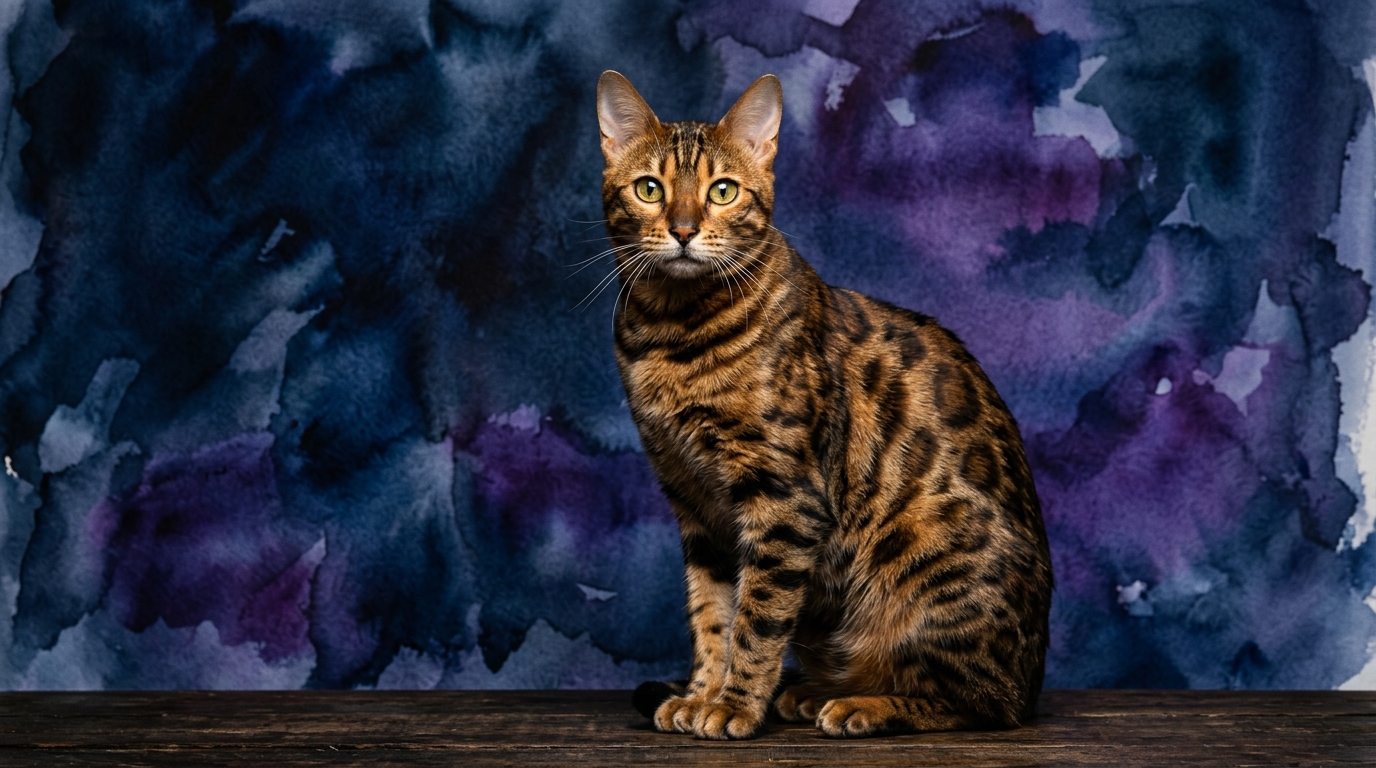
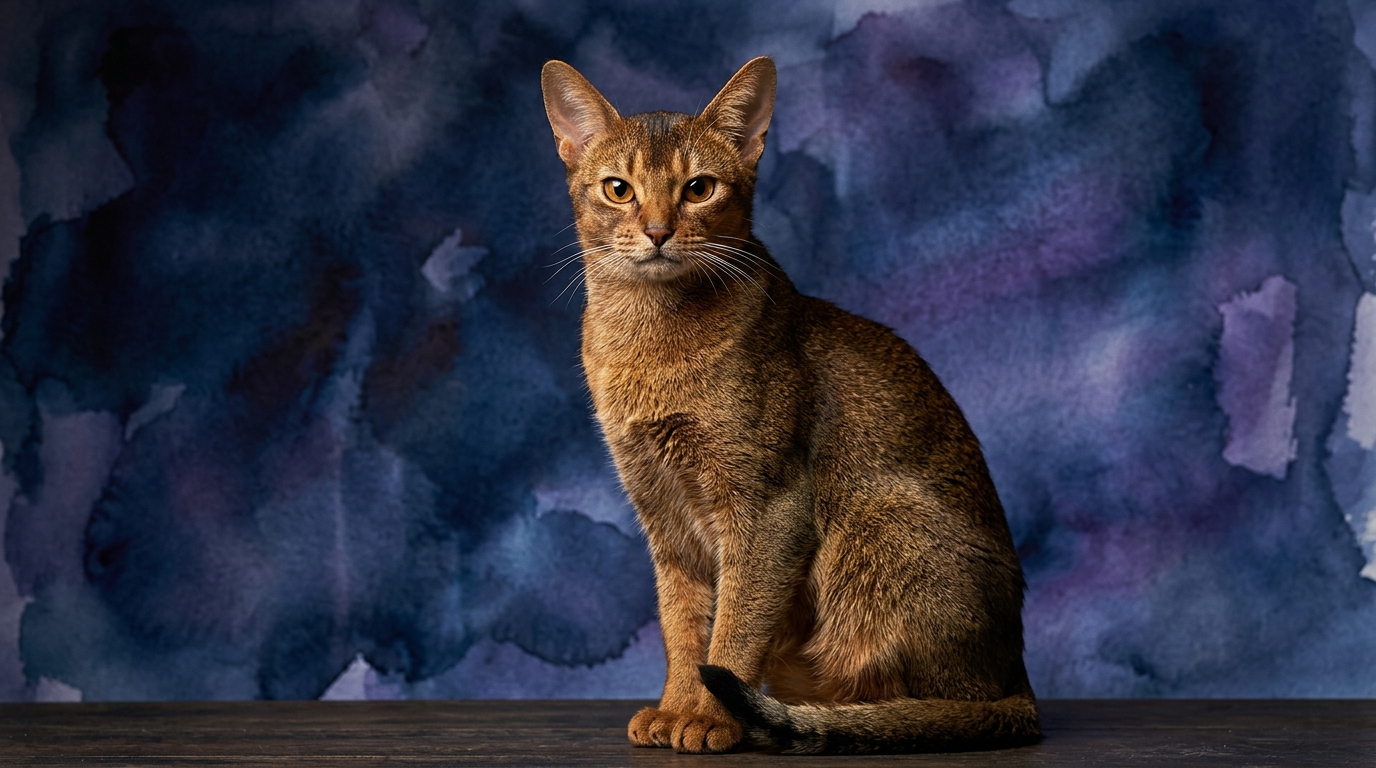
Side-by-side IQ profile
The Cosmic Pet Pet IQ Lab categorizes feline intelligence across five key dimensions. For the Bengal, its profile shows Problem Solving at 5/5, Training Speed at 4/5, Social Intelligence at 4/5, Instinctive Drive at 5/5, and Memory at 5/5. This suggests a highly capable feline, adept at navigating challenges, remembering complex sequences, and driven by profound natural instincts. Its training speed, while not perfect, indicates a rapid learner within the right motivational framework.
The Abyssinian presents an equally formidable, yet subtly different, cognitive makeup: Problem Solving 5/5, Training Speed 5/5, Social Intelligence 4/5, Instinctive Drive 5/5, and Memory 5/5. The Abyssinian matches the Bengal in every category except Training Speed, where it achieves a perfect score. This hints at an animal exceptionally receptive to instruction and new routines, eager to engage in collaborative learning, while maintaining the same high scores in complex thought, environmental awareness, and recollection as its counterpart.
Where Bengal wins cognitively
While both breeds share top marks in several areas, the Bengal's specific expression of its cognitive gifts often leans into its powerful physical capabilities and exploratory drive. Its 5/5 for Instinctive Drive, paired with 5/5 Problem Solving and Memory, suggests a cat that excels at physically navigating complex environments, perhaps demonstrating superior spatial reasoning when it comes to intricate climbing routes or figuring out how to access elevated spaces. For instance, a Bengal might more readily devise a multi-step plan involving jumping and balancing to reach a desired object on a high shelf, leveraging its athletic prowess and innate curiosity for territory exploration. Their memory (5/5) supports recalling these complex routes and problem-solving strategies, building a rich mental map of their domain. While their training speed (4/5) is one point lower than the Abyssinian, it still represents a rapid acquisition of skills, particularly when those skills are framed as "hunts" or "explorations," aligning with their profound innate drives. This means a Bengal might quickly master a puzzle feeder if it simulates a hunting scenario, or learn to fetch if the interaction is high-energy and rewarding.
Where Abyssinian wins cognitively
The Abyssinian's distinct advantage truly shines in its perfect 5/5 Training Speed. This metric indicates an exceptional capacity for learning new behaviors, commands, and routines with remarkable efficiency and minimal repetition. Coupled with its 5/5 Problem Solving and 5/5 Memory, the Abyssinian is not just solving puzzles, but rapidly learning the underlying principles of those puzzles, allowing for quick adaptation to variations or new challenges. For example, an Abyssinian might not only figure out how to open a treat-dispensing toy but would quickly generalize that mechanism to similar toys or even apply it to novel situations that require similar manipulation. Their 4/5 Social Intelligence also plays a crucial role here, manifesting as a greater attentiveness to human cues during training, often eager to please and quick to form associations between actions and positive reinforcement. This collaborative learning style, where they seem to actively engage with their human trainers, gives them an edge in structured educational settings.
Which is easier to train and why
Based on the IQ profiles, the Abyssinian unequivocally holds the edge for ease of training. Its perfect 5/5 Training Speed means an Abyssinian will typically grasp new commands, tricks, or desired behaviors with fewer repetitions and a faster understanding of expectations. This breed often exhibits a genuine eagerness to engage in training sessions, displaying a cooperative spirit that makes activities like clicker training, leash walking, or learning complex tricks incredibly rewarding. Their strong social intelligence (4/5) contributes to this, as they tend to be highly attuned to their human companions' moods and intentions, making communication during training more fluid. They are responsive and adaptable, quickly integrating new information into their existing behavioral repertoire.
The Bengal, with a still impressive 4/5 Training Speed, is by no means difficult to train, but requires a slightly different approach. Their robust Instinctive Drive (5/5) means they need training to be stimulating, engaging, and often tied into their natural hunting and exploring behaviors. While they learn quickly, they might be more prone to distraction if a training session doesn't capture their intense focus or if their environment offers more compelling "prey" to pursue. Training a Bengal often benefits from incorporating agility courses, problem-solving games, and interactive play that satisfies their need for physical and mental challenge, rather than purely repetitive command drills. Their keen memory (5/5) ensures once a skill is learned, it is retained, but the initial acquisition might demand more creative, high-energy methods to maintain their interest compared to the Abyssinian's consistent eagerness.
Which makes a better family pet for active owners vs relaxed owners
Neither the Bengal nor the Abyssinian are suited for genuinely "relaxed" owners who prefer a largely independent or sedentary feline companion. Both breeds demand significant engagement and interaction.
For active owners, both breeds can be an excellent match, but their specific needs diverge. The Bengal excels with owners who can provide consistent, high-energy physical and mental stimulation. Their 5/5 Instinctive Drive translates into a need for robust play sessions, puzzle toys that mimic hunting scenarios, and opportunities for climbing, exploring, and even water play. An active owner who enjoys designing enrichment courses, playing fetch for extended periods, or leash training for outdoor adventures will find the Bengal a thrilling and capable partner. They thrive on challenges that engage their formidable problem-solving skills and exceptional physical prowess.
The Abyssinian, while also very active and playful, might be a slightly more adaptable choice for active owners who prioritize interactive games, collaborative training, and a strong social bond over constant physical exertion resembling a mini-safari. Their 5/5 Training Speed means they are eager participants in learning new tricks, agility courses, and interactive puzzle play, making them highly engaging companions. They are very much "people-oriented" and thrive on being involved in family activities. They can match the energy of active households but might be marginally less demanding in terms of raw physical output compared to a Bengal's often relentless need to explore and conquer.
For owners leaning towards a more relaxed lifestyle, neither breed is an ideal fit without significant commitment to enrichment. If "relaxed" means an owner wants a cat that doesn't demand constant attention and interaction, both breeds will likely find themselves bored and potentially destructive. However, if "relaxed" means an owner is willing to provide dedicated daily interactive playtime and intellectual stimulation but perhaps doesn't have the space or desire for a cat that will scale every curtain, the Abyssinian might be the less challenging of the two. Its eagerness to learn and participate in structured play makes quality interaction efficient and rewarding, potentially fitting better into a slightly less extreme active owner's schedule.
The verdict
The Verdict
Choose the Bengal if you are an owner prepared to match a profound, instinct-driven intelligence with boundless physical and mental enrichment, appreciating a cat that independently seeks out and solves environmental challenges with athletic grace.
Opt for the Abyssinian if your ideal companion is a highly responsive and cooperative learner, eager to engage in collaborative intellectual pursuits and structured play, offering a constant, interactive presence within the family.
🧠 Find Your Pet's IQ Score
Our Pet IQ Lab assessment covers 25+ tests across 5 cognitive dimensions — personalized to your breed.
Take the Full IQ Test →Frequently Asked Questions
Are Bengals cognitively superior to Abyssinians, or vice-versa?
Based on The Cosmic Pet Pet IQ Lab metrics, both breeds demonstrate comparable high-level intelligence, achieving 5/5 in Problem Solving, Instinctive Drive, and Memory. The primary difference lies in Training Speed, where the Abyssinian scores a perfect 5/5 compared to the Bengal's 4/5. This suggests a difference in learning style and receptiveness to structured instruction rather than an overall cognitive superiority.
Which breed is more independent, the Bengal or the Abyssinian?
Both Bengals and Abyssinians have a Social Intelligence score of 4/5, indicating they are interactive and form strong bonds with their human companions rather than being truly independent. The Bengal's profound Instinctive Drive (5/5) means it often channels its intelligence into self-directed exploration and "hunting" behaviors, which might appear more independent. However, both crave interaction and mental stimulation from their owners.
How do these breeds typically interact with other family members or pets?
With a Social Intelligence score of 4/5, both Bengals and Abyssinians generally adapt well to multi-pet households and enjoy interacting with various family members. They are known for their sociable nature and can form bonds with other cats, friendly dogs, and children, provided proper introductions and socialization occur. Their interactive temperaments mean they appreciate being part of the family's daily activities.