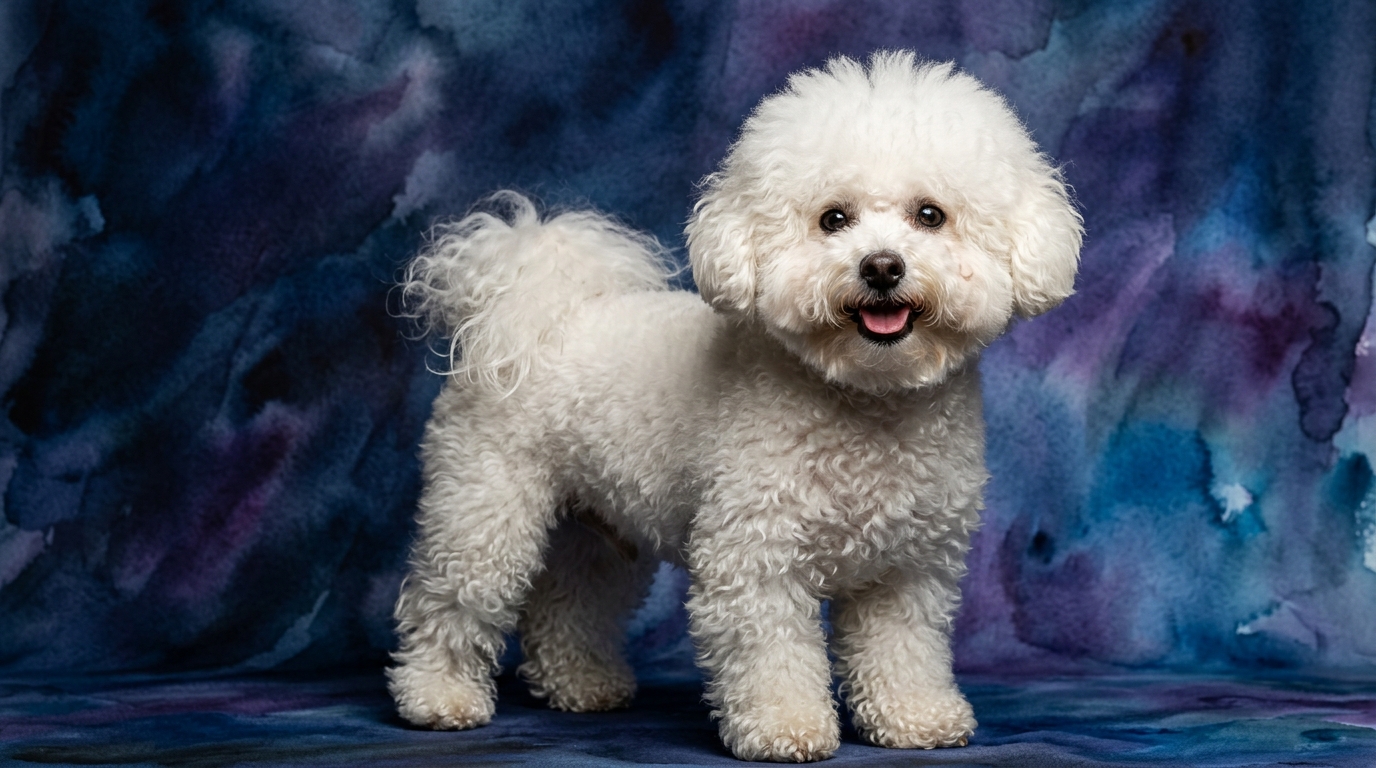

Side-by-Side IQ Profile: Bichon Frisé vs. Chesapeake Bay Retriever
The Cosmic Pet Pet IQ Lab employs a multi-dimensional assessment to understand canine cognition beyond a simple 'smart' label. Here’s how the Bichon Frisé and Chesapeake Bay Retriever compare across five key intelligence dimensions.
**Bichon Frisé (Coren Rank #45)**
**Problem Solving (3/5)**: The Bichon Frisé shows moderate problem-solving, mastering routines and navigating familiar spaces. While they can figure out simple puzzles, novel, multi-step challenges often require more guidance and repetition. Their approach is typically trial-and-error within known contexts rather than abstract reasoning for new dilemmas.
**Training Speed (3/5)**: Learning new commands comes at a moderate pace for the Bichon. Trainable with consistency, positive reinforcement, and patience, they may need several sessions to solidify a concept, emphasizing clear communication from the trainer.
**Social Intelligence (5/5)**: This is where the Bichon truly excels, demonstrating exceptional understanding of human emotions and social cues. They are incredibly attuned to family moods, offering comfort or seeking interaction based on subtle signals. Their ability to integrate seamlessly and form deep, empathetic bonds is a hallmark of their cognitive makeup.
**Instinctive Drive (2/5)**: The Bichon Frisé has a relatively low instinctive drive for traditional working tasks. Their core motivation revolves around companionship and interaction, not innate urges for hunting, herding, or guarding. Play is typically for social engagement, not fulfilling a deep-seated work drive.
**Memory (3/5)**: Their memory is moderate; they retain learned commands and experiences reasonably well but benefit significantly from ongoing reinforcement. Without regular practice, recall of less used commands might fade, highlighting the importance of consistent engagement.
**Chesapeake Bay Retriever (Coren Rank #27)**
**Problem Solving (4/5)**: The Chesapeake Bay Retriever displays a strong aptitude for problem-solving. They adeptly navigate complex environments, figuring out how to retrieve objects from challenging locations and adapting strategies to obstacles. Their cognitive flexibility allows independent assessment and resourceful solutions when pursuing goals.
**Training Speed (4/5)**: Chesapeake Bay Retrievers learn new commands at an above-average pace. Their eagerness to work and focus, combined with quick association of actions with consequences, makes them responsive students. They typically require fewer repetitions than many breeds to master skills with clear, engaging training.
**Social Intelligence (3/5)**: While affectionate with family, the Chesapeake Bay Retriever exhibits moderate social intelligence. They form strong, loyal bonds but can be more reserved or independent, not always seeking constant human validation. They understand family dynamics but might process social cues pragmatically rather than empathetically.
**Instinctive Drive (3/5)**: The Chesapeake Bay Retriever possesses a moderate to strong instinctive drive, particularly for retrieving, swimming, and working alongside a handler. Rooted in their waterfowl retriever heritage, this manifests as a desire to carry objects, explore water, and engage in purposeful activities. Outlets for these drives are crucial.
**Memory (4/5)**: Chesapeake Bay Retrievers demonstrate good memory for commands, routines, and past experiences. Once learned, skills tend to stick, making them reliable in retaining training. This strong recall contributes to their effectiveness in field work, where remembering complex sequences is paramount.
Where the Bichon Frisé Wins Cognitively
The Bichon Frisé undeniably excels in the realm of social intelligence, scoring a perfect 5/5 in this dimension. Their profound ability to read and respond to human emotions is a standout cognitive strength. This isn't just about being friendly; it's a sophisticated understanding of subtle cues – a shift in tone, a facial expression, or a change in body language – that allows them to anticipate needs or offer comfort. This makes them incredibly intuitive companions, capable of forming deep, empathetic connections with their human families. This high social IQ means they often integrate seamlessly into family life, understanding household dynamics and adapting their behavior to suit the mood of the room. Unlike breeds primarily driven by tasks, the Bichon's cognitive energy is channeled into understanding and interacting with their social environment, making them masters of interpersonal canine-human communication.
Where the Chesapeake Bay Retriever Wins Cognitively
The Chesapeake Bay Retriever demonstrates superior cognitive strengths in areas of practical application and sustained learning. Their problem-solving ability (4/5) is notably higher than the Bichon's, allowing them to independently assess and navigate complex situations, whether it's finding a dropped bumper in dense cover or figuring out how to open a gate. This resourcefulness is coupled with a faster training speed (4/5) and a robust memory (4/5). They process new information efficiently, retain learned behaviors reliably, and can apply past experiences to new challenges. This combination of quick learning, strong retention, and practical intelligence makes them exceptionally capable in structured training environments and demanding outdoor activities, where precise execution and adaptability are paramount. Their cognitive profile is geared towards purposeful action and efficient mastery of skills.
Which is Easier to Train and Why
When evaluating ease of training, the Chesapeake Bay Retriever holds an advantage, primarily due to its higher scores in training speed (4/5) and problem-solving (4/5), coupled with a strong memory (4/5). They tend to pick up new commands and concepts more quickly, requiring fewer repetitions to achieve mastery. Their innate drive for purposeful work also means they often approach training sessions with a focused intensity and eagerness to engage, especially if the tasks align with their natural retrieving instincts. For instance, a Chessie might quickly learn a multi-step retrieve command because it taps into their inherent abilities.
In contrast, the Bichon Frisé, with its moderate training speed (3/5) and problem-solving (3/5), may require more patience and consistency. While perfectly trainable, they might take longer to grasp new concepts and could become easily distracted if training isn't kept engaging and positive. Their lower instinctive drive means they aren't inherently motivated by 'work' in the same way, so their training motivation often stems from the desire for social interaction and positive reinforcement from their beloved humans. This means a Bichon might excel at tricks that earn them attention, but might need more encouragement for less socially rewarding tasks.
Which Suits Active Owners vs. Relaxed Owners
The choice between these two breeds significantly depends on an owner's lifestyle and activity level. The Chesapeake Bay Retriever, with its moderate instinctive drive (3/5) and robust physical capabilities, is best suited for active owners. They thrive when given a 'job' to do, whether it's field work, competitive dog sports, or extensive outdoor adventures like hiking and swimming. Their cognitive profile, geared towards problem-solving and efficient learning, means they require consistent mental stimulation alongside physical exertion. An owner who can provide daily vigorous exercise and engaging training sessions will find a Chessie to be a fulfilling and capable partner, preventing boredom-induced behaviors.
Conversely, the Bichon Frisé, with its lower instinctive drive (2/5) and exceptional social intelligence (5/5), is an ideal match for more relaxed owners. While they certainly enjoy playtime and walks, their primary need is for companionship and social interaction. Their cognitive strengths are focused on understanding and engaging with their human family, making them content with less intense physical activity, provided they receive ample attention and mental engagement through interactive play and cuddles. They are well-suited to apartment living or households where a constant, empathetic presence is valued over a demanding exercise regimen.
The Verdict
Choose the Bichon Frisé if your priority is a deeply empathetic, socially attuned companion who thrives on close human interaction and requires moderate physical activity. Their cognitive strength lies in understanding and responding to your emotional landscape, making them exceptional family members.
Opt for the Chesapeake Bay Retriever if you are an active individual seeking a capable, resourceful working partner who excels at problem-solving and learns quickly, provided you can meet their significant needs for mental and physical engagement.
🧠 Find Your Pet's IQ Score
Our Pet IQ Lab assessment covers 25+ tests across 5 cognitive dimensions — personalized to your breed.
Take the Full IQ Test →Frequently Asked Questions
Does a higher Coren rank mean a dog is always 'smarter'?
The Coren rank primarily assesses a breed's working and obedience intelligence, reflecting how quickly they learn commands and their obedience reliability. It's one aspect of intelligence, but doesn't encompass social intelligence or instinctive drives, which are equally important for a dog's overall cognitive profile and suitability as a pet.
Can a Bichon Frisé excel in dog sports despite its lower instinctive drive?
Absolutely. While their instinctive drive is lower, a Bichon Frisé's high social intelligence and desire to please their owner can make them enthusiastic participants in sports like agility or obedience. Success depends more on consistent, positive training and building a strong bond than on innate drive alone.
Are Chesapeake Bay Retrievers difficult for first-time dog owners?
Chesapeake Bay Retrievers can be challenging for first-time owners due to their strong will, high energy, and need for consistent training and socialization. Their problem-solving abilities and drive require an owner who is committed to providing structure, mental stimulation, and a clear leadership role to prevent unwanted behaviors.