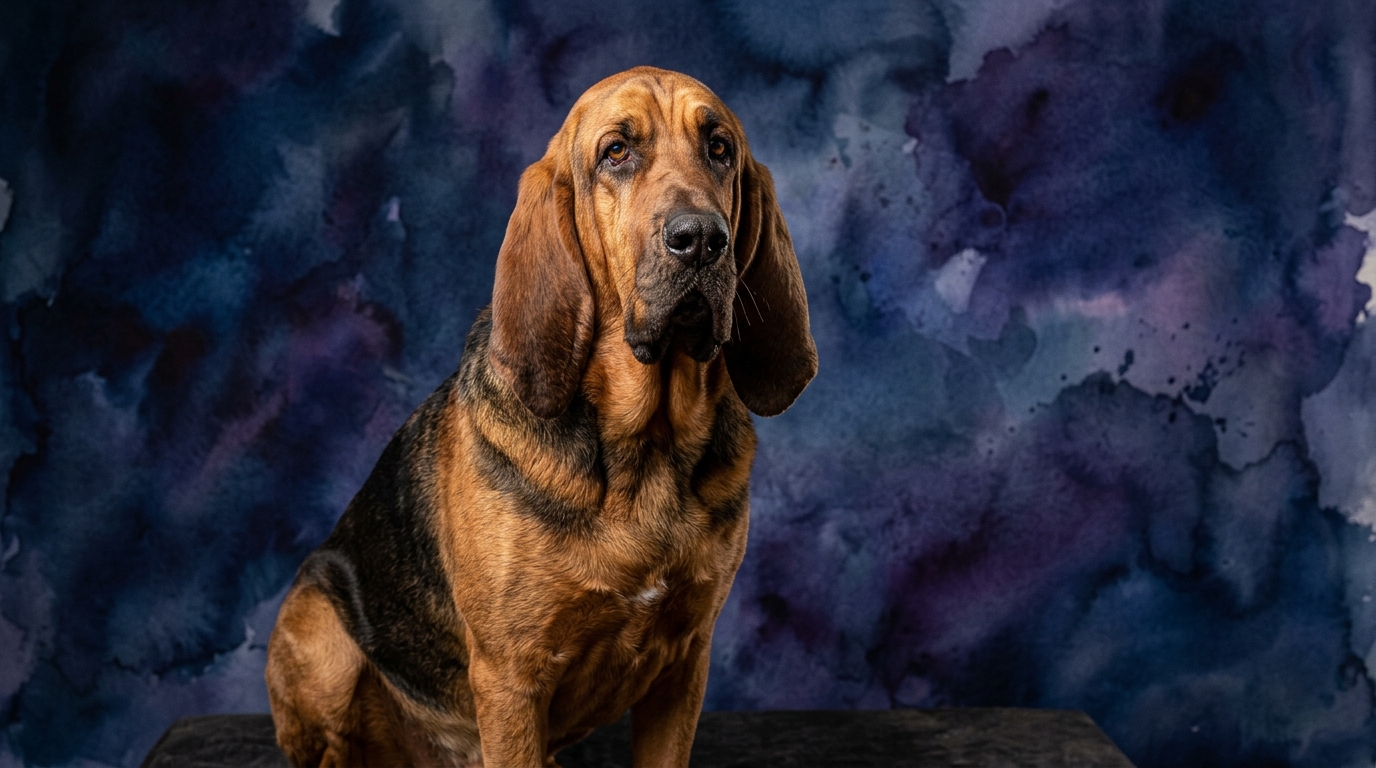
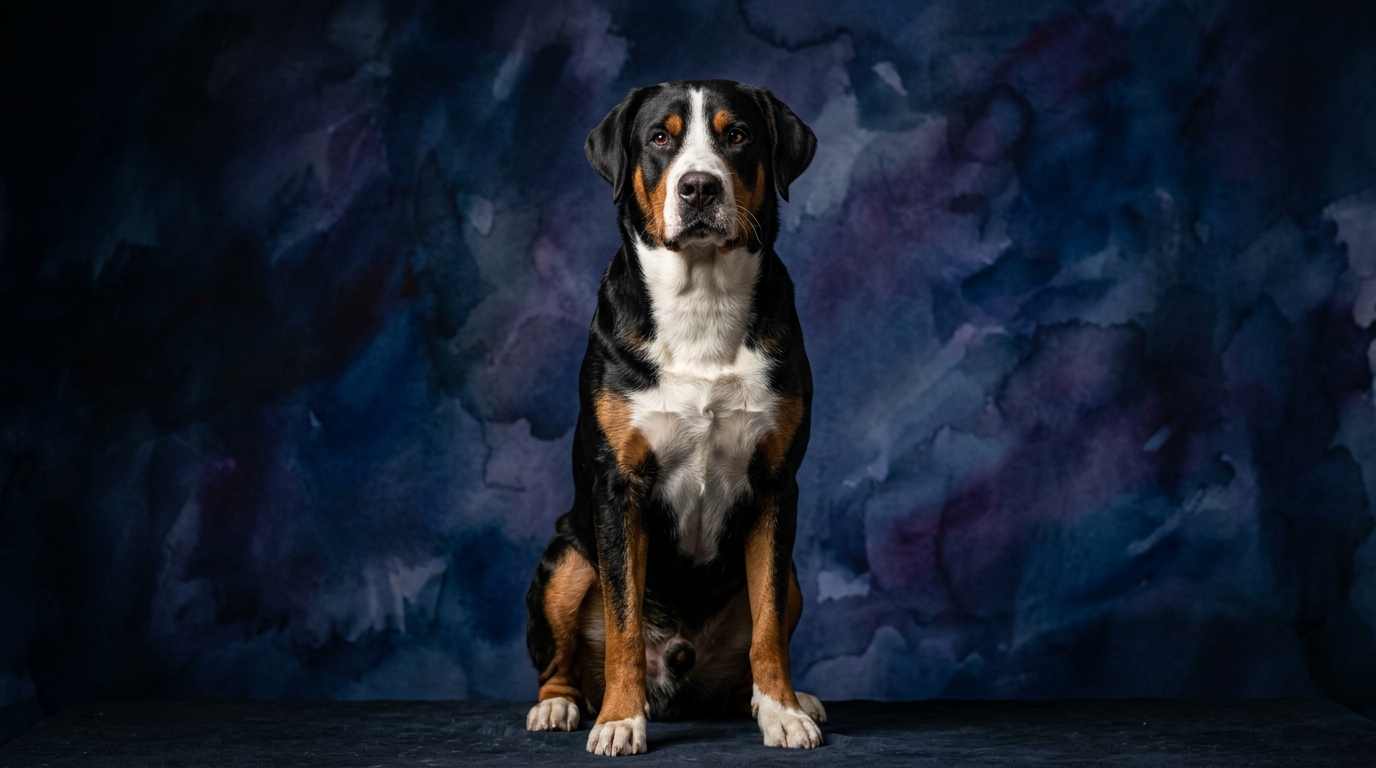
Side-by-Side Cognitive Profiles
The Cosmic Pet Pet IQ Lab employs a five-dimensional framework to assess canine intelligence, moving beyond simple obedience scores to capture a more nuanced understanding of a dog's mental landscape. For the Bloodhound, this framework illuminates a highly specialized intellect, while for the Greater Swiss Mountain Dog, it reveals a balanced and adaptable cognitive toolkit.
Bloodhounds, categorized as Hounds, exhibit a remarkable cognitive blueprint. Their Problem Solving is rated 5/5, a testament to their unparalleled ability to unravel complex scent puzzles, tracing faint trails over vast distances and varied terrain. However, this intense focus often comes at the expense of traditional biddability, reflected in a Training Speed of 1/5, as their primary motivation lies in their olfactory world rather than human commands. Social Intelligence sits at 2/5; while capable of affection, their primary drive isn't social interaction but the pursuit of scent. An Instinctive Drive of 5/5 underscores their relentless dedication to tracking, a trait that defines their very existence. Finally, their Memory is rated 5/5, specifically for retaining intricate scent patterns and trail sequences, allowing them to pick up old trails with surprising accuracy. The Bloodhound's Coren rank of #74 further emphasizes their specialized rather than general obedience intelligence.
In contrast, the Greater Swiss Mountain Dog, a robust Working breed, presents a more uniformly capable cognitive profile. Their Problem Solving is rated 3/5, indicating a practical aptitude for navigating everyday challenges and learning task-oriented solutions, though not with the singular focus of a Bloodhound. Training Speed is 3/5, suggesting they learn new commands and routines at a moderate pace, responsive to consistent guidance. Social Intelligence also scores 3/5, reflecting their generally amiable and engaged nature within a family unit, capable of forming strong bonds and understanding social cues. An Instinctive Drive of 3/5 highlights their heritage as all-around farm dogs, possessing a moderate drive for various tasks like drafting or guarding, without the overwhelming fixation seen in scent hounds. Their Memory, rated 3/5, is functional and sufficient for retaining learned behaviors, routines, and social connections. Unlike the Bloodhound, the Greater Swiss Mountain Dog is not specifically Coren-ranked, placing it outside the traditional obedience intelligence hierarchy, yet its balanced IQ scores point to a capable and adaptable companion.
Where the Bloodhound's Mind Excels
The Bloodhound's cognitive superiority undeniably lies in its olfactory prowess and the complex mental operations associated with it. Their 5/5 Problem Solving isn't about opening a latch or retrieving a toy; it's about dissecting a tapestry of odors, filtering out distractions, and reconstructing a narrative from invisible molecules. They excel at pattern recognition in scent, understanding the nuances of decay, direction, and individual signatures, a feat of analytical processing that few other breeds can rival. This deep specialization means they can follow a trail hours, even days, old, demonstrating an unparalleled capacity for sustained, focused mental work.
Coupled with their 5/5 Memory, a Bloodhound can retain vast libraries of scent information and recall specific trail characteristics. This isn't just about remembering a single scent, but the entire sequence of a trail, the environmental factors influencing it, and the subtle shifts in odor concentration. Their instinctive drive (5/5) fuels this cognitive engine, allowing them to maintain intense concentration for extended periods, pushing through fatigue and distraction with a singular purpose. For tasks requiring relentless, scent-driven deduction, the Bloodhound stands in a league of its own, demonstrating a form of intelligence uniquely adapted to its ancestral role.
Where the Greater Swiss Mountain Dog Shines Cognitively
The Greater Swiss Mountain Dog's cognitive strengths are found in its balanced adaptability and practical, cooperative intelligence. Their 3/5 Problem Solving reflects an ability to learn and execute practical tasks efficiently, whether it's navigating obstacles on a hike, understanding household routines, or responding appropriately to various situations. They possess a general intelligence that allows them to adapt to different environments and expectations, making them versatile companions.
Their 3/5 Social Intelligence is a significant asset, enabling them to integrate smoothly into family dynamics, read human emotions, and respond appropriately to social cues. This cognitive skill fosters strong human-animal bonds and contributes to their reputation as reliable family members. Unlike the Bloodhound's single-minded focus, the Greater Swiss Mountain Dog's moderate Instinctive Drive (3/5) means their motivations are more varied and controllable, allowing them to engage with their surroundings in a more generalized, cooperative manner. Their functional 3/5 Memory supports the retention of learned commands, household rules, and social interactions, making them predictable and responsive within a structured home environment.
Trainability: Bloodhound's Challenge vs. Swissy's Cooperation
The difference in trainability between these two breeds is profound, stemming directly from their cognitive profiles and instinctive drives. The Bloodhound, with a Training Speed of 1/5 and an Instinctive Drive of 5/5, presents a significant challenge for traditional obedience training. Their problem-solving is intrinsically linked to scent, and their memory is optimized for olfactory data. This means they are not inherently motivated by human approval or repetitive drills when a compelling scent is present. A Bloodhound will learn what they perceive as relevant to their primary drive, which is tracking. Teaching them to 'sit' or 'stay' when a captivating odor is nearby requires immense patience and highly specialized motivation, often feeling like a battle against their very nature. They are not stubborn out of defiance, but because their brain is wired to prioritize olfactory input above all else.
In contrast, the Greater Swiss Mountain Dog's Training Speed of 3/5, coupled with a 3/5 Social Intelligence and moderate Instinctive Drive, makes them a much more amenable student. They are generally eager to please their human companions and find value in cooperative learning. While not as quick to pick up new commands as some top-ranked breeds, their willingness to engage and their ability to generalize learned behaviors across different contexts makes the training process rewarding and effective. Their instinct to work alongside humans, derived from their farm dog heritage, translates into a more compliant and responsive attitude during training sessions. They are motivated by praise, treats, and the opportunity to interact with their people, making them suitable for a wider range of training disciplines, from basic obedience to various dog sports.
Lifestyle Suitability: Specialized Drive vs. Versatile Companion
Matching a dog's cognitive profile to an owner's lifestyle is crucial for a harmonious relationship. The Bloodhound is unequivocally suited for owners who are not only active but also deeply committed to channeling their dog's specialized cognitive drive. These dogs thrive when given opportunities for extensive scent work, whether it's formal tracking, search and rescue, or engaging scent games in a secure outdoor area. Their boundless stamina and relentless focus mean they require hours of mental and physical engagement tailored to their olfactory talents. A relaxed owner who expects a low-maintenance companion for casual walks will quickly find themselves overwhelmed by a Bloodhound's unfulfilled instinctive needs, which can manifest as destructive behaviors or incessant vocalization. Their ideal owner understands and respects their singular purpose, providing a structured outlet for their incredible cognitive and physical energy.
The Greater Swiss Mountain Dog, with its balanced cognitive attributes, appeals to a broader range of active owners. While they are a robust breed requiring regular exercise, their needs are more generalist than specialist. They enjoy hiking, playing in the yard, and participating in family activities. Their social intelligence makes them excellent companions for active families who want a dog that can join them on adventures and then settle down comfortably at home. They are not suited for entirely relaxed owners who prefer minimal engagement, as their moderate instinctive drive and need for mental stimulation will lead to boredom. However, for owners seeking a sturdy, loyal, and moderately energetic partner for a variety of pursuits, who can also appreciate a calm presence indoors, the Greater Swiss Mountain Dog offers a fulfilling and adaptable companionship.
The Verdict
Choose the Bloodhound if you are an experienced, dedicated owner passionate about scent work and prepared to channel a singularly focused, high-drive intellect into specific tracking disciplines. Be ready for a dog whose problem-solving and memory are almost exclusively olfactory, requiring immense patience for traditional obedience.
Opt for the Greater Swiss Mountain Dog if you seek a robust, versatile, and socially engaged companion capable of practical problem-solving and moderate trainability for a variety of active family pursuits. They are an excellent choice for owners who appreciate a balanced intellect and cooperative nature in a large, loyal dog.
🧠 Find Your Pet's IQ Score
Our Pet IQ Lab assessment covers 25+ tests across 5 cognitive dimensions — personalized to your breed.
Take the Full IQ Test →Frequently Asked Questions
Are Bloodhounds difficult to live with due to their low training speed?
Bloodhounds are not inherently 'difficult,' but their low training speed and high instinctive drive mean they require a different approach. Their primary motivation is scent, so traditional obedience may be challenging without extreme dedication and motivation tailored to their natural instincts, making them better suited for owners who understand and embrace this specialization rather than fighting it.
Do Greater Swiss Mountain Dogs need a lot of exercise?
Greater Swiss Mountain Dogs require regular, moderate exercise to stay healthy and content. While not as relentlessly driven as a Bloodhound, they are a working breed that enjoys daily walks, play sessions, and opportunities to explore. They are well-suited for active families who can provide consistent physical and mental engagement, but not necessarily extreme endurance activities.
Which breed is better for a first-time dog owner?
For a first-time dog owner, the Greater Swiss Mountain Dog is generally a more manageable choice due to its more balanced cognitive profile, higher social intelligence, and moderate training speed. The Bloodhound's specialized drives and challenging trainability make them better suited for experienced owners who understand the demands of a scent hound.