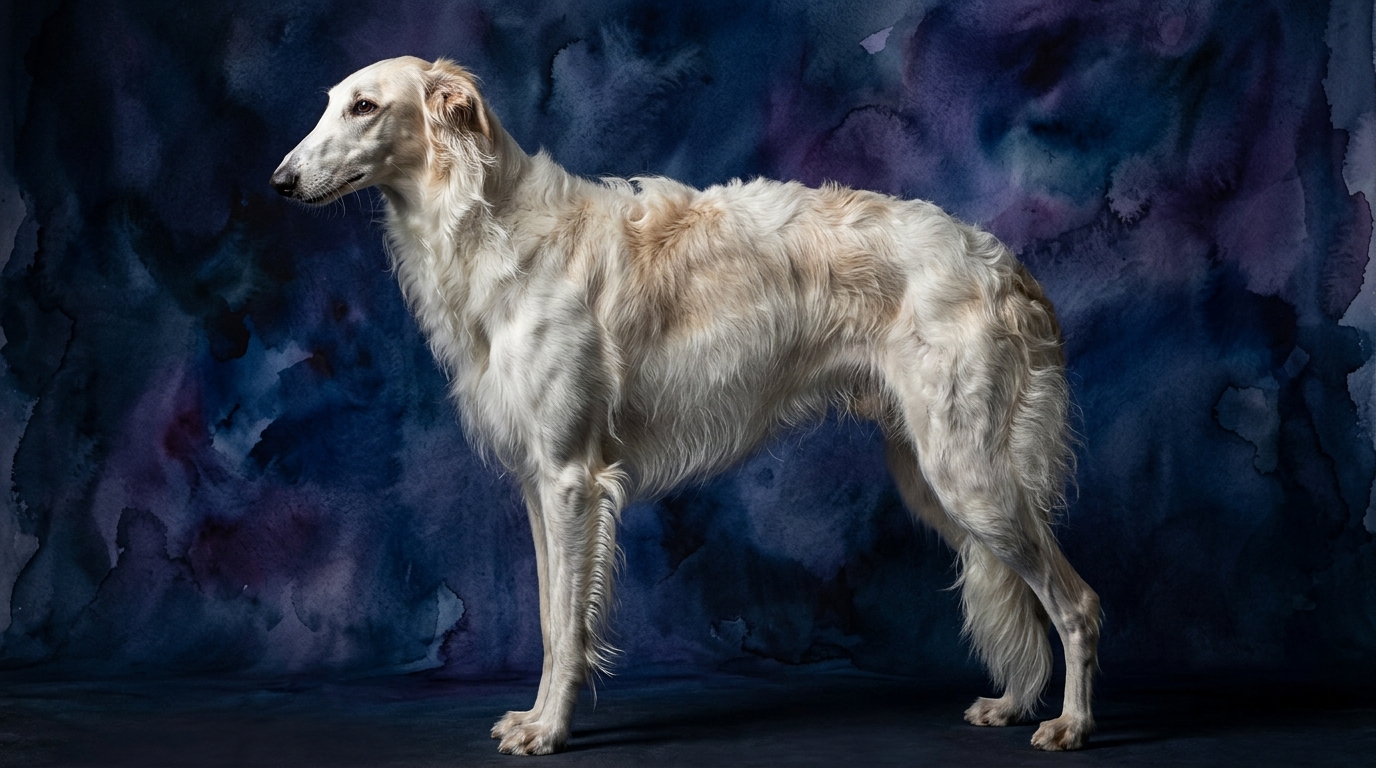
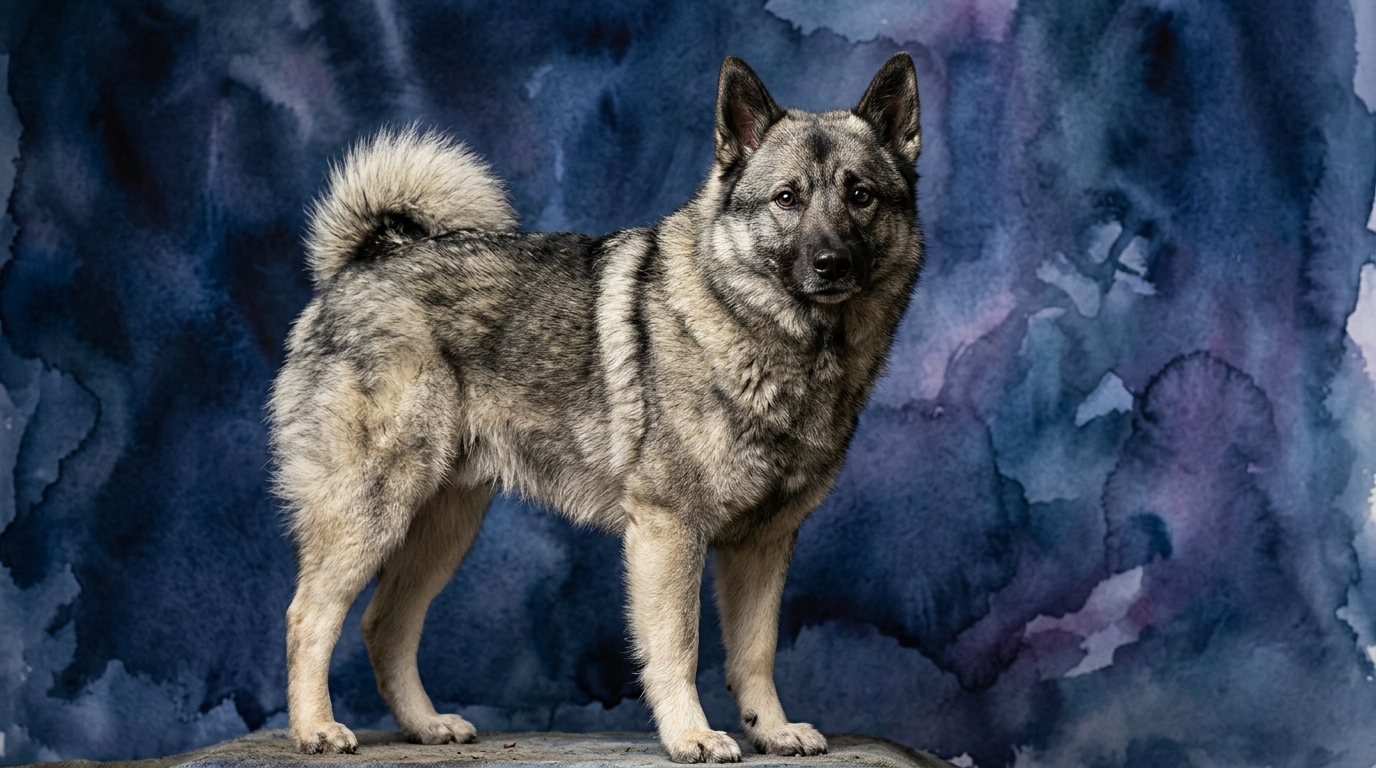
Side-by-Side Cognitive Profiles: Borzoi vs. Norwegian Elkhound
The Cosmic Pet Pet IQ Lab employs five key dimensions to evaluate canine intelligence: problem-solving, training speed, social intelligence, instinctive drive, and memory. While both the Borzoi and Norwegian Elkhound are classified as Hounds, their Coren ranks – Borzoi at #75 and Elkhound at #36 – immediately signal a significant divergence in their typical cognitive performance and biddability, setting the stage for a detailed examination.
The Borzoi, a breed known for its distinctive silhouette and independent spirit, scores consistently at 3 out of 5 across all five IQ dimensions. This uniform rating indicates a balanced cognitive approach where problem-solving is adequate for its needs, training requires patience due to its independent nature, social intelligence is discerning, instinctive drives are present but not overwhelming, and memory serves its sighthound purpose effectively. Its cognitive profile reflects a self-reliant thinker, often processing information with an inherent sense of autonomy.
In contrast, the Norwegian Elkhound presents a profile with several higher scores. It registers 4 out of 5 in problem-solving, training speed, and memory, while its social intelligence and instinctive drive stand at 3 out of 5. These elevated scores suggest a more readily adaptable and instruction-oriented mind, capable of quicker learning and better retention of complex information, alongside a similar level of social awareness and instinctual motivation as the Borzoi.
Where the Borzoi Shines Cognitively
While its scores of 3/5 might not suggest overt brilliance, the Borzoi’s cognitive strengths lie in its specific application of intelligence, particularly concerning its sighthound heritage. Its problem-solving, though not rapid in the context of human-devised puzzles, excels in tasks requiring independent judgment and swift action in open spaces, such as calculating the trajectory of moving prey or navigating complex terrain during a chase. This isn't a dog that waits for instructions; it assesses and acts.
The Borzoi’s memory, rated at 3/5, is particularly adept at spatial recall and recognizing familiar environments or individuals, rather than rote memorization of commands. This allows it to remember hunting grounds, safe paths, or the layout of its home with considerable accuracy, contributing to its self-assured demeanor. Its social intelligence, also 3/5, manifests as a nuanced understanding of social cues, making it discerning rather than universally effusive, forming deep bonds with its chosen few while maintaining a polite distance with strangers. This isn't a lack of social acumen, but a preference for quality over quantity in its interactions.
Norwegian Elkhound's Cognitive Edge
The Norwegian Elkhound’s cognitive advantages are evident in its higher ratings across problem-solving, training speed, and memory. Its 4/5 problem-solving score means it approaches challenges with a more analytical and persistent mindset, often demonstrating ingenuity in overcoming obstacles or figuring out how to access desired items. This translates to a dog that can learn complex sequences of actions and adapt strategies more readily than the Borzoi in varied scenarios.
Its superior training speed (4/5) and memory (4/5) are interconnected, allowing the Elkhound to grasp new commands and routines quickly and retain them over extended periods. This cognitive profile makes it particularly adept at tasks requiring consistent obedience, agility, or scent work, where recalling specific instructions and applying learned behaviors is crucial. The Elkhound's intelligence is often directed towards purposeful activity, reflecting its long history as a versatile working dog, capable of sustained mental engagement and learning from experience more rapidly.
Training Dynamics: Borzoi's Independence vs. Elkhound's Eagerness
When it comes to training, the difference between these two breeds becomes particularly pronounced, largely due to their 'training speed' scores. The Borzoi, with its 3/5 training speed, requires a trainer who understands and respects its independent thought process. This isn't a dog that is slow to understand, but one that often evaluates whether a command serves its own perceived purpose. Training a Borzoi demands patience, positive reinforcement, and making the learning process engaging and rewarding enough to appeal to its sighthound instincts, which prioritize self-directed action over constant human instruction. Its 3/5 instinctive drive means it will follow its nose or eyes if a compelling stimulus arises, sometimes overriding learned commands.
The Norwegian Elkhound, scoring 4/5 in training speed, typically exhibits a greater eagerness to please and a stronger desire to engage in cooperative learning. This makes it generally more responsive to traditional training methods and capable of mastering a wider range of commands and tricks with less repetition. Its 3/5 instinctive drive, while present, is often more readily channeled into structured activities like tracking or obedience, integrating learned behaviors with its natural inclinations. The Elkhound's higher problem-solving and memory scores further support its trainability, allowing it to generalize learned behaviors to new situations and retain complex sequences of actions more effectively.
Lifestyle Match: Active Engagement vs. Elegant Companionship
The cognitive profiles of the Borzoi and Norwegian Elkhound strongly influence the types of owners and lifestyles they thrive in. The Norwegian Elkhound, with its higher scores in problem-solving, training speed, and memory, genuinely benefits from active owners who can provide consistent mental stimulation and purposeful activities. These dogs are at their best when given a job, whether it's participating in dog sports like agility or obedience, engaging in challenging puzzle toys, or accompanying their owners on long, exploratory hikes. Their cognitive makeup means they enjoy learning and applying their intellect to various tasks, making them ideal for individuals or families who value an engaged and versatile canine partner.
Conversely, the Borzoi’s cognitive strengths lend themselves to owners who appreciate a more self-possessed and elegant companion. While they still require regular exercise appropriate for a sighthound (often intense, short bursts of running), their mental engagement might be less about constant instruction and more about shared, calm presence, occasional independent exploration in secure areas, or enjoying quiet companionship. Owners who understand and respect the Borzoi’s discerning social intelligence and independent problem-solving will find a deeply loyal, albeit less overtly demonstrative, companion. They are suited for those who appreciate a dog that thinks for itself and finds contentment in a balanced routine of rest, affection, and specific bursts of physical activity.
The Verdict
Choose the Borzoi if you seek an elegant, independent companion who offers discerning affection and thrives on specific bursts of physical activity, appreciating a dog that thinks for itself.
Opt for the Norwegian Elkhound if you desire a highly trainable, versatile, and engaged partner who excels in learning and thrives on consistent mental and physical challenges.
🧠 Find Your Pet's IQ Score
Our Pet IQ Lab assessment covers 25+ tests across 5 cognitive dimensions — personalized to your breed.
Take the Full IQ Test →Frequently Asked Questions
Which breed is generally more responsive to obedience training?
The Norwegian Elkhound, with its 4/5 training speed, is typically more responsive to obedience training due to its eagerness to please and quicker retention of commands. The Borzoi's 3/5 training speed means it requires more patience and understanding of its independent nature.
Do either of these breeds excel in problem-solving games or puzzles?
The Norwegian Elkhound, scoring 4/5 in problem-solving, generally shows greater aptitude for figuring out puzzle toys and complex games. The Borzoi's problem-solving (3/5) is more geared towards practical, independent decision-making in open spaces rather than abstract puzzles.
How do their social intelligence scores impact their interaction with families?
Both breeds score 3/5 in social intelligence, indicating they are capable of forming strong family bonds and understanding social cues. The Borzoi might be more reserved with strangers, while the Elkhound tends to be more outgoing but still discerning, establishing clear preferences within its social circle.