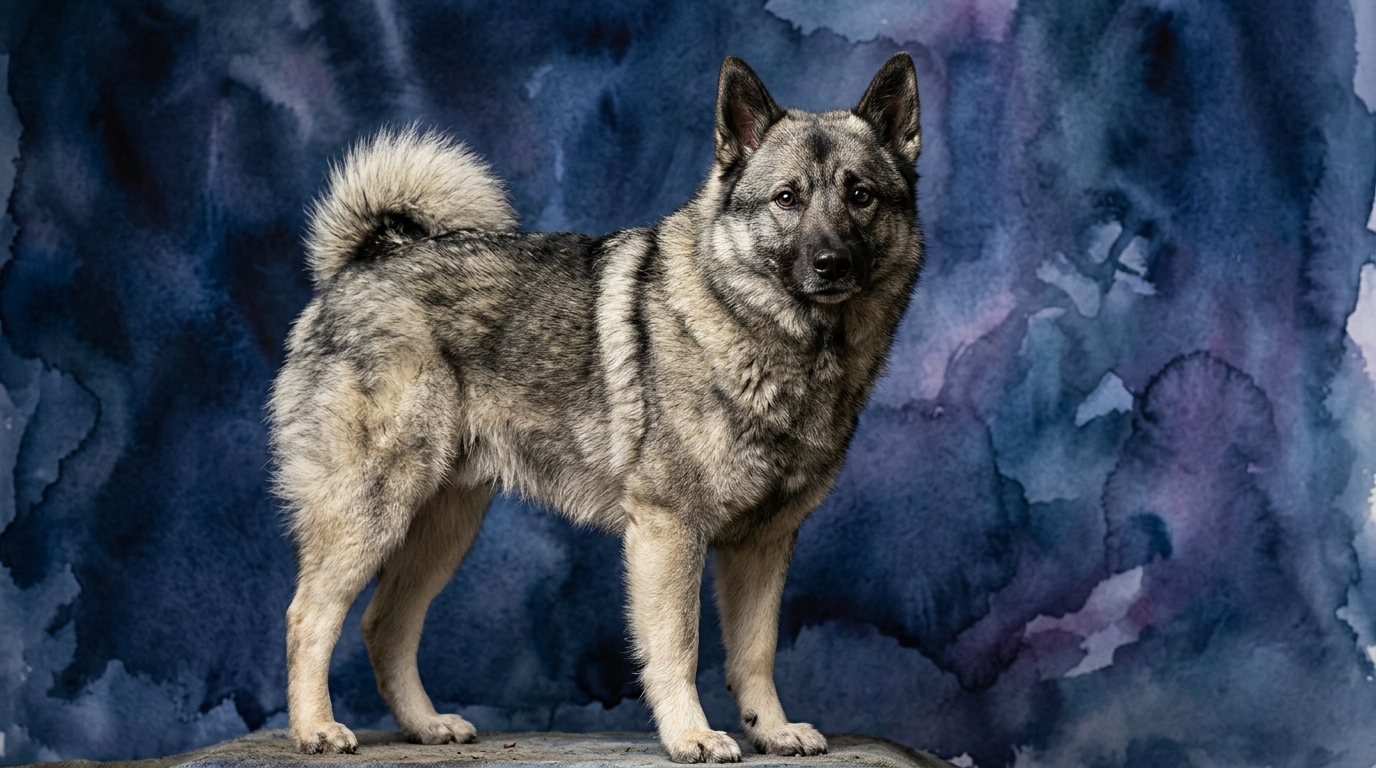
Norwegian Elkhound at a glance
| IQ Rank / Score | #36 |
|---|---|
| Trainability | ★★★☆☆ (3/5) |
| Social Intelligence | ★★★☆☆ (3/5) |
| Lifespan | 11-14 years |
| Shedding | Low to moderate |
| Exercise Needs | High (60+ min/day + training) |
| Origin | Norway |
The Maverick Mind: A Legacy of Independent Problem-Solving
At the core of the Norwegian Elkhound's intelligence lies a profound capacity for independent problem-solving. Unlike many breeds developed for close human collaboration, Elkhounds were historically tasked with tracking and holding large game like moose and bear for extended periods, often miles away from their human handlers. This demanding role required them to make critical decisions autonomously, navigate complex terrain, and adapt to unpredictable situations without direct command. Their cognitive strength isn't just about obedience, but about initiative, resourcefulness, and a deep understanding of their environment.
This independent streak means an Elkhound processes information, evaluates commands, and often chooses a course of action that aligns with its own understanding or instincts. While this can sometimes be misconstrued as stubbornness, it's actually a hallmark of a highly intelligent and self-reliant animal. Their problem-solving prowess is often practical and goal-oriented, focusing on how to achieve an objective, whether it's finding a hidden treat or navigating a tricky path, with an impressive tenacity that reflects their ancestral purpose.
Ancient Echoes: Cognition Forged in the Wilds of Norway
The cognitive evolution of the Norwegian Elkhound is inextricably linked to their ancient history in the Nordic wilderness. Archeological findings suggest dogs remarkably similar to today's Elkhound have existed for thousands of years, hunting alongside early Scandinavian settlers and Vikings. This deep historical lineage means their intelligence is finely tuned for survival and efficiency in challenging environments. Their instincts for tracking, baying (holding game at bay with barks), and navigating dense forests are not merely learned behaviors but deeply ingrained cognitive programs developed over millennia.
One surprising scientific and historical fact is that DNA evidence points to the Norwegian Elkhound as one of the most ancient dog breeds, potentially tracing their origins back 6,000 years. This makes them direct descendants of proto-dogs that hunted alongside early humans, solidifying their profound instinct for independent decision-making and resilience. Their brains are wired for endurance, precise sensory input, and the mental fortitude required to operate alone for hours, making them a living testament to evolutionary intelligence honed in the wild.
Beyond the Bark: The Elkhound's Sensory World
The Elkhound's intelligence is heavily rooted in its sensory capabilities, particularly its extraordinary olfactory and spatial reasoning. For a breed tasked with finding massive, camouflaged animals in vast forests, a superior sense of smell and an innate GPS system are paramount. They possess a sophisticated ability to differentiate scents, follow faint trails, and build a mental map of their surroundings, all while processing environmental cues like wind direction and terrain changes. This makes their cognitive process not just about 'thinking,' but about 'sensing' and interpreting a rich tapestry of information from the world around them.
Their spatial intelligence extends beyond navigation; it impacts how they interact with obstacles and plan their movements. Whether it's finding the shortest route to a desired object or strategically positioning themselves to control game, their minds are constantly evaluating distances, angles, and potential barriers. This intricate interplay between instinct, sensory input, and analytical thought forms the bedrock of their cognitive profile, enabling them to excel in tasks that demand both keen perception and strategic execution.
Decoding the 'Stubborn' Myth: Intelligence vs. Compliance
The most common myth about the Norwegian Elkhound's intelligence is that they are stubborn and difficult to train. This misconception often arises from their independent nature and their selective obedience. Owners might perceive an Elkhound's hesitation to immediately follow a command as defiance, when in reality, the dog might be evaluating the command's purpose, assessing its own priorities, or simply choosing a more efficient path to a desired outcome. This isn't a lack of intelligence; it's a display of a different kind of intelligence, one that values reasoning over blind compliance.
In truth, Elkhounds are highly intelligent and capable of learning a vast array of commands and tricks. However, their training requires consistency, patience, and a deep understanding of their unique motivations. They thrive on positive reinforcement and engagement, responding best when they feel like they are partners in the training process, rather than simply subjects. Their 'stubbornness' is often their highly developed problem-solving brain at work, evaluating if your command is the most logical or rewarding path, rather than an unwillingness to learn.
Harnessing the Hunter: Training for the Elkhound Mind
Training a Norwegian Elkhound requires a thoughtful approach that respects their ancient cognitive makeup. Rather than striving for rote obedience, focus on engaging their intellect and channeling their natural drives. Early and consistent socialization is crucial to help them develop appropriate social intelligence, as they can be reserved with strangers. Obedience training should be framed as a series of engaging puzzles, making it mentally stimulating rather than purely repetitive.
Utilizing their incredible scent drive through activities like scent work or tracking sports can be immensely rewarding and mentally tiring for an Elkhound, satisfying a core cognitive need. Because of their independent nature, recall training must be impeccable and started early, as their prey drive can easily lead them astray. Consistency, positive reinforcement, and understanding their unique thought process are key to unlocking the full potential of this magnificent and intelligent breed, transforming perceived 'stubbornness' into dedicated partnership.
IQ Lab: Elkhound Cognitive Profile Breakdown
Our Cosmic Pet IQ Lab analysis places the Norwegian Elkhound's cognitive profile firmly in the realm of independent, instinct-driven intelligence. Their problem-solving score of 4 reflects their ancestral need to make autonomous decisions in complex hunting scenarios. They excel at figuring things out for themselves, especially when a clear goal is in sight. Their training speed, at a 3, indicates they are intelligent learners but are not always quick to offer immediate, enthusiastic compliance. They ponder, they evaluate, and then they act, requiring trainers to be engaging and persuasive.
Social intelligence, rated at 3, highlights their loyalty to their core family unit but also their reserved nature with outsiders, a trait common in breeds bred for protection and independent work. The highest score, an impressive 5 for instinctive drive, speaks volumes about their powerful hunting, tracking, and guarding capabilities—these drives are the very fabric of their being. Finally, a memory score of 4 acknowledges their strong recall for learned routes, significant experiences, and effective strategies, crucial for their survival and success in their working roles.
Cosmic Pet IQ Lab: Tailored Cognitive Challenges
To truly gauge the depths of an Elkhound's intelligence, tests must go beyond simple obedience and tap into their natural cognitive strengths. The three tests selected by the Cosmic Pet IQ Lab are specifically designed to challenge their independent problem-solving, their acute sensory capabilities, and their spatial reasoning. These challenges provide insights into how Elkhounds process information, adapt to new situations, and utilize their profound instincts to achieve goals.
These tests are not merely about measuring performance but understanding the unique cognitive strategies an Elkhound employs. They illuminate the specific neural pathways and behavioral patterns that have allowed this breed to thrive for millennia, offering a comprehensive view of their inherent intellectual prowess.
Elkhound Intelligence: Unpacking Common Misconceptions
Beyond the 'stubborn' myth, some might believe Elkhounds are 'just barkers' due to their vocal nature. This misconception fails to understand that their barking is a sophisticated form of communication, honed over centuries. Historically, the 'bay' bark was essential for hunters to locate their dog and the treed or cornered game. It's a cognitive trait linked to their alerting and tracking instincts, not a sign of lesser intelligence or excessive excitability. Understanding this context transforms perceived nuisance into a functional, intelligent communication method.
Another misperception can be that they are difficult to live with due to their high energy. While energetic, their energy is often purposeful. An Elkhound's intelligence requires mental as much as physical stimulation. A bored Elkhound is a destructive Elkhound; a mentally engaged Elkhound is a calm, intelligent companion. Providing outlets for their problem-solving and scenting abilities is crucial to their well-being and demonstrates an understanding of their deep cognitive needs.
Cognitive Crossroads: Elkhound vs. Other Breeds
Comparing the Norwegian Elkhound's intelligence to other breeds highlights its unique profile. While a **Siberian Husky** shares the Elkhound's independence and cold-weather adaptability, the Elkhound's cognitive focus is more acutely on independent hunting and scent-driven problem-solving, whereas Huskies were bred for endurance in sledding teams, valuing collaborative power over individual tracking prowess. Both are independent, but their 'why' differs significantly.
Against a **Beagle**, another renowned scent hound, the Elkhound's intelligence stands out in its application. Beagles excel at following a scent trail with tenacity, often in a pack, but the Elkhound applies its scent work to large game, requiring more autonomous decision-making and strategic 'baying' rather than simply 'following.' The Elkhound's cognition integrates scent with complex spatial reasoning and independent judgment to manage a formidable quarry. Compared to a **German Shepherd**, known for high trainability and versatile working intelligence, the Elkhound's problem-solving is often more self-initiated and less reliant on immediate human directives. German Shepherds thrive on direct commands and structured tasks, whereas Elkhounds prefer to evaluate and contribute their own solutions, a testament to their self-reliant heritage.
Frequently Asked Questions About Elkhound Cognition
[object Object]
[object Object]
[object Object]
3 At-Home Tests to Measure Your Norwegian Elkhound's IQ
These tests are adapted from peer-reviewed ethology research. No equipment is needed beyond items you have at home. Run each test 5–10 times for reliable results.
The Myth: "Norwegian Elkhounds are stubborn and difficult to train."
✅ Elkhounds are highly intelligent and capable of learning complex tasks, but they require consistent, engaging, and positive reinforcement training that respects their independence. Their 'stubbornness' is often a manifestation of their problem-solving and self-reliance, meaning they'll question the 'why' before complying rather than offering blind obedience.
Norwegian Elkhound vs. Similar Breeds
🧠 What's Your Dog's IQ Score?
Our full Pet IQ Lab assessment includes 12+ tests across 5 cognitive dimensions, calibrated for Norwegian Elkhounds specifically.
Take the Full IQ Test →Frequently Asked Questions
How smart is a Norwegian Elkhound?
Our Pet IQ Lab framework scores cognition across five dimensions (max 25). The Norwegian Elkhound totals 19/25 — very high for a domestic dog. The full article breaks down each dimension with at-home tests.
Are Norwegian Elkhounds easy to train?
Norwegian Elkhounds can learn most cues, but expect to repeat lessons and keep sessions short. They score 3/5 on Training Speed in our breed profile.
Are Norwegian Elkhounds good with children and other pets?
Norwegian Elkhounds can live well with families when socialized early. Their Social Intelligence scores 3/5, so supervise interactions with small children and introduce new pets gradually.
Do Norwegian Elkhounds need a lot of mental stimulation?
Absolutely. With Problem Solving 4/5 and Instinctive Drive 5/5, Norwegian Elkhounds need daily mental work — puzzle feeders, scent games, training sessions, or nose-work — to avoid boredom.
How much exercise does a Norwegian Elkhound need?
Norwegian Elkhounds need active engagement. Plan for 45-60 minutes of exercise and training per day, plus mental stimulation.
How good is a Norwegian Elkhound's memory?
Norwegian Elkhounds score 4/5 on memory. They remember routines, hiding spots, and learned cues for months, sometimes years.
What is the typical lifespan of a Norwegian Elkhound?
Expect a lifespan of 11-14 years for a healthy Norwegian Elkhound.
The Norwegian Elkhound's intelligence is a magnificent tapestry woven from ancient instincts, profound independence, and keen sensory perception. Understanding this unique cognitive blueprint is key to forging a rewarding partnership with a breed that thinks, senses, and solves problems with an ancestral wisdom all its own.