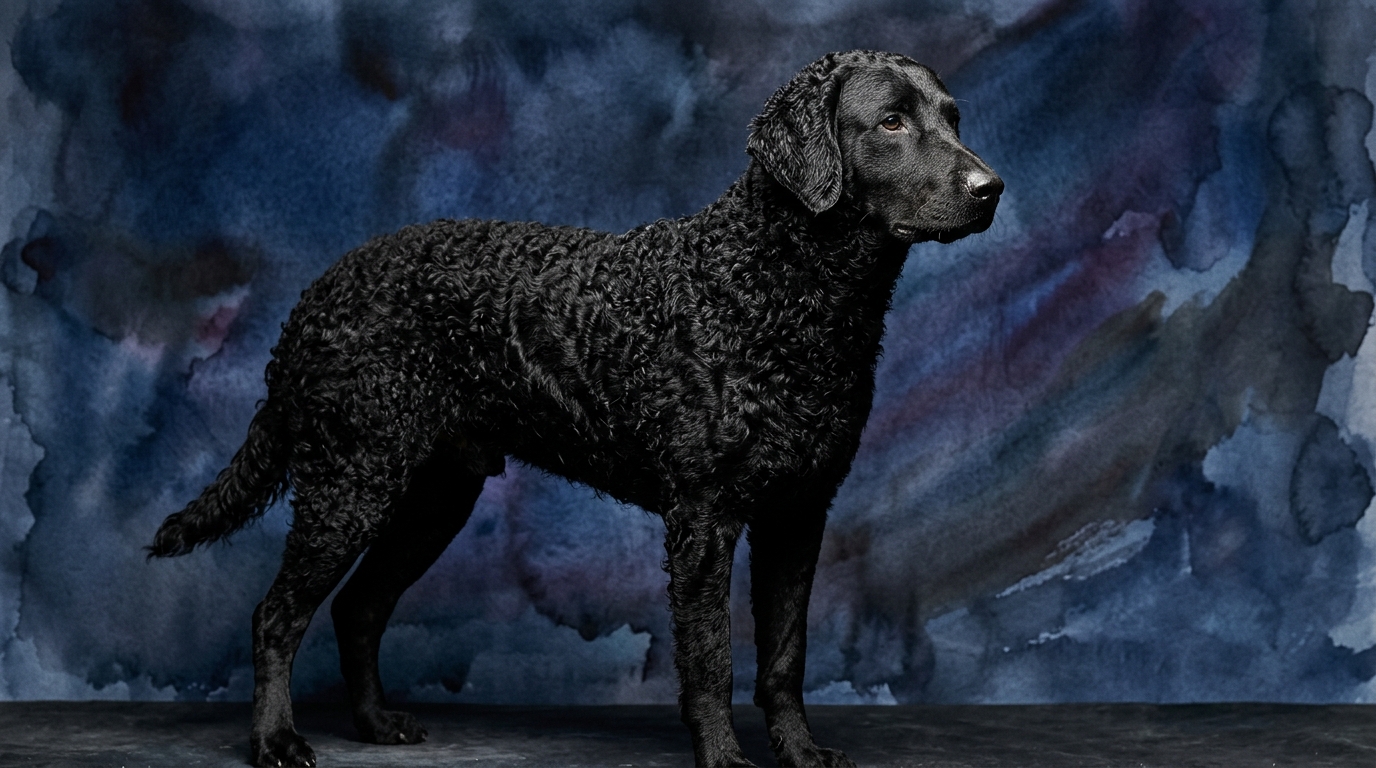
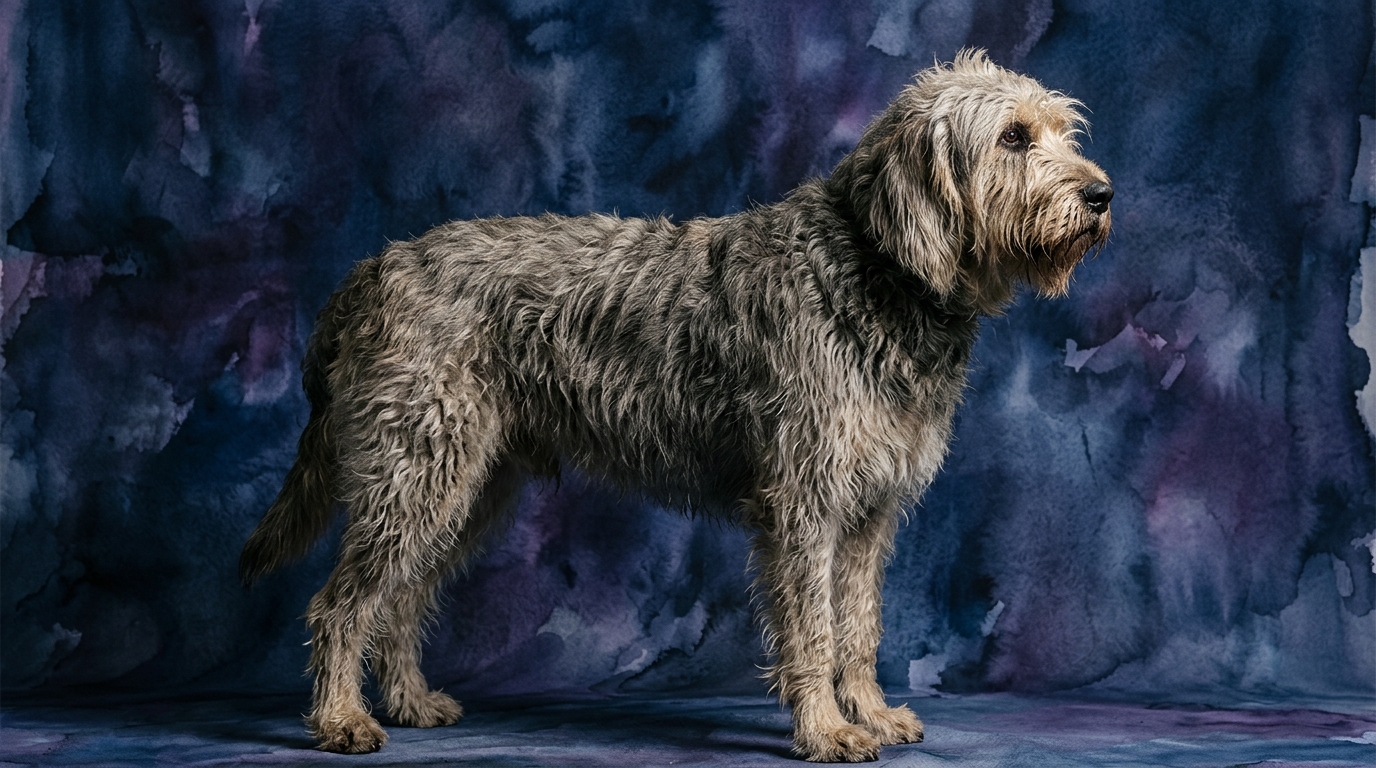
Side-by-Side IQ Profile: Curly-Coated Retriever vs. Otterhound
The Cosmic Pet Pet IQ Lab provides a comprehensive framework to understand canine intelligence across five key dimensions. For the Curly-Coated Retriever, ranked #41 by Coren, their Problem Solving is rated 3/5, indicating a practical, often learned approach to new challenges rather than highly innovative solutions. Training Speed also stands at 3/5; they acquire new commands at a moderate pace, thriving with consistent, engaging instruction. Their Social Intelligence is 3/5, fostering strong family bonds while often maintaining a reserved demeanor with unfamiliar individuals. An Instinctive Drive of 3/5 means their retrieving instincts are present and manageable, translating into a desire for purposeful work. A notable strength is their Memory, scoring 4/5, which signifies a strong capacity for retaining learned information and recalling past experiences, aiding in long-term skill retention.
The Otterhound, currently not Coren-ranked, presents a similar baseline across several cognitive dimensions, yet with distinct applications. Their Problem Solving is 3/5, typically manifesting as persistent, scent-driven efforts to unravel environmental puzzles rather than abstract reasoning. Training Speed is 3/5, reflecting a steady learning curve that requires patience and an understanding of their independent hound nature. Social Intelligence is also 3/5; they are amiable and affectionate within their family unit, though their interactions can be marked by a charming, sometimes boisterous, self-reliance. Their Instinctive Drive of 3/5 is overwhelmingly dominated by their extraordinary scenting ability, which serves as the primary lens through which they perceive and interact with their world. Lastly, their Memory is 3/5, a functional capacity for routines and familiar olfactory cues, but not a standout cognitive asset compared to their sensory focus.
Where the Curly-Coated Retriever Wins Cognitively
The Curly-Coated Retriever demonstrates a distinct cognitive advantage in the realm of memory, scoring a 4/5 compared to the Otterhound's 3/5. This translates to a superior ability to retain complex sequences of commands, recall specific locations of retrieved items, or remember past interactions with remarkable clarity. For an owner, this means that once a skill is learned, it is likely to stick, requiring less frequent refreshers over time. Their stronger memory also supports their role as a retrieving dog, where remembering the fall of multiple birds or the precise location of hidden objects is paramount. This robust recall capacity allows them to build upon their learning experiences more effectively, leading to a cumulative growth in their skill set over their lifetime, making them highly reliable partners in structured activities.
Where the Otterhound Wins Cognitively
While the Otterhound's individual IQ scores largely mirror the Curly-Coated Retriever, its specific application of these traits, particularly its instinctive drive, offers a unique cognitive strength. The Otterhound’s 3/5 instinctive drive is almost singularly focused on its profound olfactory capabilities, which are arguably among the most acute in the canine world. This isn't just a physical attribute; it's a cognitive superpower, allowing them to process and interpret a vast landscape of scent information that is largely invisible to other breeds. Their problem-solving (3/5) is often inextricably linked to this scent drive, enabling them to methodically unravel complex scent trails with unwavering determination and focus, a task where other breeds might falter due to distraction or lack of specific sensory processing. This dedication to a scent puzzle, even if it takes hours, showcases a particular type of cognitive persistence and specialized intelligence.
Which is Easier to Train and Why
When evaluating trainability, the Curly-Coated Retriever generally presents a somewhat more straightforward experience for the dedicated owner, despite both breeds scoring 3/5 in training speed. The Curly-Coated Retriever's Coren rank of #41 indicates a relatively higher predisposition towards understanding and complying with human directives in a structured environment. Their superior memory (4/5) means that once a command is learned, it is likely to be retained with greater consistency, reducing the need for constant reteaching. They are often eager to please their handlers, provided training is kept engaging and positive, leveraging their moderate social intelligence and desire for interaction, making them responsive partners in learning new skills and behaviors.
The Otterhound, while certainly trainable, often requires a different approach due to its pronounced independent streak, characteristic of many scent hounds. Their 3/5 training speed is often tempered by their powerful instinctive drive (3/5) for scent, which can lead to selective deafness when an interesting trail presents itself. While they learn, their learning is often on their own terms, and they may decide to follow their nose rather than a command, even if they understand it. This isn't a lack of cognitive ability but a prioritization of sensory input. Consistency, patience, and making training feel like a game that satisfies their exploration drive, rather than a rigid set of rules, are crucial for success with an Otterhound. Their amiable social intelligence (3/5) means they generally enjoy interacting, but their focus can be easily redirected by an intriguing smell, requiring owners to be highly adaptable and creative in their training methods.
Which Suits Active Owners vs. Relaxed Owners
Neither the Curly-Coated Retriever nor the Otterhound is suited for truly "relaxed" owners who prefer minimal engagement, as both are working breeds with inherent needs for physical and mental stimulation. However, the type of activity they thrive on differs significantly. The Curly-Coated Retriever, with its retrieving background and moderate instinctive drive (3/5), typically suits active owners who enjoy structured outdoor activities. They excel in dog sports like obedience, agility, and particularly field work, where their memory (4/5) and problem-solving (3/5) can be applied to complex tasks. These dogs appreciate routines and specific jobs, enjoying activities that involve partnership and achieving a goal alongside their human. They are excellent companions for hiking, swimming, and retrieving games that challenge both their body and mind, thriving on purpose-driven engagement.
The Otterhound, while also requiring an active lifestyle, appeals more to owners who appreciate a more free-spirited and exploratory companion. Their primary cognitive strength lies in their instinctive drive (3/5) for scent work, which means they thrive on long, meandering walks where they can follow fascinating trails, engage in scent games, or participate in tracking sports. These activities allow them to fully utilize their exceptional olfactory processing. An owner who enjoys exploring nature, isn't afraid of a dog with a strong will to follow a scent, and can provide secure, expansive environments for sniffing adventures will find the Otterhound a rewarding partner. Their problem-solving (3/5) is often engaged in deciphering scent puzzles, making them less interested in rote obedience drills and more in self-directed exploration, valuing freedom to investigate their environment.
The Verdict
Choose the Curly-Coated Retriever if you appreciate a canine partner with a robust memory and a willingness to engage in structured training and sports, excelling in tasks requiring recall and consistent performance. They thrive with owners who enjoy active, goal-oriented pursuits and value a strong working partnership.
Opt for the Otterhound if you seek a charmingly independent companion with an unparalleled nose, ideal for owners who embrace long, exploratory scent-driven adventures. They suit those who can patiently guide a dog whose primary motivation is the fascinating world of smells and who appreciate a unique, persistent personality.
🧠 Find Your Pet's IQ Score
Our Pet IQ Lab assessment covers 25+ tests across 5 cognitive dimensions — personalized to your breed.
Take the Full IQ Test →Frequently Asked Questions
Is the Curly-Coated Retriever easier to live with for first-time dog owners?
The Curly-Coated Retriever, with its moderate trainability and stronger memory, can be a good fit for first-time owners who are committed to consistent positive reinforcement training. Their desire to please and ability to retain commands makes the learning process somewhat more predictable than with a highly independent hound breed.
How do these breeds handle being left alone?
Both breeds are social and thrive on companionship, so neither should be left alone for extended periods regularly. The Curly-Coated Retriever might cope better if adequately exercised and mentally stimulated, while the Otterhound's independent nature could sometimes lead to boredom-related mischief if left without sufficient engagement or outlets for its scent drive.
Do either of these breeds excel in specific dog sports?
The Curly-Coated Retriever often excels in retrieving trials, obedience, and agility, leveraging its memory and cooperative nature. The Otterhound, while capable of basic obedience, truly shines in scent-based activities like tracking, nose work, and even mantrailing, where its exceptional olfactory processing is fully utilized.