
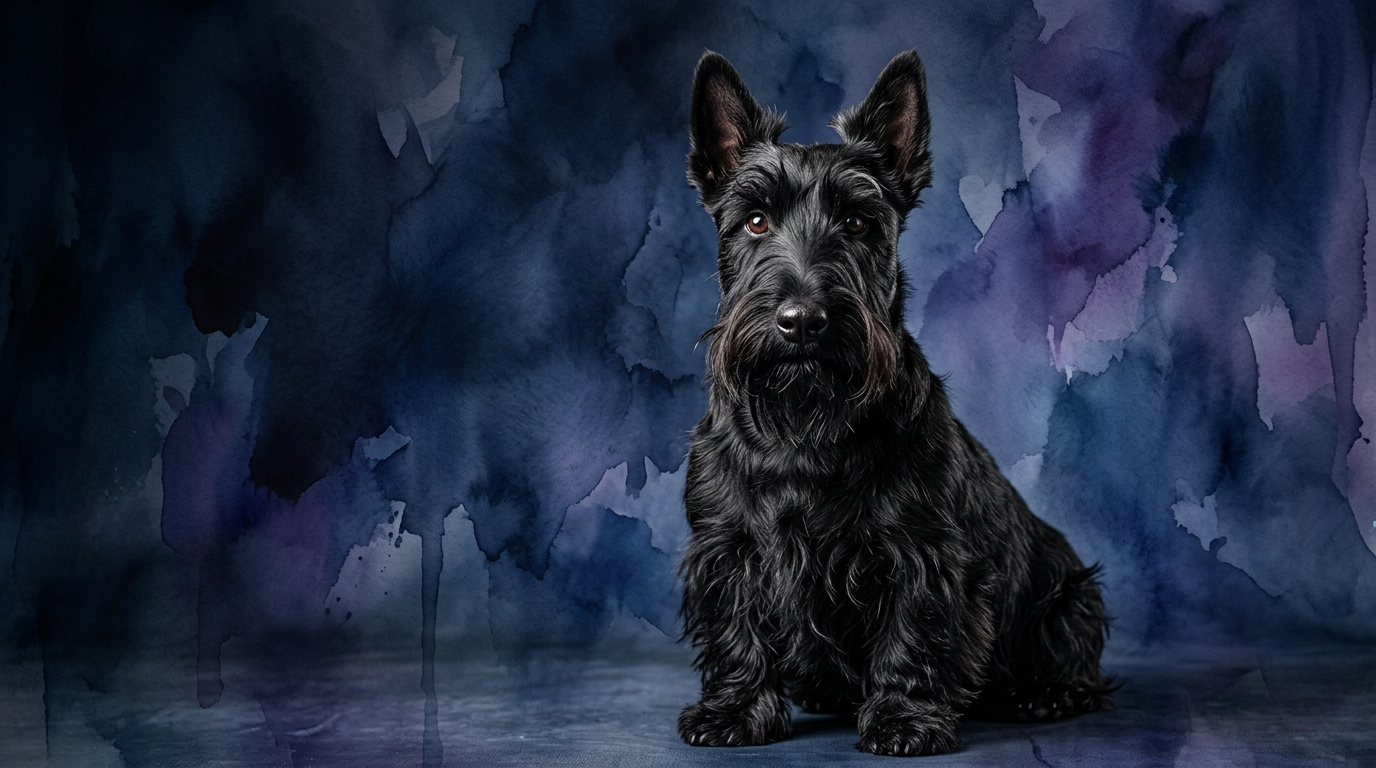
Side-by-Side IQ Profile: Dachshund vs. Scottish Terrier
**Dachshund: The Scent-Driven Strategist**
**Coren Rank: #49.** Positioned in the 'Above Average' category for Working and Obedience Intelligence, indicating a solid capacity for learning, often with an independent flair. **Problem Solving: 4/5.** Dachshunds excel at devising multi-step solutions to achieve goals, a trait honed by their history of navigating complex underground tunnels to outsmart prey. They display remarkable ingenuity in accessing desired items or overcoming obstacles. **Training Speed: 2/5.** Not known for rapid skill acquisition, their strong independent streak and powerful instinctive drives demand significant patience, consistency, and high-value rewards to maintain focus during training. **Social Intelligence: 3/5.** They form deep, often singular bonds with primary caregivers, interpreting familiar human emotions. However, they can be discerning with strangers and other animals, prioritizing their inner circle. **Instinctive Drive: 5/5.** A defining trait, their drive to hunt, track scents, and dig is extraordinarily powerful and deeply ingrained, often overriding learned commands if a compelling scent or 'prey' opportunity arises. **Memory: 3/5.** They possess good recall for routines, favored locations, and significant events, particularly those associated with strong experiences, though it can seem selective when instinct takes over.
**Scottish Terrier: The Tenacious Earth Dog**
**Coren Rank: #65.** Falling into the 'Average' category for Working and Obedience Intelligence, this suggests a steady capacity for learning that thrives on consistent reinforcement to overcome inherent terrier stubbornness. **Problem Solving: 3/5.** Scotties approach challenges with persistence and determination, often using methodical attempts and physical manipulation to overcome barriers or access resources, rather than intricate strategic planning. **Training Speed: 3/5.** They learn at a steady pace with clear, consistent methods and positive reinforcement. While capable of acquiring many commands, their independent terrier nature means compliance isn't always immediate. **Social Intelligence: 3/5.** Known for loyalty to their chosen family, Scotties interpret the emotional states of those they trust. They are typically reserved with strangers, taking time to assess new individuals before offering affection. **Instinctive Drive: 3/5.** Rooted in their earth-dog heritage, this drive includes a moderate urge to dig, chase small vermin, and guard territory. It's generally more manageable than the Dachshund's, allowing for balanced engagement. **Memory: 3/5.** Scotties reliably retain learned behaviors, routines, and memories of people and places. Their recall for specific commands and experiences is solid, contributing to their dependability within established routines.
Where the Dachshund Wins Cognitively
The Dachshund demonstrates a clear cognitive edge in two primary areas: problem-solving and instinctive drive. Their **Problem Solving (4/5)** capabilities surpass the Scottie's (3/5) due to their unique hunting history. Dachshunds were bred to navigate complex underground tunnel systems, requiring them to devise resourceful, multi-step solutions to outmaneuver badgers. This translates into a superior ability to strategically manipulate objects, figure out how to open latches, or create novel pathways to reach a desired treat or toy, often showing a more nuanced understanding of cause and effect than the Scottie's more direct approach.
Furthermore, the Dachshund's **Instinctive Drive (5/5)** is profoundly more intense and focused than the Scottish Terrier's (3/5). This isn't just about a desire to hunt; it's about an unwavering, deeply embedded cognitive focus on a primary instinct. Their olfactory prowess and relentless pursuit of scent trails are unparalleled, making them exceptionally driven in tasks related to scent discrimination or earth dog activities. This potent drive, while sometimes challenging for owners, signifies a powerful, single-minded cognitive engine geared towards their ancestral purpose, allowing them to maintain incredible focus on a scent even amidst distractions.
Where the Scottish Terrier Wins Cognitively
The Scottish Terrier exhibits a cognitive advantage primarily in **Training Speed (3/5)** when compared to the Dachshund (2/5). While neither breed is known for instant obedience, the Scottie's terrier tenacity, combined with a slightly less overwhelming instinctive drive, means they can apply themselves more consistently to structured training sessions. They often demonstrate a greater willingness to engage in repetitive drills required for mastering commands, making the initial acquisition of basic obedience skills generally smoother and more predictable than with the often more independent and scent-distracted Dachshund. Their consistent application of attention, even if occasionally punctuated by typical terrier stubbornness, allows for a more steady progression in learning.
Beyond a specific IQ dimension, the Scottie often displays a more consistent application of learned behaviors in daily life. Their problem-solving, while perhaps less strategically intricate, tends to be more predictable and less prone to being suddenly overridden by an intense, all-consuming instinctive urge. This means that once a Scottie learns a routine or a command, they are often more reliably compliant in domestic contexts, making their overall cognitive output more consistently aligned with human expectations in structured environments. This steady reliability can be a significant advantage in a home setting.
Which is Easier to Train and Why?
Considering the nuances of their cognitive profiles, the **Scottish Terrier is generally considered marginally easier to train** for foundational obedience commands. The Dachshund's formidable instinctive drive (5/5) and high problem-solving (4/5), while impressive, can present significant challenges in a training context. A Dachshund might quickly grasp the concept of "come," but their powerful drive to follow a compelling scent or investigate a perceived "den" often overrides their learned response. Their lower training speed (2/5) reflects this independent decision-making and the internal battle between instinct and instruction. For example, a Dachshund might understand that a treat awaits for a recall, but the immediate gratification of a scent trail can prove an irresistible distraction, demanding extraordinary patience from the trainer.
In contrast, the Scottish Terrier, with a training speed of 3/5, benefits from a slightly more balanced instinctive drive (3/5) and a tenacious personality that, while stubborn, can also be channeled towards learning. While Scotties certainly have their independent streak, they are often more inclined to engage in structured training and are less likely to be completely derailed by external stimuli once focused. Their problem-solving (3/5) tends to be more direct and less prone to strategic defiance, making their learning curve for obedience commands more predictable. They typically respond well to clear boundaries, positive reinforcement, and a consistent routine, making the process of establishing basic manners somewhat more straightforward than with their hound counterpart.
Which Suits Active Owners vs. Relaxed Owners?
For **active owners** who relish engaging deeply with their dog's inherent talents, the **Dachshund** is often a more fulfilling match. Their exceptionally high instinctive drive (5/5) and strategic problem-solving (4/5) mean they thrive on mental and physical engagement that directly taps into their working heritage. Owners who enjoy activities like scent work, tracking, earth dog trials, or even complex puzzle toys that demand intricate planning will find an eager and capable partner. Dachshunds benefit immensely from long, investigative walks where they are allowed to follow intriguing scent trails (within safe limits), providing both physical exercise and crucial mental stimulation. Their independent nature means they value autonomy, and owners who appreciate this will find joy in collaborative activities rather than demanding strict obedience.
For **relaxed owners** seeking a devoted companion that values routine and consistent interaction without the intense demands of a specialized working drive, the **Scottish Terrier** is often a better fit. While they certainly need regular exercise and mental stimulation, their instinctive drive (3/5) is less all-consuming and generally more manageable in a typical domestic setting. Scotties are often content with moderate daily walks, consistent play sessions, and puzzle toys that encourage persistence rather than intricate strategy. Their social intelligence (3/5) allows them to be a deeply loyal, if discerning, companion in a quieter household, provided their need for consistent boundaries and a clear leadership structure is met. They appreciate a predictable routine and a calm, confident owner.
The Verdict
If you are an owner who deeply appreciates a highly independent, strategic thinker with an unparalleled drive for scent work and problem-solving, and you are prepared for the patience and creative engagement required in training a dog whose instincts are often its primary guide, choose the Dachshund.
If you seek a devoted, resilient companion with a steady learning pace, a balanced instinctive drive, and a preference for consistent routines, and you value a dog that, while tenacious, is often more predictably engaged in structured activities, choose the Scottish Terrier.
🧠 Find Your Pet's IQ Score
Our Pet IQ Lab assessment covers 25+ tests across 5 cognitive dimensions — personalized to your breed.
Take the Full IQ Test →Frequently Asked Questions
Do Dachshunds and Scottish Terriers get along with other pets?
Both breeds can coexist with other pets, especially if socialized early and appropriately. Dachshunds might exhibit a stronger prey drive towards smaller, fast-moving animals, while Scotties can be particular about other dogs, especially those of the same sex, in their established territory.
Are Dachshunds or Scottish Terriers better for first-time dog owners?
Neither breed is typically recommended for absolute first-time dog owners due to their independent, sometimes stubborn natures and specific training requirements. However, a patient first-time owner committed to consistent, positive reinforcement training and understanding breed-specific traits could succeed with either, with the Scottie perhaps offering a slightly more predictable initial training journey.
What kind of mental stimulation do these breeds need?
Dachshunds thrive on scent games, puzzle toys that require strategic thinking to solve, and opportunities to 'hunt' for hidden treats or toys. Scottish Terriers benefit from consistent training, interactive play sessions, and toys that allow for safe digging or 'vermin' pursuit in a controlled environment, alongside regular enrichment.